dotlah! dotlah!
  • Cities
  • Technology
  • Business
  • Politics
  • Society
  • Science
  • About
Social Links
  • zedreviews.com
  • citi.io
  • aster.cloud
  • liwaiwai.com
  • guzz.co.uk
  • atinatin.com
0 Likes
0 Followers
0 Subscribers
dotlah!
  • Cities
  • Technology
  • Business
  • Politics
  • Society
  • Science
  • About
  • Technology

NTU Scientists Develop Handheld, High-resolution Medical Imaging Device With Potential For Bedside Scanning

  • March 27, 2020
Total
0
Shares
0
0
0

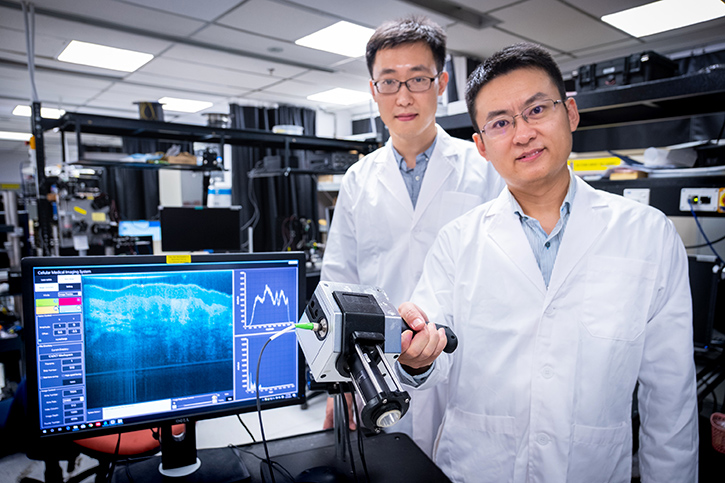
Scientists at Nanyang Technological University, Singapore (NTU Singapore) have developed the prototype of a handheld medical imaging device that can produce images down to resolutions of 1 to 2 micrometres.

This is detailed enough to spot the first signs of tumours in specific cells and is about 100 times higher resolution than what X-Ray, computed tomography (CT) and Magnetic Resonance Imaging (MRI) machines can provide.

The technology behind the device is a result of six years of optical imaging research and was jointly developed by a team from NTU with researchers at the Harvard Medical School and the University of Alabama, U.S.A.

Relying on a new imaging technology known as micro ‘Optical Coherence Tomography’ (OCT), the device emits a spectrum of light between 700 to 950 nanometres, known as near-infrared light. This harmlessly penetrates human tissue and organs, and the device then measures the delay time of the ‘echo’ from its light waves as they strike different tissue structures. This information will then be used to construct cross-section images of what is being scanned.

The results are sent in real-time to a computer system running software developed at NTU, which assists in diagnosis by assembling the 2-D cross-section images into a three-dimensional picture and rendering different parts in colour.

The NTU researchers say that their prototype was designed to be used by medical professionals who do not specialise in imaging or pathology, allowing them to scan patients using the new device in clinics or at the bedside. Patients would not face the inconvenience of waiting for MRI or CT scanner availability and requiring attendance at a specialised facility.

NTU Associate Professor Liu Linbo, who led the research team, said, “Our device is a fraction of the size of existing machines and produces clear, high-resolution images in real-time. It uses light to harmlessly penetrate the skin, and it does not involve specialised lead-shielded X-ray equipment or MRI scanners. It is small enough to be handheld, so images could be captured by the bedside.”

The prototype device has undergone clinical trials at Wuhan University’s Endoscopic Centre, and has shown promise in detecting abnormal colon polyps to the same level of accuracy as trained pathologists.

During the preliminary trial at the Renmin Hospital of Wuhan University, endoscopists used the device on 58 tissue samples from patients known to have colon polyps – abnormal growths in the colon or rectum. The samples were imaged in real-time by the device, and its assessment of whether they were malignant or benign was found to be 95 per cent accurate after comparison with an evaluation of the same samples, by senior pathologists. These findings were published in Clinical and Translational Gastroenterology in June 2019.

The device is now being commercialised by a Chinese medical technology firm, Suzhou Sai Luo Er Medical Imaging Technology Co. Ltd.

A key promise of the micro-OCT device is its potential ability to spot the first signs of cancers of the colon, stomach and skin, which begin in the nuclei of epithelial cells measuring about 1-2 micrometres. Epithelial cells are part of the barrier between the inside and outside of the body (i.e. lining inside the throat, intestines, blood vessels, and organs) and are almost impossible to image using current machines that cannot penetrate beyond half a millimetre.

“It is our hope that in future, doctors might be able to use a device like ours to precisely identify diseases as they develop at the cellular level, in real-time, and in high resolution,” said Assoc Prof Liu. “Through earlier detection, we believe that patients will receive an earlier diagnosis and if necessary, get treatment faster.”

Not involved in the study, Dr Eng Soo Yap, a Consultant Haematologist at the National University Hospital in Singapore, said, “This is a ground-breaking technology that could have widespread clinical applications. These range from real-time imaging of tissues at a microscopic level to even detecting circulating cancer cells in the blood. All this could lead to early and more accurate detection of cancer. An additional advantage is that being a portable device, it could be used at the bedside, clinics and even in patient’s homes which would extend the accessibility of this technology and cut down on waiting time.”

Prof Liu and his team are conducting more in-depth research into OCT technologies, to further improve the device and extend industry collaboration with other healthcare companies.


Total
0
Shares
Share
Tweet
Share
Share
Related Topics
  • Medical Imaging Device
  • Nanyang Technological University
  • NTU Singapore
dotlah.com

Previous Article
  • Lah!

Singapore’s GDP Contracted by 2.2 Per Cent in the First Quarter of 2020 As COVID-19 Continues

  • March 26, 2020
View Post
Next Article
  • Lah!

PUB Awards $433 Million Tuas WRP Biosolids Treatment Contract To Sembcorp Design And Construction

  • March 27, 2020
View Post
You May Also Like
Red Hat OpenShift
View Post
  • Artificial Intelligence
  • Technology

Red Hat Further Drives Digital Sovereignty for the AI Era with Red Hat OpenShift on Google Cloud Dedicated

  • Dean Marc
  • April 21, 2026
View Post
  • Artificial Intelligence
  • Technology

Here’s how to get the $7 trillion AI hardware buildout right

  • dotlah.com
  • April 18, 2026
totus-technologies-cover
View Post
  • Business
  • Technology
  • World Events

The Transatlantic Tech Rift and Why Data Sovereignty Is the New Industrial Imperative

  • Ackley Wyndam
  • April 16, 2026
View Post
  • Technology

Hon Hai Technology Group (Foxconn) Recognized As Top 100 Global Innovators 2026

  • Dean Marc
  • April 9, 2026
View Post
  • Artificial Intelligence
  • Technology

Kioxia Announces New SSD Model Optimized for AI GPU-Initiated Workloads

  • Dean Marc
  • March 17, 2026
View Post
  • Artificial Intelligence
  • Technology

U.S. Ski & Snowboard and Google Announce Collaboration to Build an AI-Based Athlete Performance Tool

  • Dean Marc
  • February 8, 2026
View Post
  • Artificial Intelligence
  • Technology

IBM to Support Missile Defense Agency SHIELD Contract

  • Dean Marc
  • February 5, 2026
Smartphone hero image
View Post
  • Gears
  • Technology

Zed Approves | Smartphones for Every Budget Range

  • Ackley Wyndam
  • January 29, 2026


Trending
  • 1
    • Cities
    • Technology
    In 2026, Hackers Taking Over Self-Driving Cars Can Gridlock Cities
    • January 17, 2020
  • Fruits and vegetables for cooking. For food processors. 2
    • Gears
    Food Processor: The Swiss Army Knife of the Kitchen – Best All-Around Picks in 2025
    • September 8, 2025
  • 3
    • Lah!
    Sustainability Research At NUS Gets A Boost From Temasek
    • October 4, 2021
  • dubai-zq-lee-DcyL0IoCY0A-unsplash 4
    • Cities
    • Technology
    How blockchain can empower smart cities – and why interoperability will be crucial
    • April 14, 2021
  • 5
    • Society
    Do Face Masks Really Prevent You From Catching Coronavirus?
    • March 13, 2020
  • usa-flag-jason-leung-mmth0KV0oFQ-unsplash 6
    • Cities
    2022’s Most Independent States In America
    • July 5, 2022
  • 7
    • Technology
    Go Beyond. Invest In Yourself
    • June 28, 2021
  • hong-kong-chloe-evans-l0y_HXhtJ1c-unsplash 8
    • Cities
    Where It’s Hardest to Afford a Home
    • April 30, 2022
  • 9
    • Science
    • Technology
    How Urban Farming Tech Is Shaping The Future Of Food
    • September 3, 2020
  • 10
    • Cities
    • Lah!
    • Society
    NUS Computing Establishes Sea Olympiad Scholarship To Attract And Nurture Top Talents In Computer Studies
    • February 27, 2022
  • 11
    • Lah!
    NUS Law Launches New Centre for Technology, Robotics, Artificial Intelligence & the Law
    • December 12, 2019
  • Internet web platform on theme of very high speed internet 12
    • Artificial Intelligence
    • Featured
    • Science
    Is Our Digital World Alive?
    • July 10, 2023
Trending
  • Red Hat OpenShift 1
    Red Hat Further Drives Digital Sovereignty for the AI Era with Red Hat OpenShift on Google Cloud Dedicated
    • April 21, 2026
  • Illustration of data storage 2
    The Splinternet Comes for European Supply Chains Why Fragmentation Is Now a Boardroom Problem
    • April 21, 2026
  • 3
    Here’s how to get the $7 trillion AI hardware buildout right
    • April 18, 2026
  • totus-technologies-cover 4
    The Transatlantic Tech Rift and Why Data Sovereignty Is the New Industrial Imperative
    • April 16, 2026
  • 5
    What will it take to get ships going through the Strait of Hormuz again?
    • April 13, 2026
  • 6
    Hon Hai Technology Group (Foxconn) Recognized As Top 100 Global Innovators 2026
    • April 9, 2026
  • 7
    3 lessons on the energy transition in an age of crisis
    • April 7, 2026
  • 8
    Samsung Unveils Galaxy A57 5G and Galaxy A37 5G, Packing Pro-Level Features at Awesome Price
    • March 25, 2026
  • 9
    The global price tag of war in the Middle East
    • March 24, 2026
  • 10
    Kioxia Announces New SSD Model Optimized for AI GPU-Initiated Workloads
    • March 17, 2026
Social Links
dotlah! dotlah!
  • Cities
  • Technology
  • Business
  • Politics
  • Society
  • Science
  • About
Connecting Dots Across Asia's Tech and Urban Landscape

Input your search keywords and press Enter.