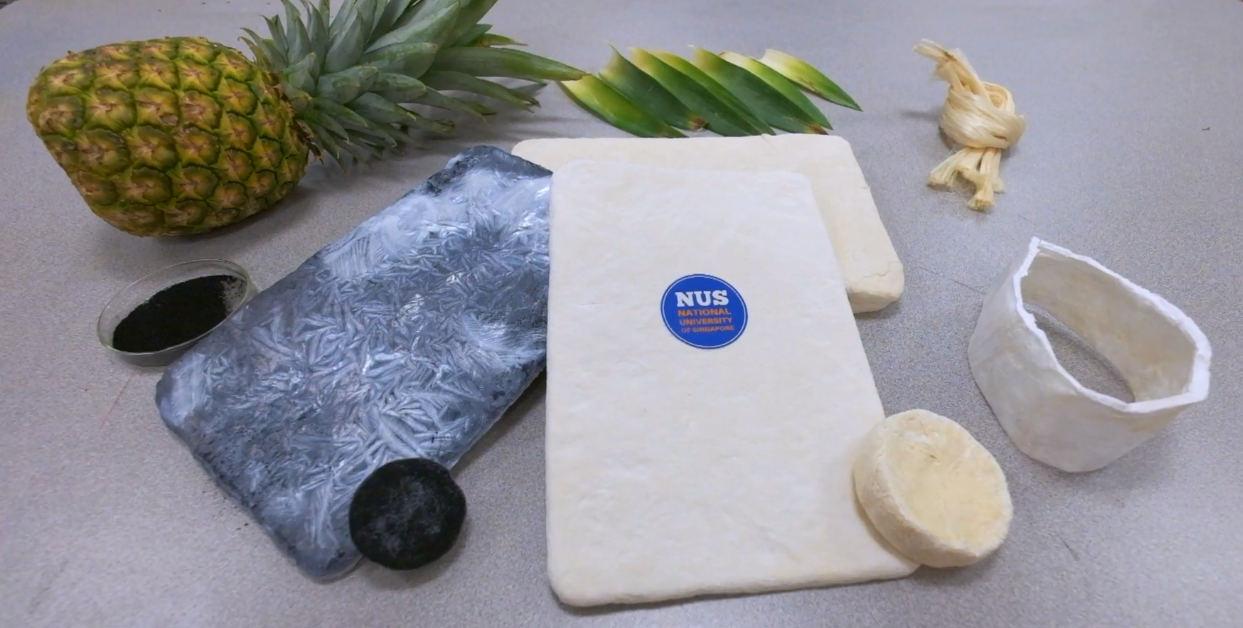
Pineapples are rich in vitamins, enzymes and antioxidants, and they are considered one of the most important fruits in the world. However, the harvesting of this delicious and healthy fruit results in tons of pineapple leaves waste which are usually left to rot or are burned. This could, in turn, release harmful chemicals and greenhouse gases that can cause serious environmental problems.
To address this challenge, researchers from NUS have devised a simple and low-cost method of using pineapple leaf fibres to create ultra-light, biodegradable aerogels. When coated with specific chemicals, these biodegradable aerogels that can be used to keep fruits and vegetables for a longer period, and to remove toxic metals from wastewater, among a wide range of other applications.
These eco-aerogels can be reused, further reducing waste and improving sustainability. They can also be safely disposed into the environment without causing pollution.

The research team from NUS Mechanical Engineering has been looking at ways to reduce waste, and in turn promote environmental sustainability, by upcycling different types of waste – such as paper, textile, plastic and rubber – into multi-functional aerogels. Their latest work on eco-aerogels started in August 2016 and took three years to achieve promising results.
“These eco-aerogels made from pineapple leaf fibres are very versatile. They are effective as oil absorbents and for heat and sound insulation. We have also demonstrated their potential applications in food preservation and wastewater treatment. This is a big step towards sustainable agriculture and waste management, and provides an additional source of income for farmers,” said Associate Professor Duong Hai-Minh, who leads the research team.
The NUS team had also produced eco-aerogels using other agricultural and food waste such as sugarcane bagasse, coffee grounds and okara.
Low cost, high value
Eco-aerogels are easy to produce, and this translates into low production cost – making a sheet of aerogel that is one-square-metre in area and one-centimetre thick cost less than S$10. When it reaches the market, a sheet of aerogel of the same size can be sold at price range of between S$30 to S$50.
The fabrication process varies according to the type of raw material used. The key steps are: shredding/blending, mixing with water and a small amount of non-toxic chemicals, stirring, aging, freezing, and freeze-drying. On average, it takes up to 12 hours to produce aerogels from the raw materials – this is about 18 times faster than the conventional ‘sol-gel’ method used to manufacture commercial aerogels.
Food preservation
To perform the function of food preservation, eco-aerogels are modified with activated carbon powder to enable them to effectively take in ethylene gas, also known as the ‘fruit-ripening hormone’, which triggers the ripening process in fruits and vegetables. This is especially relevant to climacteric fruits and vegetables – such as banana, mango, papaya, potato and tomato – that continue to ripen considerably after harvest.
Professor Nhan Phan-Thien, a senior member of the research team, explained, “Vast quantities of fresh agricultural produce are discarded due to inadequate post-harvest storage and processing facilities, as well as inefficient or disrupted transportation systems. Therefore, cutting down spoilage can go a long way in reducing waste.”
“In our lab experiments, eco-aerogels modified with activated carbon can delay the rotting process by at least 14 days. The modified eco-aerogel can absorb six times more ethylene than commercial potassium permanganate ethylene absorbents. This is also a safer method compared to the conventional use of strong oxidising agents, and more efficient than non-toxic chemical sprays, for food preservation,” said Prof Phan-Thien.
Wastewater treatment
Eco-aerogels made from pineapple leaf fibres have stronger mechanical properties and they are suitable for use in wastewater treatment. When coated with a chemical called diethylenetriamine (DETA), eco-aerogels can remove four times more nickel ions in industrial wastewater, compared to conventional methods using naturally derived clay and synthetically doped graphene. Different chemical coatings can be adopted to enable the eco-aerogels to extract different types of heavy metals from aqueous solutions.
Assoc Prof Duong said, “Due to its high porosity, eco-aerogels are highly efficient in removing metal ions, even in dilute solutions where the amount of metal ions is low. The treatment process is simple, cheaper and does not generate secondary waste. Eco-aerogels can also easily desorb the metal ions and be reused several times, further reducing costs.”
Future work
The nine-member team from NUS has filed a patent for the production of the eco-aerogels made from pineapple leaf fibres for food preservation and wastewater treatment. There are plans to work with an industry partner to scale up and commercialise this technology.
Building on their promising results, these researchers are now looking at expanding their research in several key areas.
Firstly, they are identifying different chemical coatings to fabricate eco-aerogels with high and selective adsorption of different heavy metal ions. Secondly, the researchers are finding ways to efficiently recover heavy metals from the eco-aerogels after wastewater treatment, besides reusing the eco-aerogels.
Lastly, the team is conducting studies to develop advanced, cost-effective non-woven techniques to produce eco-aerogels continuously as a roll with unlimited length. Non-woven techniques do not require any solvent and could produce eco-aerogels faster, using less energy and cheaper equipment. This will significantly reduce the production cost of eco-aerogels.