dotlah! dotlah!
  • Cities
  • Technology
  • Business
  • Politics
  • Society
  • Science
  • About
Social Links
  • zedreviews.com
  • citi.io
  • aster.cloud
  • liwaiwai.com
  • guzz.co.uk
  • atinatin.com
0 Likes
0 Followers
0 Subscribers
dotlah!
  • Cities
  • Technology
  • Business
  • Politics
  • Society
  • Science
  • About
  • Business
  • Politics

Which Countries Have The Greatest Economic Complexity?

  • May 18, 2020
Total
0
Shares
0
0
0

These are the world’s most complex economies. But what does it mean to be ‘complex’? 
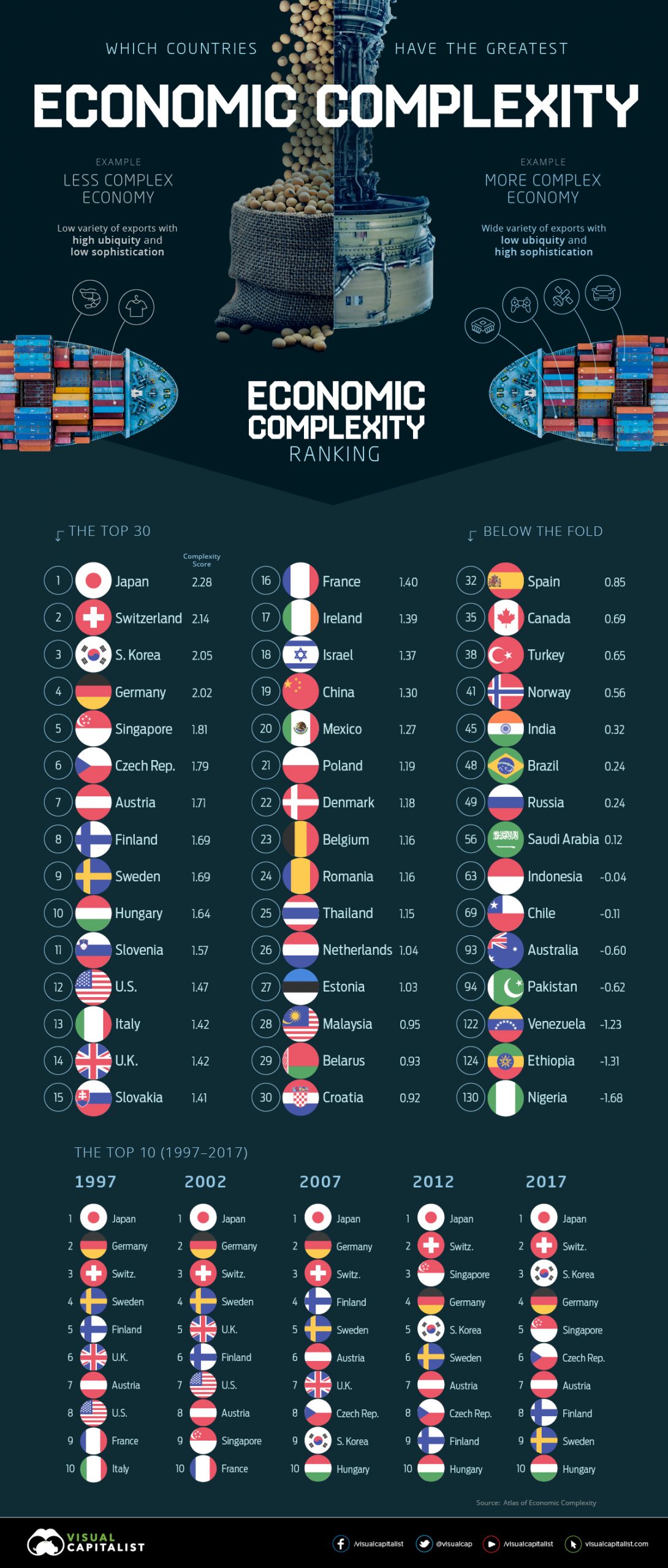
Here are the world’s most complex economies, according to the data from The Atlas of Economic Complexity.

The Atlas of Economic Complexity is a tool developed and maintained by Harvard’s Growth Lab to facilitate the exploration of the economic structure of countries around the world.

The metric for economic complexity used for the ranking is known as the Economic Complexity Index (ECI). A higher ECI score is indicative of higher economic complexity.

Highlights

As of 2017, Japan is the most economically-complex country, with an ECI score of 2.28, retaining its position since the rankings were created back in the 1990s. The country’s standout industries for export are car, electronics, and information and communications technology (ICT).

Europe owns seven of the top ten spots in economic complexity: Switzerland (2nd), Germany (4th), Czech Republic (6th), Austria (7th), Finland (8th), Sweden (9th), and Hungary (10th).

Meanwhile, apart from taking the top spot, Asia occupies the remaining places in the top ten with South Korea (3rd) and Singapore (5th).

On the flip side, Guinea is the least-complex country in terms of its economic structure, with an Index score of –1.68, ranking the country in 133rd place.

Africa takes eight of the bottom ten spots: Guinea (133rd), Angola (132nd), Burkina Faso (131st), Nigeria (130th), Congo (129th), Mauritania (126th), the Democratic Republic of the Congo (125th), and Ethiopia (124th).

Other countries positioned in the bottom ten in economic complexity are Azerbaijan (127th) and Papua New Guinea (128th).

For the full rankings, you can check the Atlas of Economic Complexity.

What is ‘economic complexity’?

For these rankings, the ECI was used as a measure for economic complexity. But what does ‘economic complexity’ mean to begin with?

The underlying concept used for the ECI is economist Adam Smith’s idea of division of labor discussed in his magnum opus, The Wealth of Nations. In essence, by dividing the economy into markets and organisations, knowledge that is held by the few will be distributed to the collective.

Economic complexity, therefore, refers to the complexity of the networks of people and organisations which facilitate interactions between individuals and catalyse the expansion of the collective knowledge base.

Following this idea, measuring economic complexity is difficult. ECI simplifies this problem by only looking at the country’s economic output.

ECI is a proxy metric of economic complexity which takes into account two factors: diversity and ubiquity of exports. Using the ECI definition, a country with high complexity with high diversity and low ubiquity.

If a country has high diversity, then that country has a lot of products that they can export. However, this is only possible if they have the necessary skill sets needed for the manufacturing of each of these products.

To acquire these skill sets, the working assumption under the ECI definition is that there is a need for an underlying complex economic structure to facilitate the exchange of knowledge.

Meanwhile, low ubiquity implies that only a few countries share the ability to export a product. If a country is connected to other countries through a non-ubiquitous product, this implies that the country possesses the skill set needed to produce the said product. Again, this implies an underlying complex economic structure if we follow the working assumptions of ECI.

What can nations do to increase their economic complexity? They can either explore combinations of existing capabilities or gain new capabilities, both of which will lead to the development of new products. This will mainly target the diversification of products available for export.

On the other hand, the identification of key sectors that are unique to the country to focus on will help lower the ubiquity of exports.


Total
0
Shares
Share
Tweet
Share
Share
Related Topics
  • Economic Complexity
  • Economy
  • Exports
  • Products
majulah

Previous Article
  • Lah!

NEA Urges Collective Community Action As We Enter Traditional Peak Dengue Season

  • May 18, 2020
View Post
Next Article
  • Cities

Here’s How Industries Shape Cities And Economies

  • May 18, 2020
View Post
You May Also Like
Illustration of data storage
View Post
  • Business
  • Featured
  • Features
  • World Events

The Splinternet Comes for European Supply Chains Why Fragmentation Is Now a Boardroom Problem

  • Ackley Wyndam
  • April 21, 2026
totus-technologies-cover
View Post
  • Business
  • Technology
  • World Events

The Transatlantic Tech Rift and Why Data Sovereignty Is the New Industrial Imperative

  • Ackley Wyndam
  • April 16, 2026
View Post
  • Business
  • Economy

What will it take to get ships going through the Strait of Hormuz again?

  • dotlah.com
  • April 13, 2026
View Post
  • Cities
  • Economy
  • Politics

The global price tag of war in the Middle East

  • dotlah.com
  • March 24, 2026
View Post
  • Economy
  • Politics

Global power struggles over the ocean’s finite resources call for creative diplomacy

  • dotlah.com
  • January 17, 2026
View Post
  • Economy
  • Politics

New Trump tariffs: early modelling shows most economies lose – the US more than many

  • dotlah.com
  • August 6, 2025
View Post
  • Politics

PBBM asks Singapore to invest more in PH renewable energy projects

  • Dean Marc
  • June 6, 2025
View Post
  • People
  • Politics

Singapore PM Wong arrives in Malacañang

  • dotlah.com
  • June 4, 2025


Trending
  • Black Friday Nintendo Switch games sale and deals 1
    • Gears
    Biggest Black Friday Nintendo Switch Deals. Physical vs. Digital Savings.
    • November 24, 2024
  • 2
    • Lah!
    UOB Raises More Than S$1.65 Million In A Month In Its Latest COVID-19 Relief Effort
    • June 24, 2020
  • 3
    • Cities
    • Lah!
    OCBC Bank Extends Green Loan To First Property Development Leveraging BCA’s New Building Energy Efficiency Assessment Tool
    • October 27, 2021
  • 4
    • Cities
    • Lah!
    OCBC Bank Enables The Instant Purchase Of Gold And Silver Digitally
    • November 7, 2021
  • Netherlands 5
    • People
    How We Can Identify Climate-Vulnerable Neighbourhoods And Protect Inhabitants
    • January 26, 2024
  • 6
    • Cities
    4 European Cities With Low Living Costs But A Great Quality Of Life
    • February 25, 2020
  • 7
    • Cities
    • Technology
    NUS And NTU Launch First-Of-Its-Kind Tropical Data Centre Testbed
    • June 17, 2021
  • 8
    • Lah!
    Changi Airport Begins Terminal 2 Expansion Works To Increase Capacity And Enhance Passenger Experience
    • January 17, 2020
  • dotlah-sentosa-joshua-tsu-4sl0QBBHRRA-unsplash 9
    • Cities
    • Lah!
    Discover Sentosa anew through partnership of iconic brands
    • May 10, 2024
  • women-hannah-busing-Zyx1bK9mqmA-unsplash 10
    • People
    • World Events
    Only Twelve Countries Have Full Equal Rights for Women
    • March 8, 2022
  • usa-flag-justin-cron-_gtwjIzQLq4-unsplash 11
    • Features
    • People
    • World Events
    Stars, Stripes, And Service. Exploring The Hierarchies And Heroes Of The U.S. Military
    • July 3, 2023
  • 12
    • Lah!
    • Technology
    Innovfest Unbound 2019: Southeast Asia’s Largest Innovation Festival Is Back
    • June 26, 2019
Trending
  • Red Hat OpenShift 1
    Red Hat Further Drives Digital Sovereignty for the AI Era with Red Hat OpenShift on Google Cloud Dedicated
    • April 21, 2026
  • Illustration of data storage 2
    The Splinternet Comes for European Supply Chains Why Fragmentation Is Now a Boardroom Problem
    • April 21, 2026
  • 3
    Here’s how to get the $7 trillion AI hardware buildout right
    • April 18, 2026
  • totus-technologies-cover 4
    The Transatlantic Tech Rift and Why Data Sovereignty Is the New Industrial Imperative
    • April 16, 2026
  • 5
    What will it take to get ships going through the Strait of Hormuz again?
    • April 13, 2026
  • 6
    Hon Hai Technology Group (Foxconn) Recognized As Top 100 Global Innovators 2026
    • April 9, 2026
  • 7
    3 lessons on the energy transition in an age of crisis
    • April 7, 2026
  • 8
    Samsung Unveils Galaxy A57 5G and Galaxy A37 5G, Packing Pro-Level Features at Awesome Price
    • March 25, 2026
  • 9
    The global price tag of war in the Middle East
    • March 24, 2026
  • 10
    Kioxia Announces New SSD Model Optimized for AI GPU-Initiated Workloads
    • March 17, 2026
Social Links
dotlah! dotlah!
  • Cities
  • Technology
  • Business
  • Politics
  • Society
  • Science
  • About
Connecting Dots Across Asia's Tech and Urban Landscape

Input your search keywords and press Enter.