Ian Parmeter, Australian National University
The growing rift between the Biden administration and the Netanyahu government over Israel’s war in Gaza is now in the open, with public disagreement between them on the viability of a two-state solution to the conflict.
US President Joe Biden literally embraced Prime Minister Benjamin Netanyahu within days of Hamas’ horrific attack in southern Israel on October 7, and the US has steadfastly protected Israel’s interests in the UN Security Council.
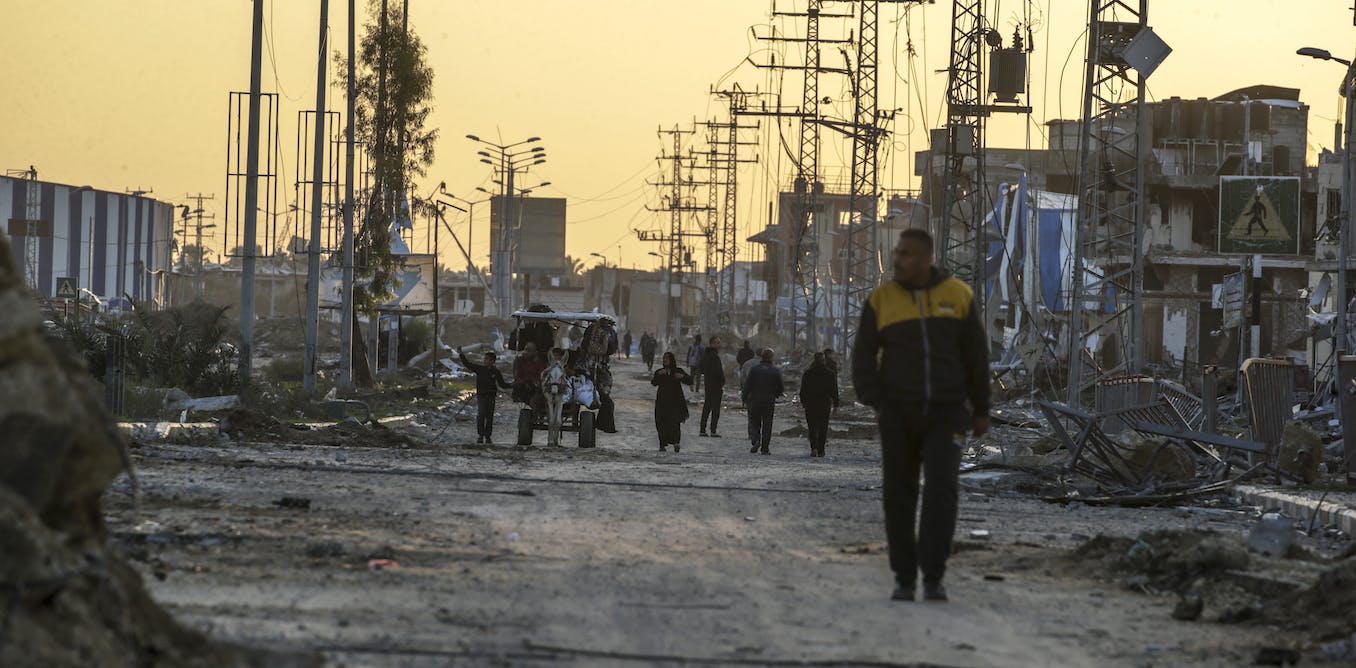
But tensions have mounted as the civilian death toll from Israel’s massive retaliation in Gaza has climbed to more than 25,000 – 70% of whom are women and children.
To put that in context, more non-combatants have been killed in less than four months in Gaza than in nearly two years of war in Ukraine, where the civilian death toll only recently exceeded 10,000.
Biden warned in December that Israel was losing international support over its “indiscriminate bombing” of Gaza. The administration has also made clear through background media briefings its concern that Netanyahu has no postwar plan for Gaza’s governance.
And following the preliminary order issued by the International Court of Justice in the genocide case against Israel this past weekend, White House commentary made clear the court’s orders aligned with US policy. Specifically, the court said Israel must take all possible steps to minimise civilian harm and increase the flow of humanitarian assistance to Gaza.
With criticism of Israel mounting on the global stage, the Biden administration has inserted the United States’ long-standing support for a two-state solution to the Israeli-Palestinian conflict.
In response, Netanyahu has thrown down the gauntlet – flatly rejecting the creation of a separate Palestinian state. He posted on X: “I will not compromise on full Israeli security control over the entire area in the west of Jordan – and this is contrary to a Palestinian state”.
Butting heads with US presidents
This rift between the two leaders should not be a surprise. Netanyahu is Israel’s longest-serving prime minister and has the self-belief that goes with 16 years in office.
This is not the first time he has butted heads with a US president. In particular, he had a poisonous relationship with Barack Obama, notably visiting Washington to address a joint sitting of Congress in 2015 without bothering to call on the president – an extraordinary breach of protocol.
Despite the fact the Oslo Accords of 1993 and 1995, signed by former Israeli Prime Minister Yitzhak Rabin and Palestinian leader Yasser Arafat, laid down a pathway to the creation of a Palestinian state, Netanyahu has never hidden his opposition to the concept.
In a recently published profile of Netanyahu in the New Yorker, David Remnick describes how the Israeli leader made a speech in 2009 in which he “conveyed a wary and highly conditional openness to a Palestinian state”. The conditions included:
-
Palestinian recognition of Israel as a Jewish state
-
no return of Palestinian refugees outside Israel
-
the demilitarisation of a future Palestinian state
-
and Jerusalem remaining the united capital of Israel.
None of these was likely to be acceptable to Palestinians.
Remnick comments the speech was a tactical move, with a larger goal in mind. He quotes the reaction of then-US ambassador to Israel, Martin Indyk:
We met a day or two after the speech. [Netanyahu] was all puffed up, and he said to me, ‘All right, I said it, now can we get back to dealing with Iran?‘
Is Biden or Netanyahu right?
This leads to the current – and more important – question: who is right about the future viability of a two-state solution, Biden or Netanyahu?
Putting aside questions of equity and morality, analysis of the evidence suggests the answer is Netanyahu.
The simple fact is the number of Israeli settlers in the occupied West Bank (including East Jerusalem) – now about 700,000, who live alongside three million Palestinians – means there is not much space left for a Palestinian state.
That gap is narrowing, with population growth higher among settlers than Palestinians. Ultra-Orthodox Jews, who comprise one-third of the settlers, have a fertility rate in Israel of 6.5 live births per woman. The current fertility rate among Palestinians is around 3.8 births per woman. If this trend continues, by mid-century, the Israeli-Palestinian population in the West Bank could be equal.
The only way space could be made for another state would be if the government were to dismantle the settlements and direct the settlers to live within the borders that existed before Israel seized the West Bank in the 1967 Six-Day War.
Despite the fact the settlements are illegal under international law – they violate the Fourth Geneva Convention – no Israeli government is likely to try to remove them for fear of violent domestic consequences. Some in Netanyahu’s government are already talking about Israel annexing the West Bank, in the way it annexed East Jerusalem in 1980.
Talk of land swaps usually ends with potential offers of land for Palestinians in the barely habitable Negev desert. The major Jewish settlement blocks in the West Bank, by contrast, are in prime real estate.
Then there is the question of Gaza, which is barely large enough to accommodate its current population of 2.3 million. With unemployment there at nearly 50%, it is a breeding ground for radicalism, as the Hamas attack in October demonstrated.
Most Israelis agree with Netanyahu
The other factor is that Netanyahu’s rejection of a Palestinian state reflects the current views of most Israelis.
Polling by the Pew Research Center in March and April 2023 – well before the Hamas attack – showed only 35% of Israelis (including both Jewish and Arab respondents) thought “a way could be found for Israel and an independent Palestinian state to coexist peacefully”. That was down nine percentage points from 2017 and 15 points from 2013.
Among Jewish Israelis, those who agreed with the statement dropped from 46% in 2013 to 32% last year. The decline was even sharper among Arab Israelis, who had been more optimistic in 2013, with 74% thinking peaceful coexistence was possible. By 2023, the proportion was just 41%.
The extent to which Netanyahu, in office throughout this period, might have influenced these declines is difficult to measure. But considering the current level of hatred and distrust between Israelis and Palestinians, it’s difficult to envisage any potential replacement for Netanyahu taking a different line on a Palestinian state.
That reality is reinforced by the Orthodox Jewish demographics noted above. Orthodox Jews tend to vote for conservative religious parties, which means growing numbers of Orthodox voters favour the formation of right-wing governments (given Israel’s strict proportional representation voting system). Netanyahu currently leads an extremist right-wing government, and it’s unlikely to be the last.
That means talk of a two-state solution by Western governments is simply kicking the can down the road. It’s not going to happen. Israelis respect the US and value the materiel and diplomatic support provided by US presidential administrations, but they won’t be ordered about by them.
And there could be a change in leadership in the US this year, too. The leading Republican candidate, Donald Trump, had a reputation as the most pro-Israel US leader since Harry Truman when he was in office. So, if Trump wins the election and Netanyahu is still in office next year, there will be little head-butting at all.
Ian Parmeter, Research Scholar, Centre for Arab and Islamic Studies, Australian National University
This article is republished from The Conversation under a Creative Commons license. Read the original article (https://theconversation.com/israel-palestinian-conflict-is-the-two-state-solution-now-dead-221967).
Image credits: Mohammed Saber/EPA