
dotlah! dotlah!
  • Cities
  • Technology
  • Business
  • Politics
  • Society
  • Science
  • About
Social Links
  • zedreviews.com
  • citi.io
  • aster.cloud
  • liwaiwai.com
  • guzz.co.uk
  • atinatin.com
0 Likes
0 Followers
0 Subscribers
dotlah!
  • Cities
  • Technology
  • Business
  • Politics
  • Society
  • Science
  • About
  • Society

Why So Many Epidemics Originate In Asia And Africa – And Why We Can Expect More

  • March 4, 2020
Total
0
Shares
0
0
0

The coronavirus disease, known as COVID-19, is a frightening reminder of the imminent global threat posed by emerging infectious diseases. Although epidemics have arisen during all of human history, they now seem to be on the rise. In just the past 20 years, coronaviruses alone have caused three major outbreaks worldwide. Even more troubling, the duration between these three pandemics has gotten shorter.

On Feb. 18, 2020, in Seoul, South Korea, people wearing face masks pass an electric screen warning about COVID-19. AP Photo/Ahn Young-joon

I am a virologist and associate director of the Animal Diagnostic Laboratory at Penn State University, and my laboratory studies zoonotic viruses, those that jump from animals and infect people. Most of the pandemics have at least one thing in common: They began their deadly work in Asia or Africa. The reasons why may surprise you.

Shoppers in face masks as they line up at a grocery store in Wuhan, a city of 11 million, in central China’s Hubei Province. The urbanization of once densely forested areas of Asia and Africa have contributed to the spread of these deadly viruses. AP Photo / Arek Rataj

Population explosion and changing urban landscapes

An unprecedented shift in human population is one reason why more diseases originate in Asia and Africa. Rapid urbanization is happening throughout Asia and the Pacific regions, where 60% of the world already lives. According to the World Bank, almost 200 million people moved to urban areas in East Asia during the first decade of the 21st century. To put that into perspective, 200 million people could form the eighth most populous country in the world.

Migration on that scale means forest land is destroyed to create residential areas. Wild animals, forced to move closer to cities and towns, inevitably encounter domestic animals and the human population. Wild animals often harbor viruses; bats, for instance, can carry hundreds of them. And viruses, jumping species to species, can ultimately infect people.

Eventually, extreme urbanization becomes a vicious cycle: More people bring more deforestation, and human expansion and the loss of habitat ultimately kills off predators, including those that feed off rodents. With the predators gone – or at least with their numbers sharply diminished – the rodent population explodes. And as studies in Africa show, so does the risk of zoonotic disease.

The situation is only likely to get worse. A major proportion of East Asia’s population still lives in rural areas. Urbanization is expected to continue for decades.
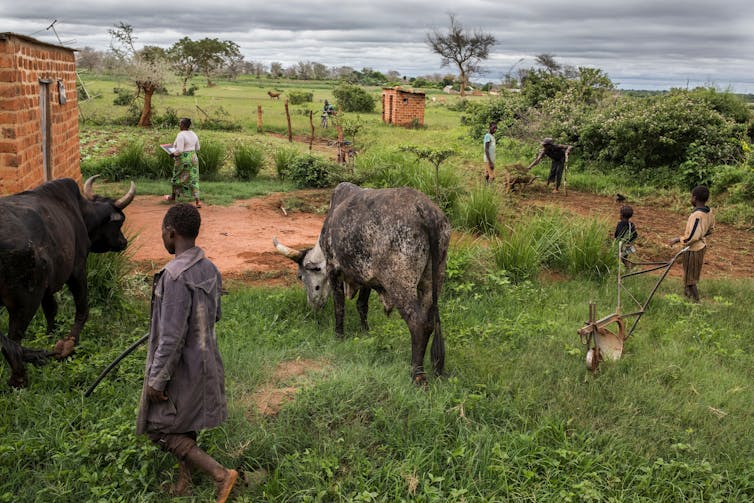
A family farm in Zambia. Disease in livestock is common, an easy way for pathogens to transfer from animals to people. Getty Images / Guillem Sartorio / AFP

Subsistence agriculture and animal markets

Tropical regions, rich in host biodiversity, already hold a large pool of pathogens, greatly increasing the chance that a novel pathogen will emerge. The farming system throughout Africa and Asia doesn’t help.

On both continents, many families depend on subsistence farming and a minuscule supply of livestock. Disease control, feed supplementation and housing for those animals is extremely limited. Cattle, chickens and pigs, which can carry endemic disease, are often in close contact with each other, a variety of nondomestic animals and humans.

And not just on the farms: Live animal markets, commonplace throughout Asia and Africa, feature crowded conditions and the intimate mixing of multiple species, including humans. This too plays a key role in how a killer pathogen could emerge and spread between species.

Another risk: bushmeat hunting and butchering, which is particularly widespread in sub-Saharan Africa. These activities, as they threaten animal species and irrevocably change ecosystems, also bring people and wild animals together. Bushmeat hunting is a clear and primary path for zoonotic disease transmission.

So is traditional Chinese medicine, which purports to provide remedies for a host of conditions like arthritis, epilepsy and erectile dysfunction. Although no scientific evidence exists to support most of the claims, Asia is an enormous consumer of traditional Chinese medicine products. Tigers, bears, rhinos, pangolins and other animal species are poached so their body parts can be mixed into these questionable medications. This, too, is a major contributor to increasing animal-human interactions. What’s more, demand is likely to go up, as online marketing soars along with Asia’s relentless economic growth.

A matter of time

The viruses, thousands of them, continue to evolve. It’s just a matter of time before another major outbreak occurs in this region of the world. All the coronaviruses that caused recent epidemics, including the COVID-19, jumped from bats to another animal before infecting humans. It’s difficult to predict precisely what chain of events cause a pandemic, but one thing is certain: these risks can be mitigated by developing strategies to minimize human effects which contribute to the ecological disturbances.

As the current outbreak has shown, an infectious disease that starts in one part of the world can spread globally in virtually no time whatsoever. There is an urgent need for constructive conservation strategies to prevent deforestation and reduce animal-human interactions. And a comprehensive global surveillance system to monitor the emergence of these diseases – now missing – would be an indispensable tool in helping us fight these deadly and terrifying epidemics.

The Conversation

Suresh V Kuchipudi, Clinical Professor and Associate Director of Animal Diagnostic Laboratory, Pennsylvania State University

This article is republished from The Conversation under a Creative Commons license. Read the original article.

Total
0
Shares
Share
Tweet
Share
Share
Related Topics
  • Africa
  • Asia
  • Bats
  • Coronavirus
  • COVID-19
  • Epidemic
  • Livestock
  • Pandemic
  • Viruses
majulah

Previous Article
  • Cities

The US Cities Where Apartment Rents Are Rising The Fastest

  • March 4, 2020
View Post
Next Article
  • Animals
  • Environment
  • People

Why So Many Epidemics Originate In Asia And Africa – And Why We Can Expect More

  • March 4, 2020
View Post
You May Also Like
View Post
  • Cities
  • Lah!
  • Society

NUS Computing Establishes Sea Olympiad Scholarship To Attract And Nurture Top Talents In Computer Studies

  • dotlah.com
  • February 27, 2022
View Post
  • Cities
  • Lah!
  • Society

Joint Study: Diverse Leadership Brings Better Firm Performance

  • dotlah.com
  • February 23, 2022
View Post
  • Lah!
  • Society

Community And Mentorship Help Women Entrepreneurs Thrive

  • dotlah.com
  • November 23, 2021
View Post
  • Lah!
  • Society

ST Engineering Champions Employee Wellness, Raises Funds For Charity And Launches Women Support Group

  • dotlah.com
  • November 14, 2021
View Post
  • Lah!
  • Society

NUS Honours 40 Alumni For Outstanding Contributions To Alma Mater And Society

  • dotlah.com
  • November 7, 2021
View Post
  • Cities
  • Lah!
  • Society

The COVID-19 Pandemic Has Made Many Singaporeans Adopt Better Financial Habits

  • dotlah.com
  • November 3, 2021
View Post
  • Lah!
  • Society

A Cleaning Revolution: How JCS-Echigo Partnered A*STAR To Clean Faster And Smarter

  • dotlah.com
  • October 16, 2021
View Post
  • Lah!
  • Society

Singapore 100 Women In Tech 2021

  • dotlah.com
  • October 16, 2021


Trending
  • 1
    • Lah!
    Ocean Financial Centre Is Singapore’s First Commercial Building To Achieve The WELL Health-Safety Rating
    • March 10, 2021
  • 2
    • Lah!
    Six Inspirational Works Make The Shortlist For S$50,000 NUS Singapore History Prize
    • July 13, 2021
  • Volvo Group: Confidently ahead at CES 3
    • Technology
    Volvo Group: Confidently ahead at CES
    • January 8, 2025
  • 4
    • Artificial Intelligence
    • People
    AI Meets Climate: MIT Energy And Climate Hack 2023
    • December 18, 2023
  • 5
    • Lah!
    Building Resilience In A Post-COVID World
    • September 8, 2020
  • 6
    • People
    • World Events
    How Contagious Is The Wuhan Coronavirus And Can You Spread It Before Symptoms Start?
    • January 30, 2020
  • 7
    • Economy
    • People
    • World Events
    Global Poverty: Coronavirus Could Drive It Up For The First Time Since The 1990s
    • June 17, 2020
  • Earth 8
    • People
    Why Standards And Controls Are Essential To The Future Of Digital Financial Markets
    • January 31, 2024
  • 9
    • Environment
    • People
    • World Events
    Coronavirus: We Need To Start Preparing For The Next Viral Outbreak Now
    • February 26, 2020
  • 10
    • Cities
    Reduction Of Toll Charges At Woodlands And Tuas Checkpoints
    • February 11, 2020
  • studying stressed books 11
    • Features
    • People
    Feeling Stressed All The Time? Here Are 7 Things To Try
    • December 18, 2020
  • charity-water-cw_Selects_16x9_19 12
    • dotZero
    • Features
    • Op-Ed
    • Outsights
    • People
    Join the Movement: Provide Clean Water and Transform Lives
    • June 13, 2023
Trending
  • 1
    Chinese tech giant Huawei unveils Mate 90 series smartphones with flagship Tau chips adopting logic folding technology
    • October 3, 2026
  • 2
    Google Opens Singapore Engineering Center to Build and Export Enterprise Cloud and AI to the World
    • September 15, 2026
  • 3
    Apple Flagship Hardware Launch for September 2026
    • September 10, 2026
  • 4
    MIT researchers tackle the economic realities of fusion power
    • August 10, 2026
  • 5
    ASEAN, treaty parties push stronger cooperation as Treaty of Amity and Cooperation in Southeast Asia marks 50 years
    • July 26, 2026
  • 6
    The Fastest AI Fried Chicken In The World
    • June 29, 2026
  • 7
    Zed Approves | How to Stay Cool in Extreme Heat
    • June 29, 2026
  • 8
    Was Venezuela struck by an earthquake ‘doublet’? Here’s what we know so far
    • June 27, 2026
  • 9
    Zed Approves | It’s Prime Day 2026! Time to Upgrade Your World Cup Viewing Setup and Beat the Heat
    • June 25, 2026
  • 10
    Zed Approves | The Best Prime Day PC Deals: Top Gaming Rigs, Workstations, and Everyday Laptops
    • June 25, 2026
Social Links
dotlah! dotlah!
  • Cities
  • Technology
  • Business
  • Politics
  • Society
  • Science
  • About
Connecting Dots Across Asia's Tech and Urban Landscape

Input your search keywords and press Enter.