
Following a government initiative launched last year, Singapore has come up with more than 100 generative AI solutions.
Image: Unsplash/Mike Enerio
This article was first published in May 2024 and updated in July 2024.
- While smart cities already harness artificial intelligence (AI), some urban centres now incorporate generative AI into their operations.
- The World Economic Forum’s G20 Global Smart Cities Alliance has developed guiding principles for the responsible use of smart city technologies.
- From self-driving trucks to versatile chatbots, here’s how five global cities are embracing gen AI.
Nine out of ten mayors in cities around the world want to engage with generative artificial intelligence (gen AI).
But how many are actually doing so? Just 2%, according to a Bloomberg Philanthropies survey from 2023.
Of course, gen AI in its current iteration – with the advent of ChatGPT, DALL-E and the like – is only a couple of years old, so it’s understandable that “most cities are at the beginning of their generative AI journey”, as Forbes puts it.
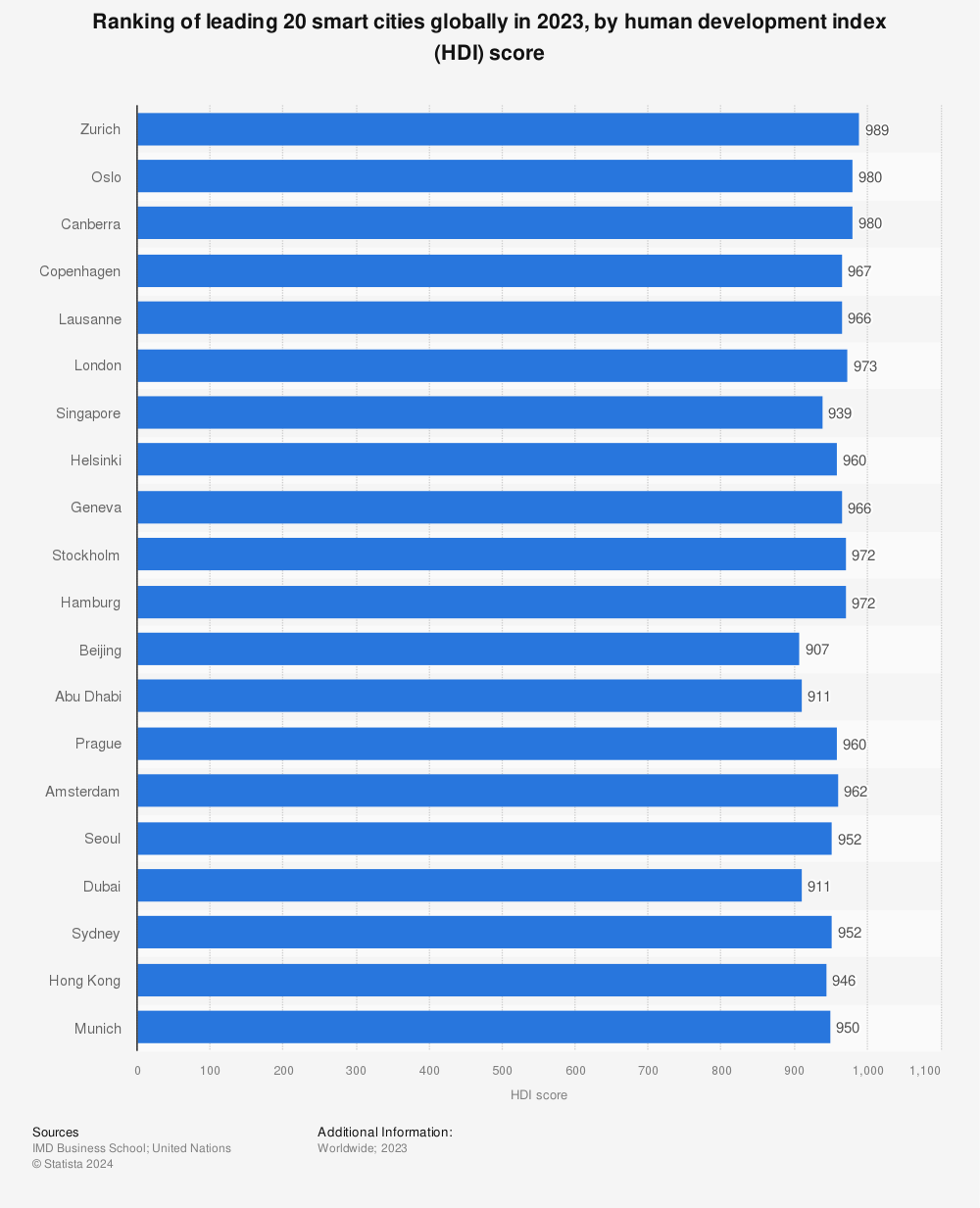
As more cities adopt generative AI capabilities, smart cities could get even smarter.Image: Statista
But smart cities – which make use of data, technology and AI to streamline services – have been gaining traction for some time now. In 2019, the World Economic Forum’s G20 Global Smart Cities Alliance proposed “a shared set of core guiding principles for the responsible use of smart city technologies”.
So what can gen AI add to our metropolises? According to City AI Connect, a new digital platform to connect up local governments trialling gen AI, current use cases range from optimizing public transport timetables to making multi-lingual chatbots for better access to services.
Here are five global cities leading the way with the technology.
Buenos Aires: The versatile chatbot
Argentina’s capital city was ahead of the game, launching its chatbot in 2019. “Boti” has evolved alongside generative AI, achieving a record 11 million conversations in January 2022 to become “a preferred channel for citizens”, says the Observatory of Public Sector Innovation.
It served as the official government channel for testing and vaccinations during the pandemic but has now expanded its scope to include services such as bike sharing and social care.
Singapore: 100 gen AI innovations
The city-state was the world’s first nation to have a digital twin – essentially, a virtual model of Singapore. And now, following a government initiative launched last year, it has come up with more than 100 gen AI solutions.
One use case enables teaching staff to swiftly develop new course content, another is a chatbot for community centres, reports The Straits Times.
While many world governments are taking a cautious approach to AI and introducing guardrails, Singapore’s government is keen to make the most of the technology, announcing a revised National AI Strategy at the end of 2023 focusing on “ways to get the Singapore economy to embrace and utilize AI”.
With this in mind, an interdisciplinary research group, led by 17 professors from the Massachusetts Institute of Technology (MIT), is examining the “human-machine relationship, enhancing existing AI initiatives in the city-state”.
Amsterdam: Generating sustainable materials
Natural language processing – the backbone of gen AI chatbots like ChatGPT – uses word data to make new linguistic connections. Now a research project at the University of Amsterdam is swapping words for molecules to create new, sustainable materials.
Applying a generative modelling approach to materials “touches on exactly what we do as chemists”, says Bernd Ensing, lead professor of the project Artificial Intelligence for Sustainable Molecules and Materials (AI4SMM). “We build new molecules and new materials. Using AI to assist us with that, or even do it for us, will change the way we do our science. It will make us less dependent on what you might call ‘chemical intuition’,” he says.
The AI4SMM team is initially focused on creating energy storage salts, sustainable steel, safe plastic and new plant proteins.
Dallas: Next-level autonomous vehicles
Autonomous vehicles have already been trialled with varying degrees of success. Now a new breed of self-driving lorries is being tested between Dallas and Houston in the United States state of Texas. The difference? They are trained on generative AI.
Where a “standard” autonomous vehicle will use data and images to plan routes and detect objects, the new system – Copilot4D – is trained on lidar sensors, which can detect how far away an object is and continuously “visualize a 3D map of the vehicle’s surroundings”, according to MIT Technology Review. This means the vehicle can generate predictions of what will happen up to 10 seconds in the future – and therefore anticipate problems.
Raquel Urtasun, CEO of Waabi, the self-driving company behind this innovation, says that their “AI-first” approach means that the system “learns from data” rather than having to be “taught reactions to specific situations”.
If these gen AI vehicles prove to be safer and more reliable than their predecessors, the potential is there to tackle a number of issues, including supply chain hold-ups, carbon emissions and labour shortages, says the Toronto Globe and Mail.
Boston: Envisaging a bicycle-city future
The US city of Boston would like to become more bike-friendly, and planners have been looking to Copenhagen in Europe as a good example to follow. But locals are concerned about how such changes could impact their city – and not all of them can hop across the Atlantic to find out how it might look. Now gen AI is helping Bostonians envisage – and hopefully embrace – a different layout for their city.
“With the help of generative AI, we can bring the Copenhagen style of the bicycle infrastructure, overlay it on top of the Boston infrastructure and Boston building environment, so that Bostonians can have a tangible sense of, if we promote and build a bicycle [network], what our city will look like,” Jinhua Zhao, Professor of Cities and Transportation at MIT, told the Forum.
By: Madeleine North (Senior Writer, Forum Agenda)
Originally published at: World Economic Forum