Brendan Smialowski/Getty Images
Xianda Huang, University of California, Los Angeles
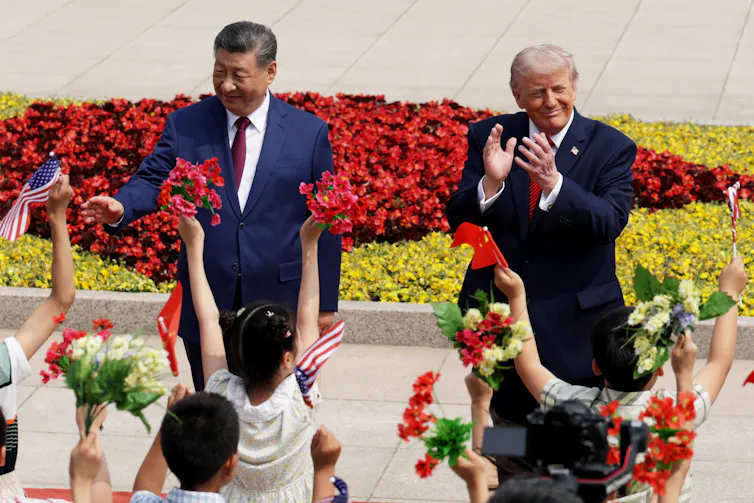
Diplomacy often masquerades as theater. And nearly nine years after his first state visit to China, Donald Trump returned to Beijing with an extended cast of characters.
Alongside the U.S. president on his May 2026 visit was a senior delegation of politicians including his secretary of defense, and a phalanx of business leaders and technology executives. It was a traveling display of American political and corporate power.
Not that the hosting Chinese were short of symbolic gestures themselves. Trump’s first China visit in 2017 had already shown how far Beijing was willing to go to turn diplomacy into theater. On that occasion, Chinese President Xi Jinping and his wife Peng Liyuan personally accompanied Donald and Melania Trump through the Forbidden City, Beijing’s former imperial palace, drinking tea inside the palace walls and taking in a Peking opera at the Belvedere of Pleasant Sounds, a Qing imperial theater built for court entertainment.
So what was being conveyed this time around? As a cultural historian of modern China, I took a peek beyond the official statements and trade headlines of the Xi-Trump summit and into the images, gestures and cultural symbolism on display.
Brendan Smialowski/ AFP via Getty Images
The weight of heaven
The formal choreography began at Beijing’s Great Hall of the People, where the two leaders exchanged views on the Iran conflict, the war in Ukraine and the Korean Peninsula, among other items.
But the more interesting story of the visit, to me, was told outside the meeting room.
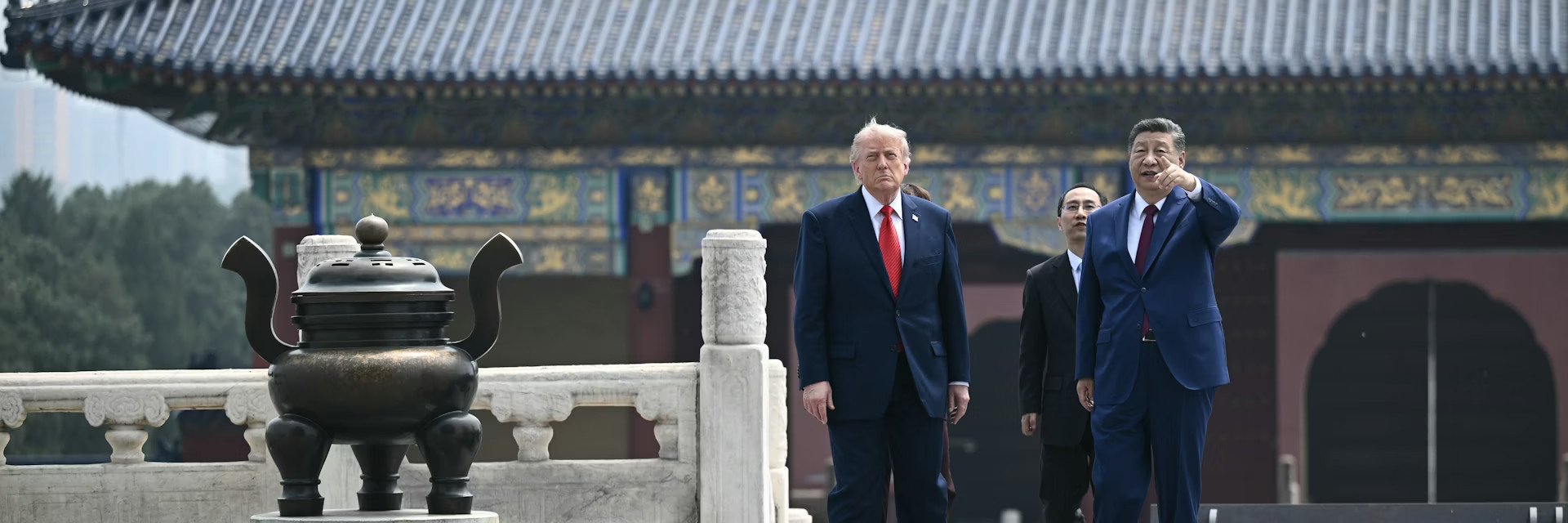
After their two-hour bilateral meeting, Trump and Xi paid a cultural visit to the Temple of Heaven in Southern Beijing. Built in the early 15th century, the temple is China’s most complete surviving imperial religious complex. For nearly five centuries, emperors of the Ming and Qing dynasties came here to worship Heaven and pray for good harvests.
Its most recognizable structure, the Hall of Prayer for Good Harvests, rises in three tiers of blue-glazed tiles above a marble platform, its circular form and crimson columns translating cosmology into architecture. UNESCO inscribed the site as a World Heritage Site in 1998, recognizing it as “a masterpiece of architecture and landscape design.”
When Trump and Xi posed for photographs, they were standing in a place long associated with cosmic order and the welfare of the people. To bring a foreign leader there is to invite a particular reading of the relationship: not simply as a bargain between states, but as a relationship that Beijing hopes to associate with order, abundance and peace.
There was also a more practical layer to this symbolism. The Temple of Heaven links political authority to agricultural abundance. Emperors came here to pray not for abstract harmony but for grain. That made it a pointed setting for a visit in which American agricultural exports — soybeans, grains and beef among them — were expected to matter.
For Trump, any Chinese commitment to buy more U.S. farm goods would have clear domestic political value. For Xi, the setting allowed a hard bargaining issue — farm purchases — to be translated into an older symbolic language of harvest that spoke to both domestic and international audiences.
Before Trump, Kissinger
Trump was not the first American statesman to be brought to the Temple of Heaven.
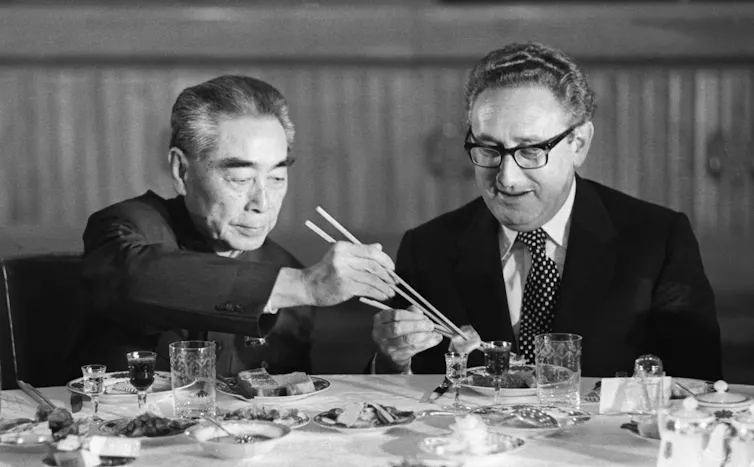
In July 1971, Henry Kissinger, then national security adviser to President Richard Nixon, arrived in Beijing on his famous secret mission — the back-channel visit that helped re-open the door between two countries that had little direct contact for more than two decades. Between tense negotiations with Chinese premier Zhou Enlai, Kissinger made time to visit the temple.
There, standing amid the old cypress groves, he was said to have been deeply moved by the timeless atmosphere of the hall and its surroundings.
Bettman/Getty Images
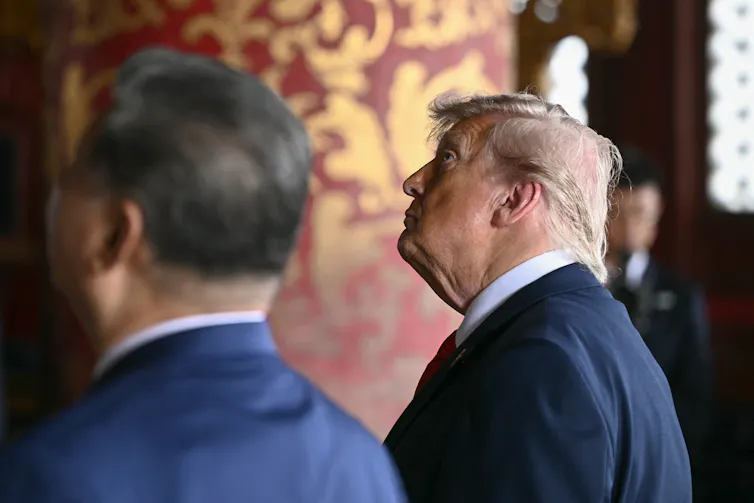
The motif of old trees and deep time returned on May 15, when Xi gave Trump a rare walk through Zhongnanhai, the walled compound that now houses the core of China’s party-state leadership. Reuters reported that a hot mic captured Xi drawing Trump’s attention to the age of the trees around them — some centuries old, some said to be more than a thousand years old. When Trump asked whether Xi had taken other presidents on similar walks, Xi replied that he had only rarely.
Together, the Kissinger anecdote and the Zhongnanhai walk reveal a recurring logic in Chinese-American diplomacy: America’s fast-moving economy is invited to look at China’s sense of tradition. Xi has used this tactic with other leaders, too. When French President Emmanuel Macron visited China in 2023, he attended a guqin performance invoking the classical idea of the zhiyin — the rare listener who truly understands one’s music.
Basketball and roast duck
Trump’s visit was not staged only through imperial grandeur, however. It also moved into a more familiar register: food, sports and popular culture.
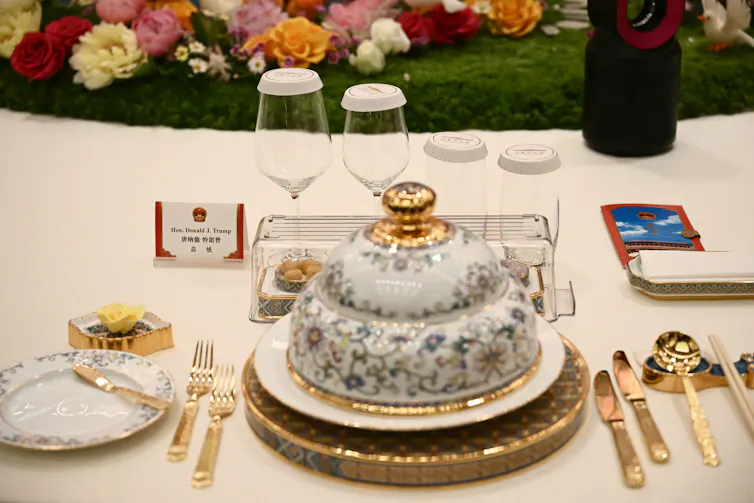
The state dinner on May 14 was another study in careful hospitality. Chefs designed the menu to honor both Chinese culinary prestige and Americans’ — and Trump’s — known preferences: Peking roast duck, crispy beef ribs, pan-fried pork bun, tiramisu and fruit and ice cream.
Brendan Smialowski/AFP via Getty Images
Trump thanked Xi for a “magnificent welcome like none other,” then replied in a language more recognizably his own. He spoke not only of power politics but of people-to-people ties: Chinese workers who helped build America’s railroads, Chinese enthusiasm for basketball and blue jeans and the sheer presence of Chinese restaurants across the U.S.
The examples were characteristically Trumpian — simple, vivid and easy to grasp. But they pointed to something important. U.S.–China relations have never been made only by presidents, diplomats and official communiques. They have also been shaped by athletes, musicians, restaurant owners, students and tourists.
The basketball reference was especially resonant. Sports have long offered a softer language for U.S.–China relations. In April 2026, just weeks before Trump’s visit, China and the U.S. marked the 55th anniversary of ping-pong diplomacy — the famous 1971 exchange in which a “little ball” helped move the “big ball” of world politics.
Basketball now plays a similar role. For many Chinese fans, the NBA is a deeply familiar world of players, teams and memories that represents the spirit of America: Michael Jordan, Kobe Bryant, LeBron James and Yao Ming. That reservoir of affection has survived even periods of political tension. Trump, in invoking it, was drawing on something real.
A second act in the US?
The main lesson of all this symbolism is that, in U.S.–China relations, atmosphere has never been secondary.
Diplomatic theater cannot settle disputes over technology or Taiwan, or determine the future of the global order. But it can shape the mood in which rivalries are managed, and the stories that leaders tell their public about what the relationship means.
And on that front, the summit worked on several levels. To the Chinese audience, it presented their leaders as confident and capable of managing a tense relationship with the U.S. on China’s own cultural terms.
Alex Wong/Getty Images
For Trump and the American delegation, it offered a lesson in Chinese traditions and culture that promotes deeper understanding across political divides. And for both societies, the references for food, sports and popular culture created a more neutral ground on which connection could still be imagined.
From the 1970s opening to Trump’s 2017 visit to the Forbidden City, and from the Temple of Heaven photo-op to the walk among old trees at Zhongnanhai in 2026, cultural staging remains central to how China presents itself to America — and how America is invited to imagine China. It was announced on May 15 that Xi will pay a state visit to the U.S. in September at the invitation of Trump. If that happens, the theater of diplomacy will move to American soil, and the question will be how Washington chooses to stage China in return.
Xianda Huang, Ph.D. Student in Asian Languages and Cultures, University of California, Los Angeles
This article is republished from The Conversation under a Creative Commons license. Read the original article ( https://theconversation.com/from-beef-ribs-to-a-heavenly-walk-xi-trump-summit-symbolism-underscored-american-power-and-chinese-tradition-282945 ).