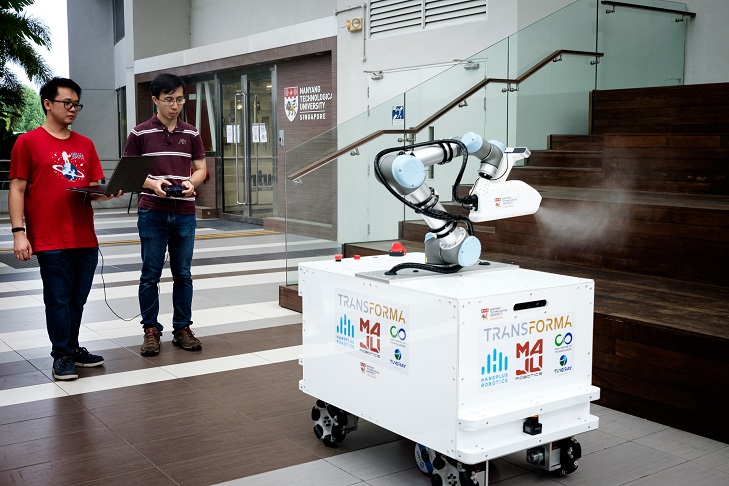
Researchers from Nanyang Technological University, Singapore (NTU Singapore) have developed a semi-autonomous robot that can disinfect large surfaces quickly. The researchers are planning to have public trials to support Singapore’s fight against COVID-19.

Named eXtreme Disinfection roBOT (XDBOT), it can be wirelessly controlled via a laptop or tablet, removing the need for cleaners to be in contact with surfaces, thereby reducing the risk of picking up the virus from potentially contaminated areas.
In this current COVOD-19 outbreak, there is a national demand for deep cleaning and disinfection services[1]. According to news reports, working hours for cleaners have doubled to 16 hours a day due to the manpower crunch.
The new robot differs from other disinfection robots currently on the market that are primarily intended to clean and vacuum floor surfaces and are unable to disinfect odd-shaped surfaces or anything above ground level.
Comprising a semi-autonomous control unit with motorised wheels, XDBOT has a 6-axis robotic arm that can mimic human movement to reach awkward locations such as under tables and beds, as well as doorknobs, tabletops and light switches.
And instead of a conventional pressure-spray nozzle, it uses an electrostatic-charged nozzle to ensure a wider and further spread of the disinfectant, behind and over hidden surfaces.
Unlike typical nozzles, XDBOT’s nozzle discharges chemicals with a positive electrical charge. These disinfectants will then be attracted to all negatively-charged surfaces. Surfaces already covered with the disinfectant will then repel the spray, making this method very efficient. This concept of charge attraction is similar to how positive and negative poles of magnets are drawn to each other.
Leader of the project, Professor Chen I-Ming, a roboticist from the NTU Robotics Research Centre, said the XDBOT was conceived when COVID19 cases started to spike worldwide in mid-February and disinfection efforts were being stepped up at Changi Airport, local hotels and hospitals[2].
“To stop the transmission of a virus means we need a way to quickly disinfect surfaces, which is a labour-intensive and repetitive activity,” Prof Chen explained.
“Using our new robot from a distance, a human operator can precisely control the disinfection process, increasing surface area cleaned by up to four times, with zero contact with surfaces.”
Prof Chen is also the founder and CEO of Transforma Robotics, a technology spin-off from NTU Singapore. The XDBot was developed by NTU scientists working with Transforma Robotics and two other NTU spin-offs, Hand Plus Robotics and Maju Robotics, along with help from two industry partners: Asia Centre of Technologies (ACOT) and Tungray Singapore Pte Ltd.
Developed and built on the NTU Smart Campus, the robot went from a theoretical concept to an operational prototype in two months.
Through its Smart Campus vision, NTU aims to harness the power of digital technology and tech-enabled solutions to support better learning and living experiences, the discovery of new knowledge, and the sustainability of resources, in support of Singapore’s Smart Nation ambitions.
NTU Senior Vice-President (Research) Prof Lam Khin Yong said that the rapid development of the robot exemplifies NTU’s ability to have innovative solutions to global challenges and that draw on a wide range of university research strengths.
“During this challenging period, we are proud that our scientists have come together and gone the extra mile to develop a homegrown robotic solution to help address the current manpower crunch in the sanitation industry and to minimise transmission risks associated with COVID-19.”
Semi-autonomous for precise disinfection
XDBOT can navigate semi-autonomously in any environment using LIDAR (Light Detection and Ranging) and high-definition cameras, while its arm is controlled by a human operator – like a tank with a rotating turret.
Currently, the operator can control the robot from up to 30 metres using a laptop/tablet, which can be increased to 50m or further with more antennas installed on XDBOT.
The robot possesses a large 8.5 litre tank that can carry a variety of disinfectants appropriate to different environments such as childcare centres, hospitals, nursing homes and shopping malls.
It can run for four hours continuously on a rechargeable battery pack and is estimated to be able to disinfect a surface area of up to four times that of manual cleaning.
Recharging its batteries takes eight hours at present, but the researchers say this can be further improved if quick-charging technology is adopted.
XDBOT has been tested in public areas on the NTU campus such as the School of Mechanical and Aerospace Engineering, North Spine Plaza and the dining area near Canopy K.
Moving forward, the team is in talks with several healthcare institutions and hopes to further test the prototype at more public areas and the local public hospitals.
If trials are successful and with sufficient commercial demand, the three spin-offs aim to develop a production-ready version of the XDBOT and scale up production so as to support Singapore’s efforts to stem the spread of COVID-19.
About Nanyang Technological University, Singapore
A research-intensive public university, Nanyang Technological University, Singapore (NTU Singapore) has 33,000 undergraduate and postgraduate students in the Engineering, Business, Science, Humanities, Arts, & Social Sciences, and Graduate colleges. It also has a medical school, the Lee Kong Chian School of Medicine, established jointly with Imperial College London.
NTU is also home to world-renowned autonomous institutes – the National Institute of Education, S Rajaratnam School of International Studies, Earth Observatory of Singapore, and Singapore Centre for Environmental Life Sciences Engineering – and various leading research centres such as the Nanyang Environment & Water Research Institute (NEWRI) and Energy Research Institute @ NTU (ERI@N).
Ranked 11th in the world by QS, NTU has been placed the world’s top young university for the past six years. The University’s main campus is frequently listed among the Top 15 most beautiful university campuses in the world and it has 57 Green Mark-certified (equivalent to LEED-certified) building projects, of which 95% are certified Green Mark Platinum. Apart from its main campus, NTU also has a campus in Singapore’s healthcare district.
Under the NTU Smart Campus vision, the University harnesses the power of digital technology and tech-enabled solutions to support better learning and living experiences, the discovery of new knowledge, and the sustainability of resources.
For more information, visit www.ntu.edu.sg.