Scientists quantify a previously overlooked driver of human-related mercury emissions.
Adam Zewe | MIT News
MIT News (https://news.mit.edu/2024/study-global-deforestation-leads-more-mercury-pollution-0212)
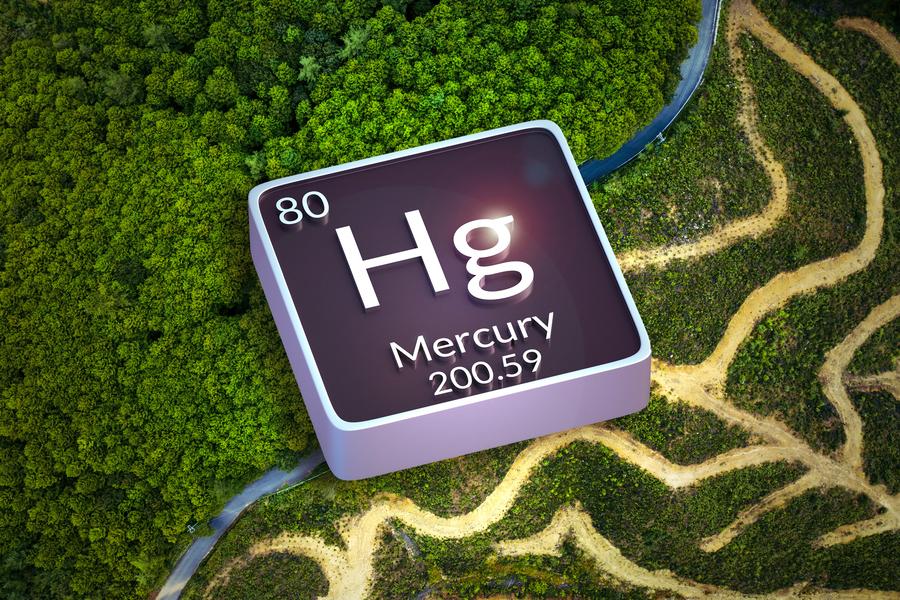
About 10 percent of human-made mercury emissions into the atmosphere each year are the result of global deforestation, according to a new MIT study.
The world’s vegetation, from the Amazon rainforest to the savannahs of sub-Saharan Africa, acts as a sink that removes the toxic pollutant from the air. However, if the current rate of deforestation remains unchanged or accelerates, the researchers estimate that net mercury emissions will keep increasing.
“We’ve been overlooking a significant source of mercury, especially in tropical regions,” says Ari Feinberg, a former postdoc in the Institute for Data, Systems, and Society (IDSS) and lead author of the study.
The researchers’ model shows that the Amazon rainforest plays a particularly important role as a mercury sink, contributing about 30 percent of the global land sink. Curbing Amazon deforestation could thus have a substantial impact on reducing mercury pollution.
The team also estimates that global reforestation efforts could increase annual mercury uptake by about 5 percent. While this is significant, the researchers emphasize that reforestation alone should not be a substitute for worldwide pollution control efforts.
“Countries have put a lot of effort into reducing mercury emissions, especially northern industrialized countries, and for very good reason. But 10 percent of the global anthropogenic source is substantial, and there is a potential for that to be even greater in the future. [Addressing these deforestation-related emissions] needs to be part of the solution,” says senior author Noelle Selin, a professor in IDSS and MIT’s Department of Earth, Atmospheric and Planetary Sciences.
Feinberg and Selin are joined on the paper by co-authors Martin Jiskra, a former Swiss National Science Foundation Ambizione Fellow at the University of Basel; Pasquale Borrelli, a professor at Roma Tre University in Italy; and Jagannath Biswakarma, a postdoc at the Swiss Federal Institute of Aquatic Science and Technology. The paper appears today in Environmental Science and Technology.
Modeling mercury
Over the past few decades, scientists have generally focused on studying deforestation as a source of global carbon dioxide emissions. Mercury, a trace element, hasn’t received the same attention, partly because the terrestrial biosphere’s role in the global mercury cycle has only recently been better quantified.
Plant leaves take up mercury from the atmosphere, in a similar way as they take up carbon dioxide. But unlike carbon dioxide, mercury doesn’t play an essential biological function for plants. Mercury largely stays within a leaf until it falls to the forest floor, where the mercury is absorbed by the soil.
Mercury becomes a serious concern for humans if it ends up in water bodies, where it can become methylated by microorganisms. Methylmercury, a potent neurotoxin, can be taken up by fish and bioaccumulated through the food chain. This can lead to risky levels of methylmercury in the fish humans eat.
“In soils, mercury is much more tightly bound than it would be if it were deposited in the ocean. The forests are doing a sort of ecosystem service, in that they are sequestering mercury for longer timescales,” says Feinberg, who is now a postdoc in the Blas Cabrera Institute of Physical Chemistry in Spain.
In this way, forests reduce the amount of toxic methylmercury in oceans.
Many studies of mercury focus on industrial sources, like burning fossil fuels, small-scale gold mining, and metal smelting. A global treaty, the 2013 Minamata Convention, calls on nations to reduce human-made emissions. However, it doesn’t directly consider impacts of deforestation.
The researchers launched their study to fill in that missing piece.
In past work, they had built a model to probe the role vegetation plays in mercury uptake. Using a series of land use change scenarios, they adjusted the model to quantify the role of deforestation.
Evaluating emissions
This chemical transport model tracks mercury from its emissions sources to where it is chemically transformed in the atmosphere and then ultimately to where it is deposited, mainly through rainfall or uptake into forest ecosystems.
They divided the Earth into eight regions and performed simulations to calculate deforestation emissions factors for each, considering elements like type and density of vegetation, mercury content in soils, and historical land use.
However, good data for some regions were hard to come by.
They lacked measurements from tropical Africa or Southeast Asia — two areas that experience heavy deforestation. To get around this gap, they used simpler, offline models to simulate hundreds of scenarios, which helped them improve their estimations of potential uncertainties.
They also developed a new formulation for mercury emissions from soil. This formulation captures the fact that deforestation reduces leaf area, which increases the amount of sunlight that hits the ground and accelerates the outgassing of mercury from soils.
The model divides the world into grid squares, each of which is a few hundred square kilometers. By changing land surface and vegetation parameters in certain squares to represent deforestation and reforestation scenarios, the researchers can capture impacts on the mercury cycle.
Overall, they found that about 200 tons of mercury are emitted to the atmosphere as the result of deforestation, or about 10 percent of total human-made emissions. But in tropical and sub-tropical countries, deforestation emissions represent a higher percentage of total emissions. For example, in Brazil deforestation emissions are 40 percent of total human-made emissions.
In addition, people often light fires to prepare tropical forested areas for agricultural activities, which causes more emissions by releasing mercury stored by vegetation.
“If deforestation was a country, it would be the second highest emitting country, after China, which emits around 500 tons of mercury a year,” Feinberg adds.
And since the Minamata Convention is now addressing primary mercury emissions, scientists can expect deforestation to become a larger fraction of human-made emissions in the future.
“Policies to protect forests or cut them down have unintended effects beyond their target. It is important to consider the fact that these are systems, and they involve human activities, and we need to understand them better in order to actually solve the problems that we know are out there,” Selin says.
By providing this first estimate, the team hopes to inspire more research in this area.
In the future, they want to incorporate more dynamic Earth system models into their analysis, which would enable them to interactively track mercury uptake and better model the timescale of vegetation regrowth.
“This paper represents an important advance in our understanding of global mercury cycling by quantifying a pathway that has long been suggested but not yet quantified. Much of our research to date has focused on primary anthropogenic emissions — those directly resulting from human activity via coal combustion or mercury-gold amalgam burning in artisanal and small-scale gold mining,” says Jackie Gerson, an assistant professor in the Department of Earth and Environmental Sciences at Michigan State University, who was not involved with this research. “This research shows that deforestation can also result in substantial mercury emissions and needs to be considered both in terms of global mercury models and land management policies. It therefore has the potential to advance our field scientifically as well as to promote policies that reduce mercury emissions via deforestation.
This work was funded, in part, by the U.S. National Science Foundation, the Swiss National Science Foundation, and Swiss Federal Institute of Aquatic Science and Technology.
Reprinted with permission of MIT News (http://news.mit.edu/)