dotlah! dotlah!
  • Cities
  • Technology
  • Business
  • Politics
  • Society
  • Science
  • About
Social Links
  • zedreviews.com
  • citi.io
  • aster.cloud
  • liwaiwai.com
  • guzz.co.uk
  • atinatin.com
0 Likes
0 Followers
0 Subscribers
dotlah!
  • Cities
  • Technology
  • Business
  • Politics
  • Society
  • Science
  • About
  • People
  • World Events

Beyond The Curve: A Visual Journey Into Our Post-Pandemic Future

  • July 16, 2020
Total
0
Shares
0
0
0

What changes in the built environment can we make to shape a sustainable post-pandemic future?

COVID-19 is reshaping our world in ways that our generation hasn’t seen before, bringing about changes which we have to live with even after successfully ending the pandemic.

In Arup’s recent publication, Beyond the curve, the reader is invited to imagine and question the world in a post-pandemic era and to consider how the future can be designed to be more sustainable and resilient for everyone.

To do this, Arup’s Foresight team consulted with firm experts, conducted internal workshops, research, and expert interviews to study the impact of COVID-19 in our homes, neighbourhoods, offices, as well as in transit and retail.

Let’s explore the main points.

Home

As our personal lives continue to blend with our jobs in our homes, it is important to establish boundaries.

Within the home, a clear separation of spaces for different activities should be established to maintain our physical and mental well-being. A temporal boundary established through the use of wearable devices and mobile apps is also important in ensuring the proper allocation of our time.
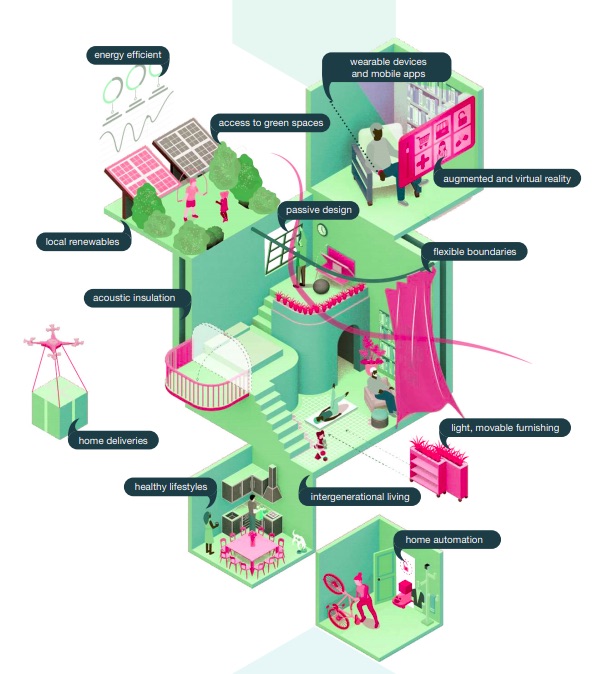
Source: Arup

For businesses, the post-pandemic world is a good opportunity to continue the improvement of delivery services and home automation solutions. Exploring augmented and digital reality to create an immersive sensory experience at the comfort of one’s home is another worthy endeavor.

For home builders, the creation of living spaces that support healthy lifestyles and provide access to green spaces are some of the ways to boost value.

Neighbourhoods

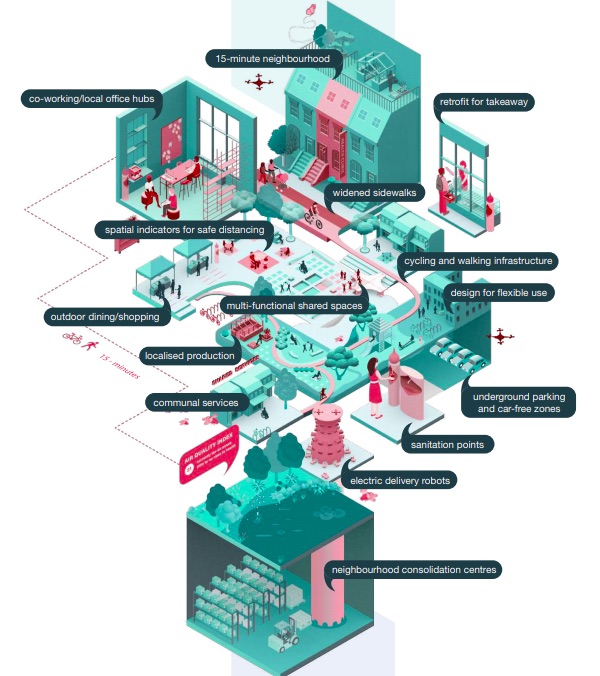
The formation of ‘15-minute neighbourhoods’ — distributed hubs which provide access to essential goods and services — will help in reducing the use of cars in favor of walking and cycling.
Source: Arup

The shift to remote and flexible working conditions is a good opportunity to build coworking and local office hubs where people can access high-quality equipment.

Another aspect highlighted by this pandemic is the importance of the localisation of production when it comes to the resilience of businesses since border restrictions can easily paralyse operations.

Designing assets for flexible use would also allow businesses to improve the speed of their emergency responses.

Transit

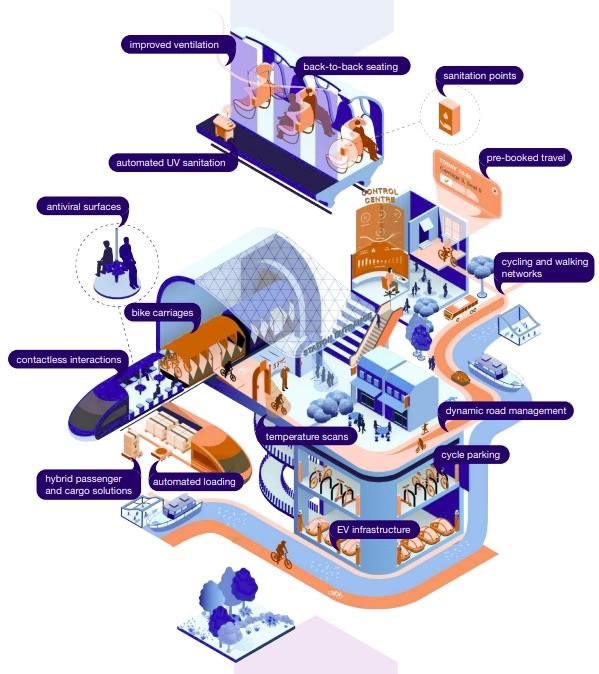
Increasing micro-mobility options like bikes, scooters, and walking is a good way to maintain physical distancing. This would simultaneously promote modes of transport that are more sustainable than cars.
Source: Arup

To lower travel risk, public transport systems should consider pre-booked travels, flexible working and 24/7 operations to keep occupancy to a minimum. Redistributing seats to a back-to-back configuration, on the other hand, would promote social distancing.

Meanwhile, hybrid passenger and cargo solutions through the use of the underutilised portions of public transport for freight would aid in keeping up with the increased demand for deliveries due to the surge in the use of online shopping platforms.

Office

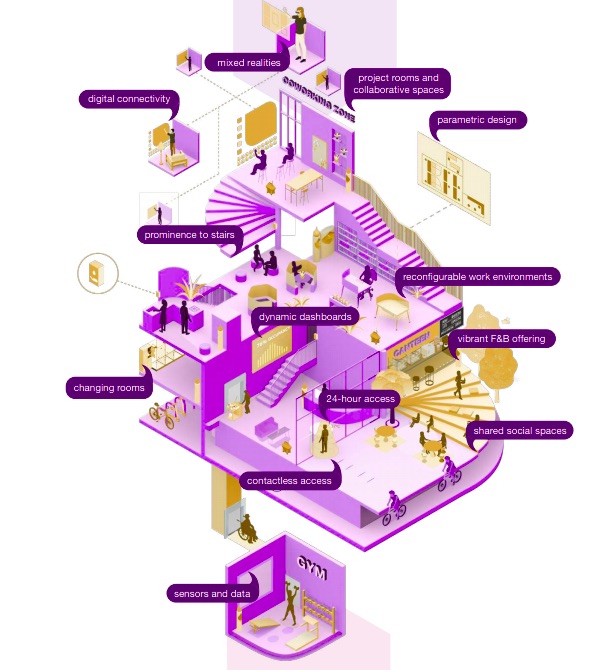
Similar to homes and business assets, offices would benefit from reconfigurable work environments to accommodate diverse working styles. In line with this, digital connectivity should be strengthened to ensure that everyone stays on the same page.
Source: Arup

A 24-hour access to facilities along with the provision of food, concierge services, and changing rooms would help in supporting a coarse distribution of work shifts and in lowering peaks in transport demand.

The use of sensors and dashboards would aid in controlling occupancy and informing employees of any anomalies. Encouraging the use of stairs can decrease the risk of infections due to the overreliance on lifts.

Retail

Flexible store layouts would help in the integration of different activities. This can pave the way towards the introduction of experiences that consumers cannot access through online platforms including workshops and immersive installations.
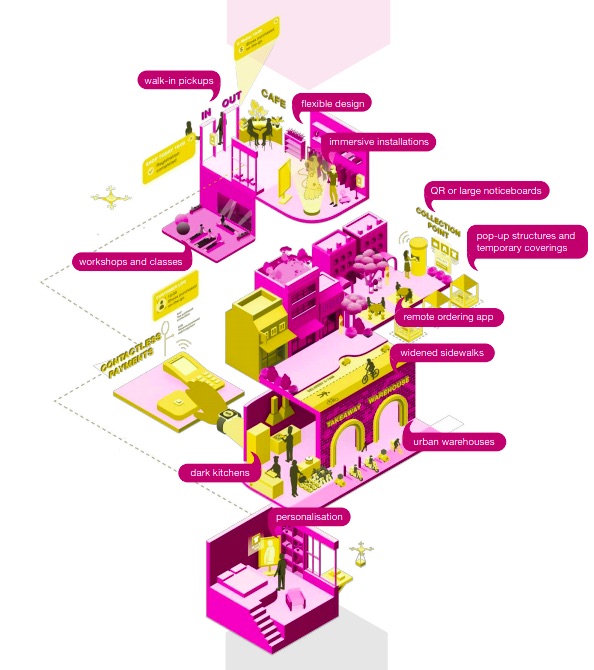
Restaurants, in particular, can provide menus via QR codes and large notice boards to keep everything touchless. Furthermore, redesigning their structures to accommodate walk-in pickups combined with the use of remote ordering apps will reduce waiting times.

Lastly, technologies like facial recognition and proximity sensors to enable touchless payments can be considered.

Total
0
Shares
Share
Tweet
Share
Share
Related Topics
  • Coronavirus
  • COVID-19
  • Post Pandemic
  • Resilience
  • Sustainability
dotlah.com

Previous Article
  • Lah!

Asia Produces Half The Plastic In The World

  • July 16, 2020
View Post
Next Article
  • Cities

The Top 50 Smart Cities In The World 2020

  • July 16, 2020
View Post
You May Also Like
View Post
  • Cities
  • Environment
  • People

Was Venezuela struck by an earthquake ‘doublet’? Here’s what we know so far

  • dotlah.com
  • June 27, 2026
View Post
  • People

Singapore Airlines to Add Services Across Europe, Launch New Flights to Madrid in October 2026

  • Dean Marc
  • May 8, 2026
Illustration of data storage
View Post
  • Business
  • Featured
  • Features
  • World Events

The Splinternet Comes for European Supply Chains Why Fragmentation Is Now a Boardroom Problem

  • Ackley Wyndam
  • April 21, 2026
totus-technologies-cover
View Post
  • Business
  • Technology
  • World Events

The Transatlantic Tech Rift and Why Data Sovereignty Is the New Industrial Imperative

  • Ackley Wyndam
  • April 16, 2026
View Post
  • People
  • Working Life

About 23,000 community care sector employees could get at least 7% pay raise as part of new salary guidelines

  • dotlah.com
  • February 18, 2026
View Post
  • People
  • Technology

This is what the new frontier of AI-powered financial inclusion looks like

  • dotlah.com
  • January 2, 2026
View Post
  • People
  • Working Life

Skills development is critical to bridging the global digital talent gap

  • dotlah.com
  • December 22, 2025
Points, Lines and a Question
View Post
  • Engineering
  • Op-Ed
  • People

What Is The Point In Making Points?

  • Dean Marc
  • November 27, 2025


Trending
  • Earth 1
    • People
    Why Standards And Controls Are Essential To The Future Of Digital Financial Markets
    • January 31, 2024
  • 2
    • Cities
    Don’t Feel Like Taking Public Transport? Try These Next-Level Ways To Get Around The City
    • July 14, 2020
  • 3
    • Lah!
    SGX Welcomes Nanofilm Technologies International Limited To Mainboard
    • November 2, 2020
  • 4
    • Lah!
    Discover Your Singapore Airlines
    • September 30, 2020
  • 5
    • Cities
    This ‘Self-Sufficient’ Chinese City Is Being Built With Future Pandemics In Mind
    • September 14, 2020
  • 6
    • Lah!
    Inflation Expectations Decline Modestly
    • July 21, 2020
  • social-media-heart-karsten-winegeart-60GsdOMRFGc-unsplash 7
    • People
    • Technology
    How Social Media Can Help Boost Your Optimism
    • April 9, 2022
  • 8
    • Cities
    • Economy
    India’s Smartphone Market Set To Surge
    • September 22, 2023
  • 9
    • Lah!
    LTA Pilots New Initiative To Help Commuters With Invisible Medical Conditions
    • October 3, 2019
  • 10
    • Lah!
    MAS Issues New Rules To Strengthen Cyber Resilience Of Financial Industry
    • August 7, 2019
  • times square new york 11
    • Economy
    • People
    The US Economy Is Reliant On Consumer Spending – Can It Survive A Pandemic?
    • September 29, 2020
  • 12
    • Cities
    How GovTech Simulates Four Million Bus Rides A Day
    • March 20, 2019
Trending
  • 1
    Chinese tech giant Huawei unveils Mate 90 series smartphones with flagship Tau chips adopting logic folding technology
    • October 3, 2026
  • 2
    Google Opens Singapore Engineering Center to Build and Export Enterprise Cloud and AI to the World
    • September 15, 2026
  • 3
    Apple Flagship Hardware Launch for September 2026
    • September 10, 2026
  • 4
    MIT researchers tackle the economic realities of fusion power
    • August 10, 2026
  • 5
    ASEAN, treaty parties push stronger cooperation as Treaty of Amity and Cooperation in Southeast Asia marks 50 years
    • July 26, 2026
  • 6
    The Fastest AI Fried Chicken In The World
    • June 29, 2026
  • 7
    Zed Approves | How to Stay Cool in Extreme Heat
    • June 29, 2026
  • 8
    Was Venezuela struck by an earthquake ‘doublet’? Here’s what we know so far
    • June 27, 2026
  • 9
    Zed Approves | It’s Prime Day 2026! Time to Upgrade Your World Cup Viewing Setup and Beat the Heat
    • June 25, 2026
  • 10
    Zed Approves | The Best Prime Day PC Deals: Top Gaming Rigs, Workstations, and Everyday Laptops
    • June 25, 2026
Social Links
dotlah! dotlah!
  • Cities
  • Technology
  • Business
  • Politics
  • Society
  • Science
  • About
Connecting Dots Across Asia's Tech and Urban Landscape

Input your search keywords and press Enter.