dotlah! dotlah!
  • Cities
  • Technology
  • Business
  • Politics
  • Society
  • Science
  • About
Social Links
  • zedreviews.com
  • citi.io
  • aster.cloud
  • liwaiwai.com
  • guzz.co.uk
  • atinatin.com
0 Likes
0 Followers
0 Subscribers
dotlah!
  • Cities
  • Technology
  • Business
  • Politics
  • Society
  • Science
  • About
  • Cities

COVID-19 Has Created More Cyclists: How Cities Can Keep Them On Their Bikes

  • August 4, 2020
Total
0
Shares
0
0
0

As physical distancing measures to limit the spread of COVID-19 begin to relax in some countries and people return to work, the fears surrounding transportation and commuting continue to weigh on the minds of many.

Once popular options like public transit and ridesharing, such as Uber, now carry the risk of potentially exposing riders to COVID-19. The Toronto Transit Commission recently reported that even if it operated at only 30 per cent of capacity, roughly 510,000 riders, passengers would not be able to keep a safe distance from each other.
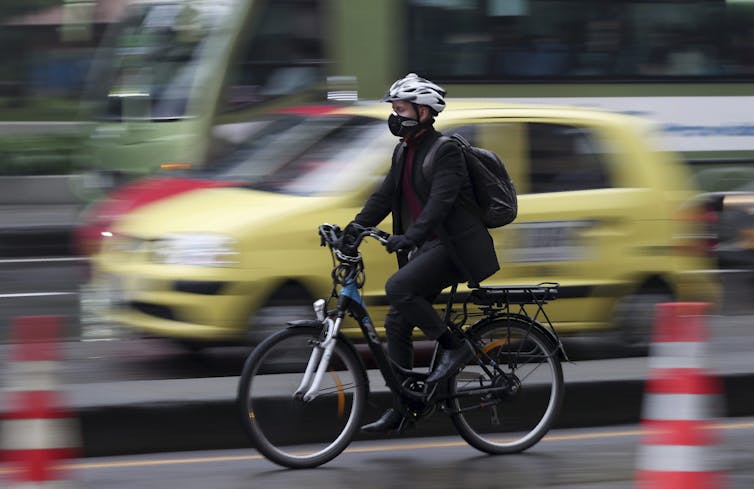
Bike routes have been expanded in many major cities, including Bogata, Columbia, to encourage people to avoid crowded public transportation. (AP Photo/Fernando Vergara)

Personal vehicles do allow for adequate distancing, but many cities cannot support the shift of public transit riders to cars. There is also a substantial cost-barrier associated with car ownership: parking, insurance, gas.

As a result, more people in North America are taking to cycling — and bike shops across the United States and Canada are seeing record sales and facing supply shortages.

The benefits of cycling

This recent surge in cyclists is beneficial for several reasons. From a public health perspective, cycling is a form of physical activity that can improve physical and mental health, prevent a host of chronic diseases, such as heart disease and Type 2 diabetes, and reduce burden on the health-care system. This translates into hundreds of millions of dollars saved from annual health-care costs for Canada.

But there is also a high return on investment from installing cycling networks. The increase in cyclists diverts cars from streets, resulting in reduced traffic and pollution, while increasing pedestrian and cyclist safety and property values. Overall, the benefits of investing in cycling infrastructure and increasing the number of cyclists on the road far outweigh its associated costs, with one study estimating a 400 per cent to 500 per cent return.

The room for growth in terms of new cyclists is enormous. Prior to the pandemic only a small proportion of people biked or walked to work: 6.7 per cent in Toronto, 7.2 per cent in Montréal and 9.1 per cent in Vancouver, and in the U.S., five per cent to 10 per cent of people in the most bike-friendly cities, like Portland, Ore., ride to work.
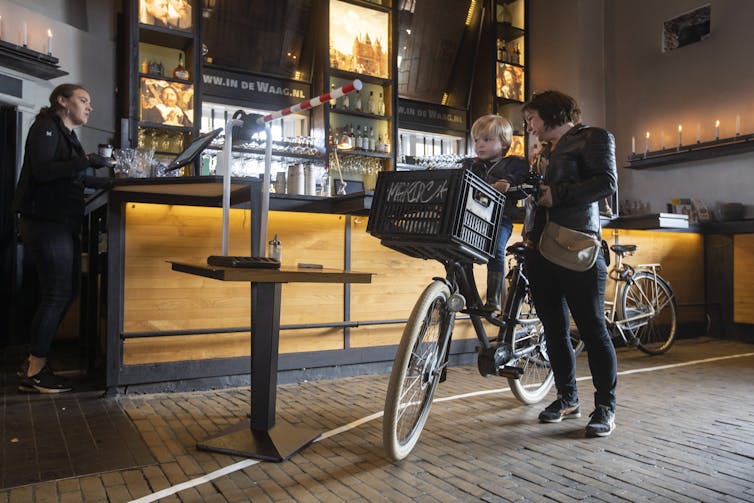
A mother and her child wait to collect their lunch at the bike-through of a restaurant in Amsterdam, Netherlands. (AP Photo/Peter Dejong)

Compared to many European bike-friendly cities like Copenhagen, which boasts a 62 per cent bicycle commuter rate, North American cities fall far behind.

Keeping new cyclists on the road

Some cities, like London, U.K., and Toronto, have closed roads to cars to make streets safer for cyclists and pedestrians. Major metropolitan cities like New York and Paris have passed bills to expand cycling infrastructure as a means to promote and maintain the accessibility and safety of cycling.

These measures, however, have been put in place in response to COVID-19 and physical distancing regulations. As cities reopen — and if transportation-related fears lessen — new cyclists may return to traditional modes of transportation, especially as the seasons bring colder weather to some cities.

So how do we get new cyclists to continue biking?

As exercise behaviour scientists, our research focuses on the factors that affect people’s motivation and intention to exercise. We’re also avid cyclists — and know what influences cycling in our communities.
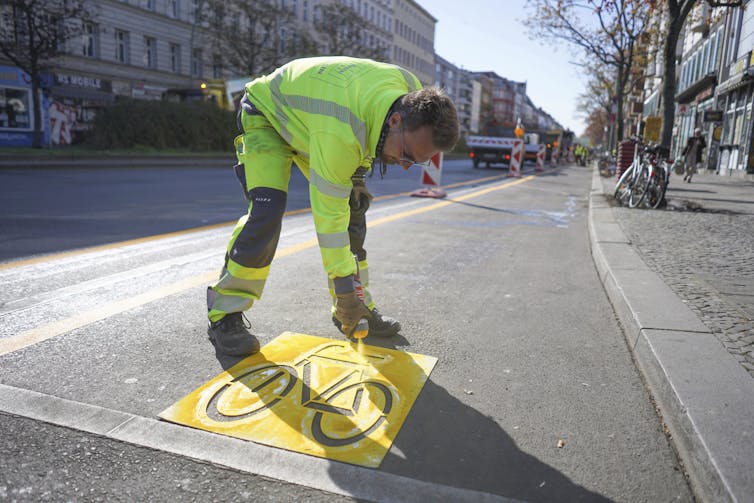
Berlin created temporary bicycle lanes to encourage people to ride bikes during the pandemic. (Joerg Carstensen/dpa via AP)

Three key factors that can facilitate and maintain cycling are safety, efficiency and cost. To address these factors, we recommend the following strategies:

Construct separated bike lanes: Safety is a paramount concern for all cyclists. Separating vehicle and foot traffic from cyclists increases safety for all groups, and should be a priority. A multi-city study found cities with protected and separated bike lanes showed 44 per cent fewer deaths, compared to an average city.

Connect existing bike networks: Many cyclists feel the connections from one bike route to another limit their cycling. Cities should identify popular routes and extend existing networks to support those routes. This will help create a more safe and efficient means of transportation.

Improve bike network maintenance during the winter: Snowy weather is a reality for cycling in Canada and parts of the U.S. Winter cyclists identify poor road surface maintenance as the primary deterrent to winter cycling — not the air temperature or weather. Some snowy countries, like Finland, make road and bike network maintenance during the winter a priority. Doing this means there are fewer cyclists on main roads and arteries, leading to a safer, quicker commute for all.

Incentivize cycling: We know cycling is hugely beneficial to health and well-being over the long term, yet people are rarely persuaded to start or continue a behaviour because of possible future rewards. Incentives, however, can help keep new cyclists on the road. Governments should offer tax deductions for bike-related purchases and services. Insurance companies should reduce premiums for bikers, as they do for non-smokers. Companies should make a bike purchase part of employee benefits, similar to the Cycle-to-Work and BiketoWork schemes popular in the U.K. and Ireland, respectively.

These strategies, taken together, will have the greatest impact on enhancing bike safety, optimizing travel time and making cycling more financially attractive than traditional modes of transportation.

Ultimately, these strategies also normalize cycling, further encouraging this new generation of cyclists to stick with it. Enacting these strategies can transform cycling from an alternative mode of transportation to the safest, fastest and most cost-effective mode of transportation, well beyond the duration of COVID-19.The Conversation


Wuyou Sui, PhD Candidate, Exercise and Health Psychology Lab, Western University and Harry Prapavessis, Professor, Kinesiology, Western University

This article is republished from The Conversation under a Creative Commons license. Read the original article.

Total
0
Shares
Share
Tweet
Share
Share
Related Topics
  • Air Pollution
  • Bike Paths
  • Biking
  • Coronavirus
  • Cycling
  • Public transit
  • Traffic accidents
dotlah.com

Previous Article
  • Lah!

NTU EcoLabs Launches Multi-million Scale-up Initiative To Support 40 Cleantech Maritime Start-ups And SMEs

  • August 4, 2020
View Post
Next Article
  • Technology

DBS Launches New Solutions To Bolster Singaporeans’ Retirement Plans And Financial Resilience Amid Tough Times

  • August 5, 2020
View Post
You May Also Like
View Post
  • Cities
  • Environment
  • People

Was Venezuela struck by an earthquake ‘doublet’? Here’s what we know so far

  • dotlah.com
  • June 27, 2026
View Post
  • Cities
  • Economy
  • Politics

The global price tag of war in the Middle East

  • dotlah.com
  • March 24, 2026
View Post
  • Cities
  • Food

How the Iran war could create a ‘fertiliser shock’ – an often ignored global risk to food prices and farming

  • dotlah.com
  • March 6, 2026
View Post
  • Cities
  • Climate Change
  • Science

New research may help scientists predict when a humid heat wave will break

  • dotlah.com
  • January 6, 2026
View Post
  • Cities

How bus stops and bike lanes can make or break your festive city trip

  • dotlah.com
  • December 29, 2025
View Post
  • Cities
  • People

We must empower local leaders to meet global goals – here’s why

  • dotlah.com
  • November 4, 2025
View Post
  • Cities

Politicians love comparing NZ’s economy to Singapore or Ireland – but it’s simplistic and misleading

  • dotlah.com
  • September 21, 2025
View Post
  • Cities
  • Technology

Meralco PowerGen’s PacificLight starts up 100 MW fast-response plant in Singapore

  • dotlah.com
  • June 20, 2025


Trending
  • 1
    • Cities
    • Economy
    India’s Smartphone Market Set To Surge
    • September 22, 2023
  • 2
    • Technology
    Ubuntu – For Developer, By Developer
    • August 26, 2017
  • 3
    • Cities
    Food Waste At East Coast Lagoon Food Village To Be Turned Into Energy And Fertiliser Under Pilot Project
    • November 17, 2021
  • 4
    • Lah!
    DBS Launches World’s First Sustainable And Transition Finance Framework And Taxonomy To Help Clients Advance On Sustainability Agenda
    • July 1, 2020
  • Hipster businessman commuter setting up electric bicycle when traveling home from work in city 5
    • Cities
    6 Convincing Reasons To Go All-Electric This Year
    • October 27, 2020
  • 6
    • Cities
    • Lah!
    Grab Partners APSN To Provide Training And Employment Opportunities To Students With Special Needs
    • October 21, 2021
  • goswifties_french-culture_20240511_wm 7
    • Featured
    Celebrating The Essence Of France That Shaped Its Culture.
    • May 15, 2024
  • 8
    • Cities
    • People
    The World’s Most Powerful Passports Of 2020
    • June 23, 2020
  • 9
    • Lah!
    Singapore And The Eurasian Economic Union Deepen Economic Relations Through A Free Trade Agreement
    • October 2, 2019
  • Autonomous systems need to be reliable, so NASA puts the code it develops through rigorous testing, like this Artemis I launch countdown training simulation, to avoid potential failures. 10
    • Science
    • Software
    • Technology
    NASA Software Catalog Offers Free Programs for Earth Science, More
    • August 10, 2023
  • 11
    • Lah!
    Project Ubin’s Fifth And Final Phase Highlights Commercial Potential, Paving Way Towards Live Adoption
    • July 15, 2020
  • 12
    • Lah!
    • Society
    DBS Delivers Care Packages And F&B Treats To Hospitals And Communities Across Singapore
    • February 25, 2020
Trending
  • 1
    Chinese tech giant Huawei unveils Mate 90 series smartphones with flagship Tau chips adopting logic folding technology
    • October 3, 2026
  • 2
    Google Opens Singapore Engineering Center to Build and Export Enterprise Cloud and AI to the World
    • September 15, 2026
  • 3
    Apple Flagship Hardware Launch for September 2026
    • September 10, 2026
  • 4
    MIT researchers tackle the economic realities of fusion power
    • August 10, 2026
  • 5
    ASEAN, treaty parties push stronger cooperation as Treaty of Amity and Cooperation in Southeast Asia marks 50 years
    • July 26, 2026
  • 6
    The Fastest AI Fried Chicken In The World
    • June 29, 2026
  • 7
    Zed Approves | How to Stay Cool in Extreme Heat
    • June 29, 2026
  • 8
    Was Venezuela struck by an earthquake ‘doublet’? Here’s what we know so far
    • June 27, 2026
  • 9
    Zed Approves | It’s Prime Day 2026! Time to Upgrade Your World Cup Viewing Setup and Beat the Heat
    • June 25, 2026
  • 10
    Zed Approves | The Best Prime Day PC Deals: Top Gaming Rigs, Workstations, and Everyday Laptops
    • June 25, 2026
Social Links
dotlah! dotlah!
  • Cities
  • Technology
  • Business
  • Politics
  • Society
  • Science
  • About
Connecting Dots Across Asia's Tech and Urban Landscape

Input your search keywords and press Enter.