COVID-19 has hit consumer industries hard. These industries employ 20% of all workers worldwide with retail as the world’s largest private-sector employer. In addition to staggering business struggles and even failures, however, the pandemic has also compelled a much-needed breakdown of long-held orthodoxies about where and how employees work.
Born out of disaster and necessity, these shifts in how work is done have given business leaders a chance to throw away the old employment playbook. The consumer industries can – and should – emerge from the pandemic with new models and a workforce that is sustainably engaged, inclusive, diverse and resilient.
The World Economic Forum’s Consumer Industries Action Group (IAG) has been grappling with how best to capture this opportunity. A series of IAG CEO discussions has begun to articulate a bold path forward, looking through three broad lenses that shape employment: the fundamental purpose of work, where work gets done; and how work gets done, including finding and developing employees.
1. The fundamental purpose of work
We propose that the idea of being a responsible business should not be considered as apart from growth and profit. The new employee value proposition must create a virtuous cycle, where purpose structurally and systemically drives employee development, enables inclusion and encourages economic development in underserved communities.
According to Accenture’s global COVID-19 Consumer Research, two-thirds of consumers expect companies to commit to higher ethical standards and be increasingly responsible to employees, customers, greater society and the environment in the wake of this pandemic. Meanwhile, a recent Global Shapers survey of 30,000 young people found that 40% viewed “an employer’s sense of purpose or impact on society” as the most important factor, after salary, in their decision to work for any company.
Statements of intent and charitable donations are unlikely to be seen as enough. All workers want to say: “My employer makes ethical decisions on behalf of society.”
2. Where work gets done
To follow through on purpose, we believe companies will need to start providing greater flexibility to build an inclusive workforce, without sacrificing productivity. Companies need a blended strategy supporting different parts of the workforce with combinations of in-person and distributed working.
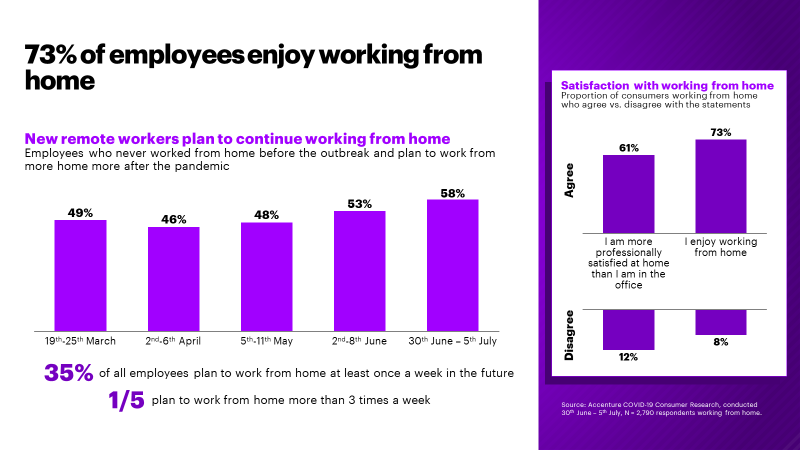
This requires challenging the work that needs to be done in person. COVID-19 has shattered long-standing assumptions. During this time, many employees who have been able to work from home have expressed high levels of satisfaction. Accenture’s study found more than half of employees felt they could collaborate more easily and be more productive at home; while one-third planned to work from home at least one day a week in the future.
But this is not just about office-based workers: consumer industry leaders are increasingly having conversations about distributed manufacturing models, where individual workers are spread across multiple locations, facilitated by remote monitoring and management. The conversation needs to extend as far as it can to retail working and other settings where face-to-face engagement is vital.
Widening the lens, such flexibility can create economic growth outside of pre-pandemic “talent hubs”. If employees can locate anywhere, companies have the potential to support economically challenged cities, smaller towns, and rural areas by bringing jobs to people, rather than requiring people to move to jobs. Done right, this offers a huge range of opportunities to address inequality.
Finally, flexible work can address barriers to inclusion. Guardian Life found that flexible work is a significant enabler for persons with disabilities. Ultimate Software study found that 57% of women working remotely in 2019 reported a promotion, compared to 35% of women working in traditional office environments. In 2019 research, Zapier found that female knowledge workers (62%) are more likely than male knowledge workers (53%) to indicate their preference for the option to work remotely and say they were most productive when working from home (50% vs 37%).
All of these ideas have enormous potential, but there are challenges to manage. Some executives in a recent Wall Street Journal article noted that projects are taking longer with collaboration becoming increasingly difficult. To solve this, companies need to actively design these new ways of working. Some are talking about creating small teams blending HR and technology skills to champion the art of the possible, actively designing how physical and virtual engagement can be best combined.
3. How work gets done, including finding and developing employees
In the coming months, executives will need answers to the following questions:
- How do we democratize decision-making across a far-flung workforce?
- How do we offer apprenticeships, develop and reward people?
- What mindset, management and mentoring approaches can supervisors embrace to ensure both productivity and control?
- How should we manage legal or regulatory factors?
The immediate next step is clear: we need collective industry action on talent availability and development.
Collaboration during COVID-19 has shown what’s possible. When employment needs spiked in supermarkets and other essential retailers while hotels furloughed workers, leaders such as Walmart and Marriott joined the People + Work Connect platform to match underutilized workers with jobs. Companies can come together for the common good.
Remote working can further enable the use of “liquid” workforces, including affiliates, freelancers and consumers themselves. Cross-company professional certifications will enable this, making it easier for businesses to source the right talent. As the industry continues to pivot towards new skills, companies should partner closely with education and government to reskill workers over their entire lifetimes – for example, programmes such as Singapore’s SkillsFuture. Collaborating across the industry to enable life-long learning could be one of the positive legacies of COVID-19.
Global survey findings are consistent: employees don’t want to return to old ways of working. It is up to business leaders to determine how far the consumer industries will develop in a way that is far better for workers, companies and the world at large.
Oliver Wright, Global Lead for Consumer Goods and Services, Accenture
Zara Ingilizian, Head of Shaping the Future of Consumption; Member of the Executive Committee, World Economic Forum
Republished from the World Economic Forum