dotlah! dotlah!
  • Cities
  • Technology
  • Business
  • Politics
  • Society
  • Science
  • About
Social Links
  • zedreviews.com
  • citi.io
  • aster.cloud
  • liwaiwai.com
  • guzz.co.uk
  • atinatin.com
0 Likes
0 Followers
0 Subscribers
dotlah!
  • Cities
  • Technology
  • Business
  • Politics
  • Society
  • Science
  • About
  • Science

Using The ‘Shadow-effect’ To Generate Electricity

  • May 27, 2020
Total
0
Shares
0
0
0

Shadows are often associated with darkness and uncertainty. Now, NUS researchers are giving shadows a positive spin by demonstrating a way to harness this common but often overlooked optical effect to generate electricity. This novel concept opens up new approaches in generating green energy under indoor lighting conditions to power electronics.

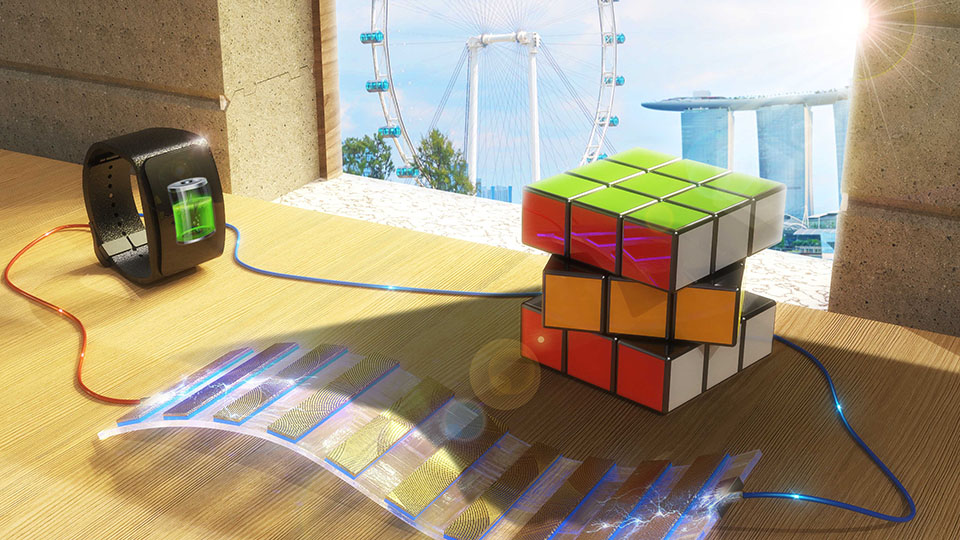
The novel shadow-effect energy generator developed by NUS researchers uses the contrast in illumination between the lit and shadowed areas to generate electricity. (Photo: Royal Society of Chemistry)

A team from NUS Materials Science and Engineering as well as NUS Physics created a device called a shadow-effect energy generator (SEG), which makes use of the contrast in illumination between lit and shadowed areas to generate electricity. Their research breakthrough was reported in the scientific journal Energy & Environmental Science on 15 April 2020.

“Shadows are omnipresent, and we often take them for granted. In conventional photovoltaic or optoelectronic applications where a steady source of light is used to power devices, the presence of shadows is undesirable, since it degrades the performance of devices. In this work, we capitalised on the illumination contrast caused by shadows as an indirect source of power. The contrast in illumination induces a voltage difference between the shadow and illuminated sections, resulting in an electric current. This novel concept of harvesting energy in the presence of shadows is unprecedented,” explained research team leader Assistant Professor Tan Swee Ching, who is from NUS Materials Science and Engineering.

Mobile electronic devices such as smart phones, smart glasses and e-watches require efficient and continuous power supply. As these devices are worn both indoors and outdoors, wearable power sources that could harness ambient light can potentially improve the versatility of these devices. While commercially available solar cells can perform this role in an outdoor environment, their energy harvesting efficiency drops significantly under indoor conditions where shadows are persistent. This new approach to scavenge energy from both illumination and shadows associated with low light intensities to maximise the efficiency of energy harvesting is both exciting and timely.

To address this technological challenge, the NUS team developed a low-cost, easy-to-fabricate SEG to perform two functions: (1) to convert illumination contrast from partial shadows castings into electricity, and (2) to serve as a self-powered proximity sensor to monitor passing objects.

Generating electricity using the ‘shadow-effect’

The SEG comprises a set of SEG cells arranged on a flexible and transparent plastic film. Each SEG cell is a thin film of gold deposited on a silicon wafer. Carefully designed, the SEG can be fabricated at a lower cost compared to commercial silicon solar cells. The team then conducted experiments to test the performance of the SEG in generating electricity and as a self-powered sensor.

“When the whole SEG cell is under illumination or in shadow, the amount of electricity generated is very low or none at all. When a part of the SEG cell is illuminated, a significant electrical output is detected. We also found that the optimum surface area for electricity generation is when half of the SEG cell is illuminated and the other half in shadow, as this gives enough area for charge generation and collection respectively,” said co-team leader Professor Andrew Wee, who is from NUS Physics.  

Based on laboratory experiments, the team’s four-cell SEG is twice as efficient when compared with commercial silicon solar cells, under the effect of shifting shadows. The harvested energy from the SEG in the presence of shadows created under indoor lighting conditions is sufficient to power a digital watch (i.e. 1.2 V).

In addition, the team also showed that the SEG can serve as a self-powered sensor for monitoring moving objects. When an object passes by the SEG, it casts an intermittent shadow on the device and triggers the sensor to record the presence and movement of the object.

Towards lower cost and more functionalities

The six-member team took four months to conceptualise, develop and perfect the performance of the device. In the next phase of research, the NUS team will experiment with other materials, besides gold, to reduce the cost of the SEG.

The NUS researchers are also looking at developing self-powered sensors with versatile functionalities, as well as wearable SEGs attached to clothing to harvest energy during normal daily activities. Another promising area of research is the development of low-cost SEG panels for efficient harvesting of energy from indoor lighting.


Total
0
Shares
Share
Tweet
Share
Share
Related Topics
  • Electricity
  • Green Energy
  • National University of Singapore
  • NUS
  • NUS Materials Science and Engineering
  • NUS Physics
  • Shadow-Effect
  • Sustainability
dotlah.com

Previous Article
  • Society

In Conjunction With Kindness Day SG, BT BAF Beneficiaries And Certis Continue To Give Back To The Community Despite The COVID-19 Circuit Breaker

  • May 27, 2020
View Post
Next Article
  • Science
  • Technology

Space Exploration Is Still The Brightest Hope-Bringer We Have

  • May 27, 2020
View Post
You May Also Like
View Post
  • Cities
  • Climate Change
  • Science

New research may help scientists predict when a humid heat wave will break

  • dotlah.com
  • January 6, 2026
Semiconductor
View Post
  • Computing
  • Science

Decoding The Digital. Distinguishing Computer Science And Information Technology In Society And Industry.

  • Dean Marc
  • May 2, 2024
View Post
  • Artificial Intelligence
  • Data
  • Research
  • Science

Generative AI Could Offer A Faster Way To Test Theories Of How The Universe Works

  • dotlah.com
  • March 17, 2024
Mercury
View Post
  • Science
  • Technology

Study: Global Deforestation Leads To More Mercury Pollution

  • dotlah.com
  • February 14, 2024
View Post
  • Science
  • Technology

Higher, Faster: What Influences The Aerodynamics Of A Football?

  • dotlah.com
  • February 11, 2024
View Post
  • Artificial Intelligence
  • Science
  • Technology

A Glimpse Of The Next Generation Of AlphaFold

  • dotlah.com
  • November 6, 2023
View Post
  • Artificial Intelligence
  • Machine Learning
  • Science
  • Technology

AI in the Classroom: Amii’s K-12 Pilot Program

  • dotlah.com
  • October 23, 2023
View Post
  • Science
  • Technology

Learning How To Learn

  • John Francis
  • October 23, 2023


Trending
  • 1
    • Lah!
    IPOS To Roll Out More Initiatives To Help Businesses Use IP To Thrive Amid COVID-19
    • August 27, 2020
  • 2
    • Cities
    • People
    Which Countries Have The Richest Adults?
    • June 17, 2020
  • 3
    • Cities
    • Technology
    Sembcorp Industries To Acquire 658MW Of Operational Wind And Solar Assets In China
    • November 14, 2021
  • First IBM Quantum Data Center in Europe Opens 4
    • Computing
    • Technology
    First IBM Quantum Data Center In Europe Opens; Will Include Ibm’s Most Performant Quantum Systems
    • October 1, 2024
  • 5
    • Artificial Intelligence
    • Technology
    U.S. Ski & Snowboard and Google Announce Collaboration to Build an AI-Based Athlete Performance Tool
    • February 8, 2026
  • 6
    • Cities
    • Lah!
    NEA Reminds Diners To Return Trays And Crockery And Clear Table Litter As Dine-In Resumes
    • June 23, 2021
  • 7
    • Cities
    Life In A Big City When You Are A Student
    • March 25, 2020
  • 8
    • Technology
    Majority Of Customers Likely To Stick To Existing Primary Banking Relationship After Opening Digital Bank Accounts, PwC Study
    • February 11, 2020
  • 9
    • Lah!
    • Technology
    Singapore’s Tech Sector Steps Forward To Offer Suite Of ICT Solutions To Businesses Affected By COVID-19
    • March 6, 2020
  • 10
    • Business
    • People
    Fast Loans With Bad Credit: 5 Best Companies To Go To
    • August 27, 2020
  • 11
    • Science
    Viral Vaccines Simplified: How Are They Made?
    • April 28, 2020
  • 12
    • Technology
    Singtel And Nokia To Trial 5G Network Slicing Capabilities
    • March 3, 2020
Trending
  • 1
    Chinese tech giant Huawei unveils Mate 90 series smartphones with flagship Tau chips adopting logic folding technology
    • October 3, 2026
  • 2
    Google Opens Singapore Engineering Center to Build and Export Enterprise Cloud and AI to the World
    • September 15, 2026
  • 3
    Apple Flagship Hardware Launch for September 2026
    • September 10, 2026
  • 4
    MIT researchers tackle the economic realities of fusion power
    • August 10, 2026
  • 5
    ASEAN, treaty parties push stronger cooperation as Treaty of Amity and Cooperation in Southeast Asia marks 50 years
    • July 26, 2026
  • 6
    The Fastest AI Fried Chicken In The World
    • June 29, 2026
  • 7
    Zed Approves | How to Stay Cool in Extreme Heat
    • June 29, 2026
  • 8
    Was Venezuela struck by an earthquake ‘doublet’? Here’s what we know so far
    • June 27, 2026
  • 9
    Zed Approves | It’s Prime Day 2026! Time to Upgrade Your World Cup Viewing Setup and Beat the Heat
    • June 25, 2026
  • 10
    Zed Approves | The Best Prime Day PC Deals: Top Gaming Rigs, Workstations, and Everyday Laptops
    • June 25, 2026
Social Links
dotlah! dotlah!
  • Cities
  • Technology
  • Business
  • Politics
  • Society
  • Science
  • About
Connecting Dots Across Asia's Tech and Urban Landscape

Input your search keywords and press Enter.