Scientists from Nanyang Technological University, Singapore (NTU Singapore) and the Agency for Science, Technology and Research (A*STAR) have showed that applying “temporal pressure” to the skin of mice can create a new way to deliver drugs.

In a paper published in Science Advances, the researchers showed that bringing together two magnets so that they pinch and apply pressure to a fold of skin, led to short term changes in the skin barrier and specifically the formation of “micropores” underneath its surface.
In tests, they showed that these micropores, of about 3 micrometres in area, allowed drugs applied on the surface of the skin to diffuse through it more easily. Six times greater quantity of drug diffused through the skin of mice with the micropores compared to the skin of mice which did not receive the temporal pressure treatment.
Lead author of the paper, Dr Daniel Lio, who did this research as part of his doctoral thesis at NTU’s School of Chemical and Biomedical Engineering, Interdisciplinary Graduate Programme, said that while needles and microneedle injections damage the skin, micropores could pave the way towards painless transdermal delivery of drugs such as insulin.
“Our research project was first inspired by the traditional Chinese medicine ‘tuina’ therapy where physicians rub and apply pressure on skin and muscle tissue and apply a topical ointment,” explained Dr Lio, who is now working at A*STAR’s Enterprise Group.
Going a step further, the joint team which included Prof David Laurence Becker from NTU Lee Kong Chian School of Medicine and Skin Research Institute of Singapore; Assoc Prof Wang Xiaomeng from the NTU Lee Kong Chian School of Medicine, and Assistant Prof Xu Chenjie from the School of Chemical and Biomedical Engineering, tested the delivery of insulin through the skin of mice using the new method.
Reducing skin damage and pain from delivering drugs through skin
Experimental results showed that nanoparticles and insulin were effectively delivered through the skin of mice, at molecular masses up to 20,000 daltons.
This mass is 40 times the largest currently reported in the scientific literature for transdermal drug delivery (i.e. via patches), which is 500 daltons.
The amount of drug delivered via the temporal pressure method was also comparable to the amount delivered by a microneedle patch – dozens of needles smaller than the width of a human hair made from biocompatible compounds, commonly used to deliver small amounts of drugs through the skin over time.
Compared to conventional injection where the skin has to be penetrated and there is a risk of a hypoglycaemia effect – when the injected insulin acts too fast and the patient gets dizzy – the new method is able to slowly deliver drugs over time without breaking the skin, thus causing less pain.
In experiments, the team also found that with their method, cells in the skin layer (epidermis) were observed to have an increase in the number of “gap junctions” and a reduction in “tight junctions”. These junctions control the amount of molecules being delivered between the cells: if there is an increased expression of gap junctions, more molecules can be delivered across the cell barrier, while tight junctions restrict the extracellular movement of molecules.
In the animal experiments, two magnets were used to apply pressure on the mouse dorsal skin for 1 or 5 minutes, depending on how fast the drug delivery is needed, before being removed and the drug is then topically applied like a cream.
The team hypothesised that for drugs that need to be delivered more slowly or in smaller doses – 1 minute would be sufficient, while for drugs to be delivered faster, more micropores would be needed, therefore 5 minutes would be required.
The drug was then left for 12 hours before the skin was imaged with fluorescent microscopy to see to what extent the drug had penetrated through the skin.
The team compared three types of skin: skin that received pressure treatment, skin which had not, and skin which had drugs delivered through microneedles.
Skin that received pressure treatment had similar amounts of drug delivered through the skin to that found with a microneedle patch, while skin that did not receive the pressure treatment had significantly less drug delivered.
Micropores were also observed to disappear a day after they were formed, which suggests that the skin cells have filled up the gaps.
Prof Becker, whose research expertise is in tissue repair and regeneration, said their paper highlighted the potential to use this method which could alleviate the need for diabetes patients to inject insulin multiple times daily using conventional needles and syringes.
“Patients who have to inject drugs daily, such as insulin, are constantly asking whether there is another way to deliver their medicines that doesn’t involve hurting or penetrating the skin. Our new findings hold promise for them and we hope that we can refine this method so that one day it may be possible to deliver enough drugs through the skin via a patch and to rid them of their daily injections,” Prof Becker added.
This multidisciplinary project, supported by the Skin Research Institute of Singapore (SRIS) – a collaboration between A*STAR, National Skin Center (NSC) and NTU, took two years and is continuing.
It is also supported by multiple grants from various agencies, which include A*STAR, SRIS, and the National Medical Research Council.
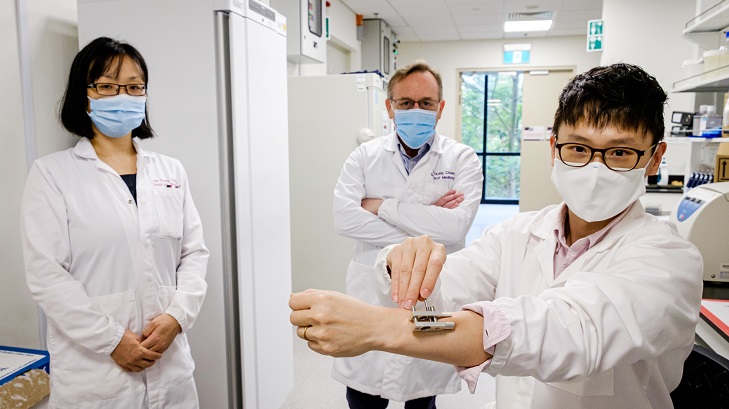
The team has since filed a patent for a pressure device, which looks like a vice-like clamp for the skin, through NTU’s innovation and enterprise company, NTUtive, and is currently carrying out further experiments to refine the drug delivery mechanism.
About Nanyang Technological University, Singapore
A research-intensive public university, Nanyang Technological University, Singapore (NTU Singapore) has 33,000 undergraduate and postgraduate students in the Engineering, Business, Science, Humanities, Arts, & Social Sciences, and Graduate colleges. It also has a medical school, the Lee Kong Chian School of Medicine, established jointly with Imperial College London.
NTU is also home to world-renowned autonomous institutes – the National Institute of Education, S Rajaratnam School of International Studies, Earth Observatory of Singapore, and Singapore Centre for Environmental Life Sciences Engineering – and various leading research centres such as the Nanyang Environment & Water Research Institute (NEWRI) and Energy Research Institute @ NTU (ERI@N).
Ranked amongst the world’s top universities by QS, NTU has also been named the world’s top young university for the last seven years. The University’s main campus is frequently listed among the Top 15 most beautiful university campuses in the world and it has 57 Green Mark-certified (equivalent to LEED-certified) building projects, of which 95% are certified Green Mark Platinum. Apart from its main campus, NTU also has a campus in Singapore’s healthcare district.
Under the NTU Smart Campus vision, the University harnesses the power of digital technology and tech-enabled solutions to support better learning and living experiences, the discovery of new knowledge, and the sustainability of resources.
For more information, visit www.ntu.edu.sg
About the Agency for Science, Technology and Research (A*STAR)
The Agency for Science, Technology and Research (A*STAR) is Singapore’s lead public sector R&D agency, spearheading economic-oriented research to advance scientific discovery and develop innovative technology. Through open innovation, we collaborate with our partners in both the public and private sectors to benefit society.
As a Science and Technology Organisation, A*STAR bridges the gap between academia and industry. Our research creates economic growth and jobs for Singapore, and enhances lives by contributing to societal benefits such as improving outcomes in healthcare, urban living, and sustainability.
We play a key role in nurturing and developing a diversity of talent and leaders in our Agency and research entities, the wider research community and industry. A*STAR’s R&D activities span biomedical sciences and physical sciences and engineering, with research entities primarily located in Biopolis and Fusionopolis. For ongoing news, visit www.a-star.edu.sg.
Follow us on
Facebook | LinkedIn | Instagram | YouTube