dotlah! dotlah!
  • Cities
  • Technology
  • Business
  • Politics
  • Society
  • Science
  • About
Social Links
  • zedreviews.com
  • citi.io
  • aster.cloud
  • liwaiwai.com
  • guzz.co.uk
  • atinatin.com
0 Likes
0 Followers
0 Subscribers
dotlah!
  • Cities
  • Technology
  • Business
  • Politics
  • Society
  • Science
  • About
  • Lah!
  • Technology

NUS Engineers Devise Novel Approach To Wirelessly Power Multiple Wearable Devices Using A Single Source

  • June 15, 2021
Total
0
Shares
0
0
0

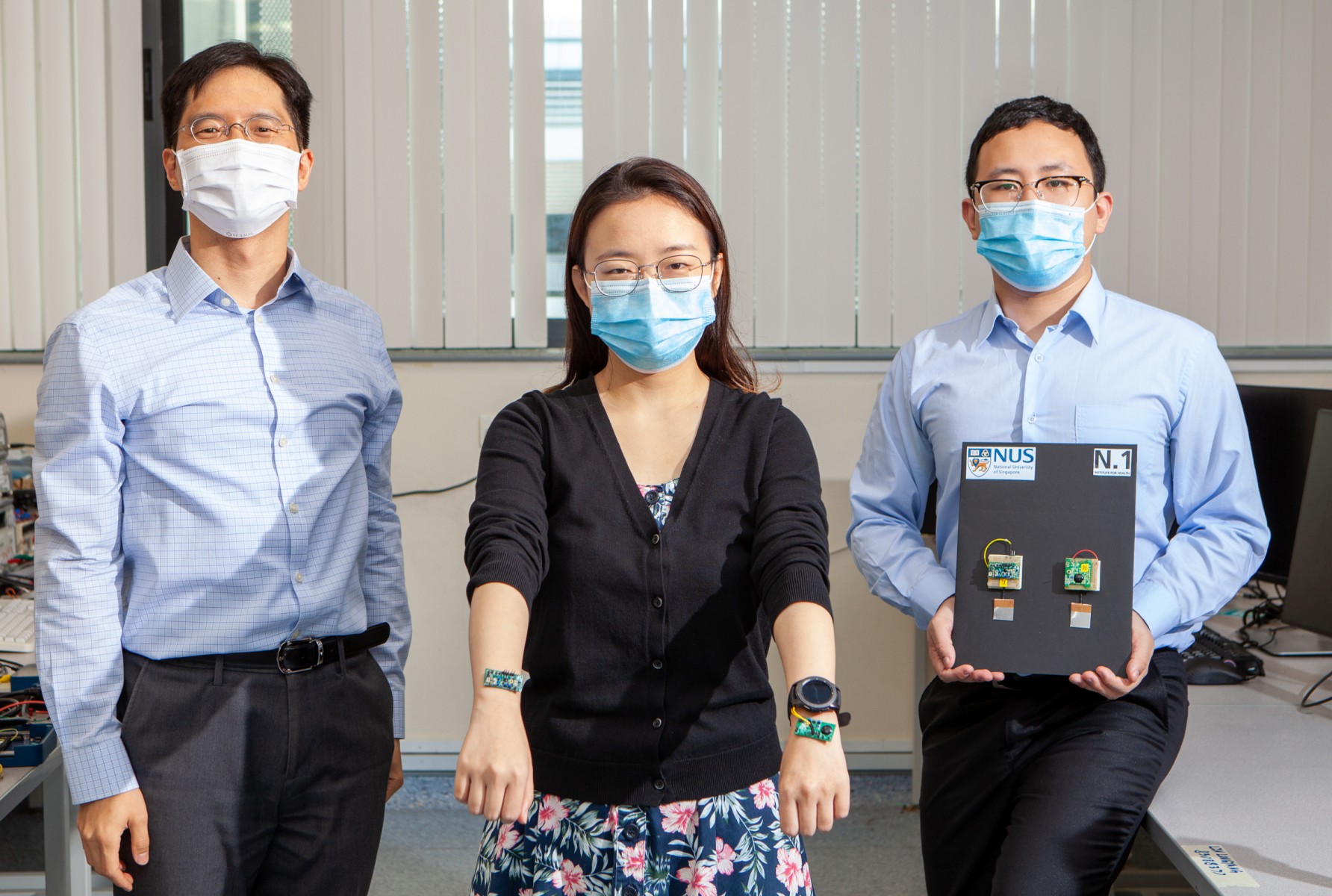
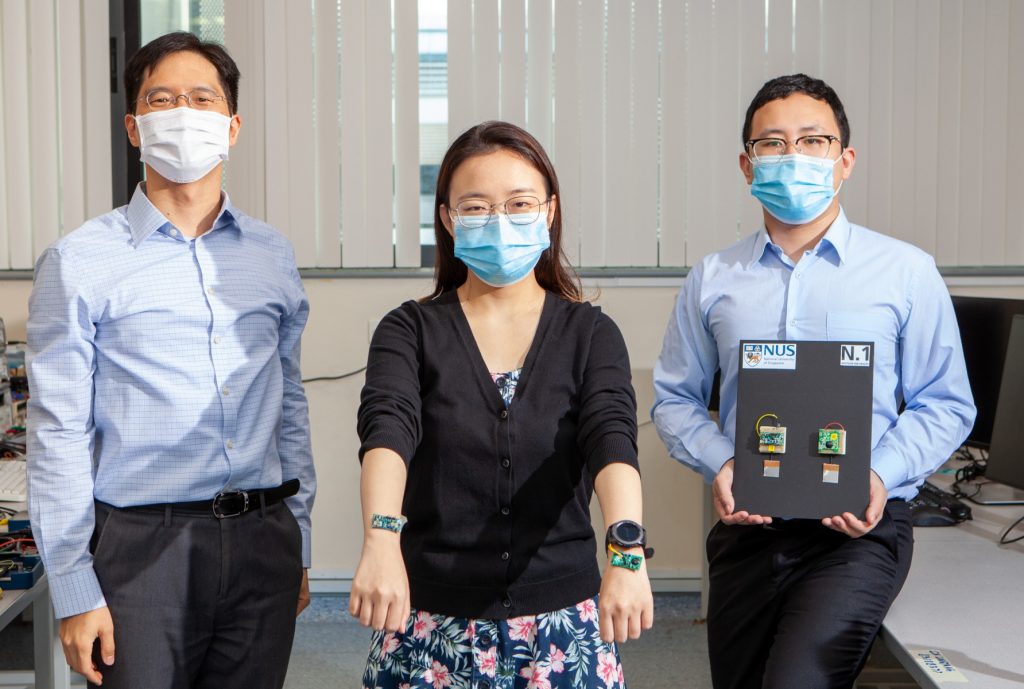
A team led by Associate Professor Jerald Yoo (left) has developed a novel wireless powering solution for wearables. With him are two team members: Ms Li Jiamin (centre), who has a transmitter on her right wrist and a receiver connected to a smart watch on her left wrist, and Mr Dong Yilong (right) who is holding a panel displaying the technology.

Advancements in wearable technology are reshaping the way we live, work and play, and also how healthcare is delivered and received. Wearables that have weaved their way into everyday life include smart watches and wireless earphones, while in the healthcare setting, common devices include wearable injectors, electrocardiogram (ECG) monitoring patches, listening aids, and more.

A major pain point facing the use of these wearables is the issue of keeping these devices properly and conveniently powered. As the number of wearables one uses increases, the need to charge multiple batteries rises in tandem, consuming huge amounts of electricity. Many users find it cumbersome to charge numerous devices every day, and inconvenient service disruptions occur when batteries run out.

A research team, led by Associate Professor Jerald Yoo from the Department of Electrical and Computer Engineering and the N.1 Institute for Health at the National University of Singapore (NUS), has developed a solution to these problems. Their technology enables a single device, such as a mobile phone placed in the pocket, to wirelessly power other wearable devices on a user’s body, using the human body as a medium for power transmission. The team’s novel system has an added advantage – it can harvest unused energy from electronics in a typical home or office environment to power the wearables.

Their achievement was first published in the journal Nature Electronics on 10 June 2021. It is the first of its kind to be established among existing literature on electronic wearables.

Using the human body as a medium for power transmission

To extend battery life and sustain fully autonomous – yet wireless – operations of wearable devices, power transmission and energy harvesting approaches are required. However, conventional approaches for powering up body area wearables are limited by the distance that power can be transmitted, the “path” the energy can travel without facing obstacles, and the stability of energy movement. As such, none of the current methods have been able to provide sustainable power to wearables placed around the entire human body.

The NUS team decided to turn the tables on these limitations by designing a receiver and transmitter system that uses the very obstacle in wireless powering – the human body – as a medium for power transmission and energy harvesting. Each receiver and transmitter contains a chip that is used as a springboard to extend coverage over the entire body.

A user just needs to place the transmitter on a single power source, such as the smart watch on a user’s wrist, while multiple receivers can be placed anywhere on the person’s body. The system then harnesses energy from the source to power multiple wearables on the user’s body via a process termed as body-coupled power transmission. In this way, the user will only need to charge one device, and the rest of the gadgets that are worn can simultaneously be powered up from that single source. The team’s experiments showed that their system allows a single power source that is fully charged to power up to 10 wearable devices on the body, for a duration of over 10 hours.

As a complementary source of power, the NUS team also looked into harvesting energy from the environment. Their research found that typical office and home environments have parasitic electromagnetic (EM) waves that people are exposed to all the time, for instance, from a running laptop. The team’s novel receiver scavenges the EM waves from the ambient environment, and through a process referred to as body-coupled powering, the human body is able to harvest this energy to power the wearable devices, regardless of their locations around the body.

Paving the way for smaller, battery-less wearables

On the benefits of his team’s method, Assoc Prof Yoo said, “Batteries are among the most expensive components in wearable devices, and they add bulk to the design. Our unique system has the potential to omit the need for batteries, thereby enabling manufacturers to miniaturise the gadgets while reducing production cost significantly. More excitingly, without the constraints of batteries, our development can enable the next generation wearable applications, such as ECG patches, gaming accessories, and remote diagnostics.”

The NUS team will continue to enhance the powering efficiency of their transmitter/receiver system, with hopes that in future, any given power-transmitting device, be it a user’s mobile phone or smart watch, can satisfy the network power demands of all other wearables on the body, thus enabling a longer battery lifetime.

Total
0
Shares
Share
Tweet
Share
Share
Related Topics
  • National University of Singapore
  • NUS
  • Wearables
dotlah.com

Previous Article
  • Cities
  • Lah!

SGX Launches The World’s First ESG REIT Derivatives

  • June 15, 2021
View Post
Next Article
The G7 plan to donate a billion COVID-19 vaccine doses to poorer countries. Image: REUTERS
  • People
  • World Events

Everything you need to know about the G7’s plan to donate 1 billion vaccine doses

  • June 15, 2021
View Post
You May Also Like
View Post
  • Artificial Intelligence
  • Technology

Google Opens Singapore Engineering Center to Build and Export Enterprise Cloud and AI to the World

  • Dean Marc
  • September 15, 2026
View Post
  • Research
  • Technology

MIT researchers tackle the economic realities of fusion power

  • dotlah.com
  • August 10, 2026
zedreviews-valerion
View Post
  • Gears
  • Technology

Father’s Day Outdoors – Build Dad the Ultimate Backyard Watch Party

  • Dean Marc
  • June 21, 2026
zedreviews-fathers-day-50830
View Post
  • Gears
  • Technology

Father’s Day Outdoors, Round Two – Gear for the Action, the Tailgate, and Beating the Heat

  • Dean Marc
  • June 21, 2026
zedreviews-fathers-day-21306
View Post
  • Gears
  • Technology

A Father’s Day Gift Guide for Every Dad – Timepieces and Travel Gear

  • Dean Marc
  • June 21, 2026
View Post
  • Gears
  • Technology

Samsung Art Store Brings Art Basel to Homes Worldwide With New Curated Collection

  • Dean Marc
  • June 15, 2026
View Post
  • Artificial Intelligence
  • Technology

The consequences of relying on AI for accurate news

  • dotlah.com
  • June 10, 2026
pope-leo-xiv-cq5dam-1500.844
View Post
  • Artificial Intelligence
  • Technology

Pope Leo XIV to Publish First Encyclical on Artificial Intelligence and Human Dignity on 25 May

  • dotlah.com
  • May 23, 2026


Trending
  • 1
    • Technology
    Ahead Of The Curve: Singapore’s Approach To 5G
    • October 17, 2019
  • 2
    • People
    Singapore Airlines to Add Services Across Europe, Launch New Flights to Madrid in October 2026
    • May 8, 2026
  • 3
    • Lah!
    Park Hotel Group Secures Its First Green Loan Of S$237 Million Under The UOB Real Estate Sustainable Finance Framework
    • February 26, 2020
  • 4
    • People
    • World Events
    How Much Do Countries Spend On Their Health Systems?
    • April 13, 2020
  • europe-map-globe-christian-lue-7dEyTJ7-8os-unsplash 5
    • Features
    • People
    Where You Can Buy Residence Permits
    • February 19, 2023
  • 6
    • Lah!
    • Society
    DBS Is Sole Company In ASEAN In Top Global Quartile Of Bloomberg’s Gender-Equality Index
    • January 30, 2021
  • 7
    • Cities
    • Lah!
    UOB Strengthens Its Multi-Generation Workforce Strategy With Gig Opportunities For Retirees
    • November 7, 2021
  • 8
    • Lah!
    • Science
    New Antibody Drug To Potentially Treat Cancer
    • August 5, 2019
  • 9
    • Cities
    • People
    • World Events
    History Tells Us Trying To Stop Diseases Like COVID-19 At The Border Is A Failed Strategy
    • September 2, 2020
  • 10
    • Lah!
    • Technology
    Singapore’s Tech Sector Steps Forward To Offer Suite Of ICT Solutions To Businesses Affected By COVID-19
    • March 6, 2020
  • Food 11
    • People
    • Technology
    Farmers In India Are Using AI For Agriculture – Here’s How They Could Inspire The World
    • January 24, 2024
  • Twitter X 12
    • People
    • Technology
    Twitter’s Rebrand To X Shifts The Focus To Musk’s ‘Everything App’ Plans But Here’s Why He Might Have Moved Too Early
    • July 29, 2023
Trending
  • 1
    Chinese tech giant Huawei unveils Mate 90 series smartphones with flagship Tau chips adopting logic folding technology
    • October 3, 2026
  • 2
    Google Opens Singapore Engineering Center to Build and Export Enterprise Cloud and AI to the World
    • September 15, 2026
  • 3
    Apple Flagship Hardware Launch for September 2026
    • September 10, 2026
  • 4
    MIT researchers tackle the economic realities of fusion power
    • August 10, 2026
  • 5
    ASEAN, treaty parties push stronger cooperation as Treaty of Amity and Cooperation in Southeast Asia marks 50 years
    • July 26, 2026
  • 6
    The Fastest AI Fried Chicken In The World
    • June 29, 2026
  • 7
    Zed Approves | How to Stay Cool in Extreme Heat
    • June 29, 2026
  • 8
    Was Venezuela struck by an earthquake ‘doublet’? Here’s what we know so far
    • June 27, 2026
  • 9
    Zed Approves | It’s Prime Day 2026! Time to Upgrade Your World Cup Viewing Setup and Beat the Heat
    • June 25, 2026
  • 10
    Zed Approves | The Best Prime Day PC Deals: Top Gaming Rigs, Workstations, and Everyday Laptops
    • June 25, 2026
Social Links
dotlah! dotlah!
  • Cities
  • Technology
  • Business
  • Politics
  • Society
  • Science
  • About
Connecting Dots Across Asia's Tech and Urban Landscape

Input your search keywords and press Enter.