dotlah! dotlah!
  • Cities
  • Technology
  • Business
  • Politics
  • Society
  • Science
  • About
Social Links
  • zedreviews.com
  • citi.io
  • aster.cloud
  • liwaiwai.com
  • guzz.co.uk
  • atinatin.com
0 Likes
0 Followers
0 Subscribers
dotlah!
  • Cities
  • Technology
  • Business
  • Politics
  • Society
  • Science
  • About
  • Lah!
  • Technology

NUS Researchers Bring Attack-Proof Quantum Communication Two Steps Forward

  • July 9, 2021
Total
0
Shares
0
0
0

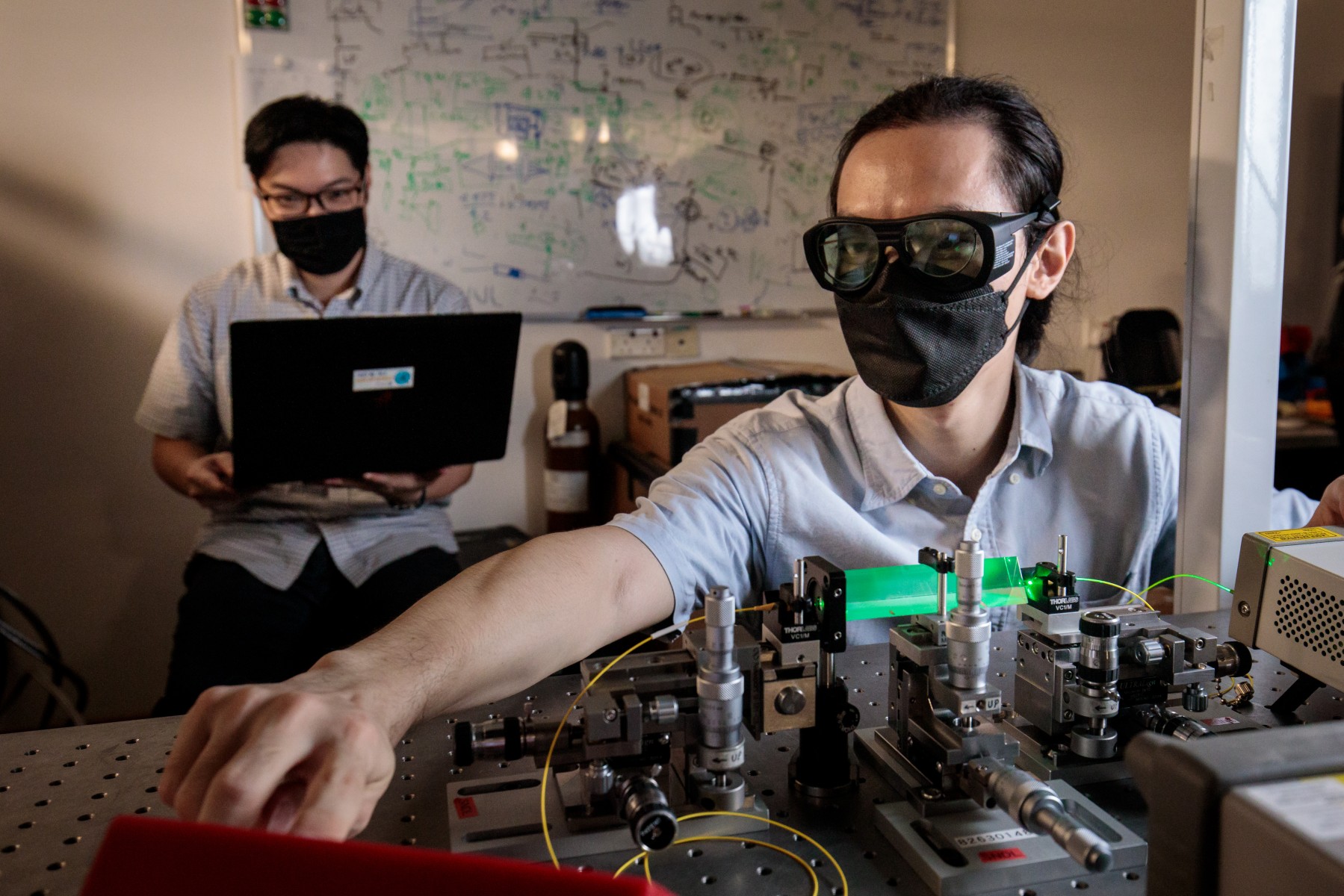
Assistant Professor Charles Lim (back) and Dr Zhang Gong (front) with their team’s first-of-its-kind quantum power limiter device.

Quantum key distribution (QKD) is a method for secure communication that uses quantum mechanics to encrypt information. While the security of QKD is unbreakable in principle, if it is incorrectly implemented, vital information could still be stolen by attackers. These are known as side-channel attacks, where the attackers exploit weaknesses in the setup of the information system to eavesdrop on the exchange of secret keys.

Researchers from the National University of Singapore (NUS) have developed two methods, one theoretical and one experimental, to ensure that QKD communications cannot be attacked in this way. The first is an ultra-secure cryptography protocol that can be deployed in any communication network that needs long-term security. The second is a first-of-its-kind device that defends QKD systems against bright light pulse attacks by creating a power threshold.

“Rapid advances in quantum computing and algorithmic research mean we can no longer take today’s toughest security software for granted. Our two new approaches hold promise to ensuring that the information systems which we use for banking, health and other critical infrastructure and data storage can hold up any potential future attacks,” said Assistant Professor Charles Lim, from the NUS Department of Electrical and Computer Engineering and Centre for Quantum Technologies, who led the two research projects.

Future-proof quantum communication protocol

Typically, in QKD, two measurement settings are used – one to generate the key and the other to test the integrity of the channel. In a paper published in the journal Nature Communications on 17 May 2021, the NUS team showed that with their new protocol, users can independently test the other party’s encryption device by generating a secret key from two randomly chosen key generation settings instead of one. The researchers demonstrated that introducing an extra set of key-generating measurements for the users makes it harder for the eavesdropper to steal information.

“It’s a simple variation of the original protocol that started this field, but it can only be tackled now thanks to significant developments in mathematical tools,” said Professor Valerio Scarani, who was one of the inventors of this type of method and is a co-author of the paper. He is from the NUS Department of Physics and Centre for Quantum Technologies.

Compared to the original ‘device-independent’ QKD protocol, the new protocol is easier to set up, and is more tolerant to noise and loss. It also gives users the highest level of security allowable by quantum communications and empowers them to independently verify their own key generation devices.

With the team’s setup, all information systems built with ‘device-independent’ QKD would be free from misconfiguration and mis-implementation. “Our method allows data to be safe against attackers even if they have unlimited quantum computing power. This approach could lead to a truly secure information system, eliminating all side-channel attacks and allowing end-users to monitor its implementation security easily and with confidence,” explained Asst Prof Lim.

A first-of-its-kind quantum power limiter device

Quantum cryptography, in practice, uses optical pulses with very low light intensity to exchange data over untrusted networks. Leveraging quantum effects can securely distribute secret keys, generate truly random numbers, and even create banknotes that are mathematically unforgeable.

However, experiments have shown that it is possible to inject bright light pulses into the quantum cryptosystem to break its security. This side-channel attack strategy exploits the way injected bright light is reflected to the outside environment, to reveal the secrets being kept in the quantum cryptosystem.

In a new paper published in PRX Quantum on 7 July 2021, the NUS researchers reported their development of the first optical device to address the issue. It is based on thermo-optical defocusing effects to limit the energy of the incoming light. The researchers use the fact that the energy of the bright light changes the refractive index of the transparent plastic material embedded in the device, thus it sends a fraction of the light out of the quantum channel. This enforces a power limiting threshold.

The NUS team’s power limiter can be seen as an optical equivalent of an electric fuse, except that it is reversible and does not burn when the energy threshold is breached. It is highly cost-effective, and can be easily manufactured with off-the-shelf components. It also does not require any power, so it can be easily added to any quantum cryptography system to strengthen its implementation security.

Asst Prof Lim added, “It is imperative to close the gap between the theory and practice of quantum secure communications if we are to use it for the future Quantum Internet. We do this holistically – on one hand, we design more practical quantum protocols, and on the other hand, we engineer quantum devices that conform closely with the mathematical models assumed by the protocols. In doing so, we can significantly narrow the gap.”

 

Total
0
Shares
Share
Tweet
Share
Share
Related Topics
  • National University of Singapore
  • NUS
  • NUS Department of Physics
  • QKD
  • Quantum Key Distribution
dotlah.com

Previous Article
  • Technology

Ransomware incidents, online scams, and COVID-19-related phishing activities dominated cyber landscape in 2020

  • July 9, 2021
View Post
Next Article
  • Cities
  • Lah!

Ascott Launches Discoverasr.com To Unify 14 Lodging Brands On One Global Online Travel Booking Platform

  • July 9, 2021
View Post
You May Also Like
View Post
  • Artificial Intelligence
  • Technology

Google Opens Singapore Engineering Center to Build and Export Enterprise Cloud and AI to the World

  • Dean Marc
  • September 15, 2026
View Post
  • Research
  • Technology

MIT researchers tackle the economic realities of fusion power

  • dotlah.com
  • August 10, 2026
zedreviews-valerion
View Post
  • Gears
  • Technology

Father’s Day Outdoors – Build Dad the Ultimate Backyard Watch Party

  • Dean Marc
  • June 21, 2026
zedreviews-fathers-day-50830
View Post
  • Gears
  • Technology

Father’s Day Outdoors, Round Two – Gear for the Action, the Tailgate, and Beating the Heat

  • Dean Marc
  • June 21, 2026
zedreviews-fathers-day-21306
View Post
  • Gears
  • Technology

A Father’s Day Gift Guide for Every Dad – Timepieces and Travel Gear

  • Dean Marc
  • June 21, 2026
View Post
  • Gears
  • Technology

Samsung Art Store Brings Art Basel to Homes Worldwide With New Curated Collection

  • Dean Marc
  • June 15, 2026
View Post
  • Artificial Intelligence
  • Technology

The consequences of relying on AI for accurate news

  • dotlah.com
  • June 10, 2026
pope-leo-xiv-cq5dam-1500.844
View Post
  • Artificial Intelligence
  • Technology

Pope Leo XIV to Publish First Encyclical on Artificial Intelligence and Human Dignity on 25 May

  • dotlah.com
  • May 23, 2026


Trending
  • 1
    • Technology
    ABB Powers Singapore’s Digital Economy
    • August 12, 2019
  • lgbt-rainbow-flag-photo-1560379790-d7f9dd2b6116 2
    • People
    The Different Types Of LGBTQ+ Flags And Why They Are Important
    • October 29, 2021
  • 3
    • Lah!
    In Singapore, Playgrounds Are Capsules Of National Identity
    • July 8, 2019
  • 4
    • Lah!
    Singapore Continues To Invest In Infrastructure, Partnerships And Innovation To Boost Our Digital Economy
    • October 17, 2019
  • 5
    • Lah!
    Sembcorp To Collaborate On Development Of The UK’s First Net Zero Emissions Power Plant – Whitetail Clean Energy
    • July 15, 2021
  • 6
    • Cities
    • Lah!
    CapitaLand And CDL To Launch CanningHill Piers, Tallest Residential Development Along The Singapore River
    • November 3, 2021
  • Cooking pots and pans 7
    • Gears
    Best Pots and Pans 2025: All-Season, All-Purpose Picks for Every Kitchen
    • September 23, 2025
  • 8
    • People
    Why You Need To Eat Meat To Stay Healthy
    • June 10, 2020
  • 9
    • People
    How To Deal With The Opioid Crisis During COVID-19?
    • July 3, 2020
  • 10
    • Technology
    OCBC Bank Is First In Southeast Asia To Enable Instant Encashment Of Cash Cheques At ATMs
    • March 13, 2020
  • 11
    • Lah!
    More Than 5,000 Premises Certified SG Clean Since The Launch Of The Campaign
    • March 15, 2020
  • 12
    • Science
    • Technology
    NUS Researchers Find Potential Solution To Overheating Mobile Phones
    • December 13, 2019
Trending
  • 1
    Chinese tech giant Huawei unveils Mate 90 series smartphones with flagship Tau chips adopting logic folding technology
    • October 3, 2026
  • 2
    Google Opens Singapore Engineering Center to Build and Export Enterprise Cloud and AI to the World
    • September 15, 2026
  • 3
    Apple Flagship Hardware Launch for September 2026
    • September 10, 2026
  • 4
    MIT researchers tackle the economic realities of fusion power
    • August 10, 2026
  • 5
    ASEAN, treaty parties push stronger cooperation as Treaty of Amity and Cooperation in Southeast Asia marks 50 years
    • July 26, 2026
  • 6
    The Fastest AI Fried Chicken In The World
    • June 29, 2026
  • 7
    Zed Approves | How to Stay Cool in Extreme Heat
    • June 29, 2026
  • 8
    Was Venezuela struck by an earthquake ‘doublet’? Here’s what we know so far
    • June 27, 2026
  • 9
    Zed Approves | It’s Prime Day 2026! Time to Upgrade Your World Cup Viewing Setup and Beat the Heat
    • June 25, 2026
  • 10
    Zed Approves | The Best Prime Day PC Deals: Top Gaming Rigs, Workstations, and Everyday Laptops
    • June 25, 2026
Social Links
dotlah! dotlah!
  • Cities
  • Technology
  • Business
  • Politics
  • Society
  • Science
  • About
Connecting Dots Across Asia's Tech and Urban Landscape

Input your search keywords and press Enter.