dotlah! dotlah!
  • Cities
  • Technology
  • Business
  • Politics
  • Society
  • Science
  • About
Social Links
  • zedreviews.com
  • citi.io
  • aster.cloud
  • liwaiwai.com
  • guzz.co.uk
  • atinatin.com
0 Likes
0 Followers
0 Subscribers
dotlah!
  • Cities
  • Technology
  • Business
  • Politics
  • Society
  • Science
  • About
  • Lah!
  • Technology

NUS Researchers Develop World’s First Smart Bandage That Detects Multiple Biomarkers For Onsite Chronic Wound Monitoring

  • October 27, 2021
Total
0
Shares
0
0
0
2021 1021 Smart bandage 1
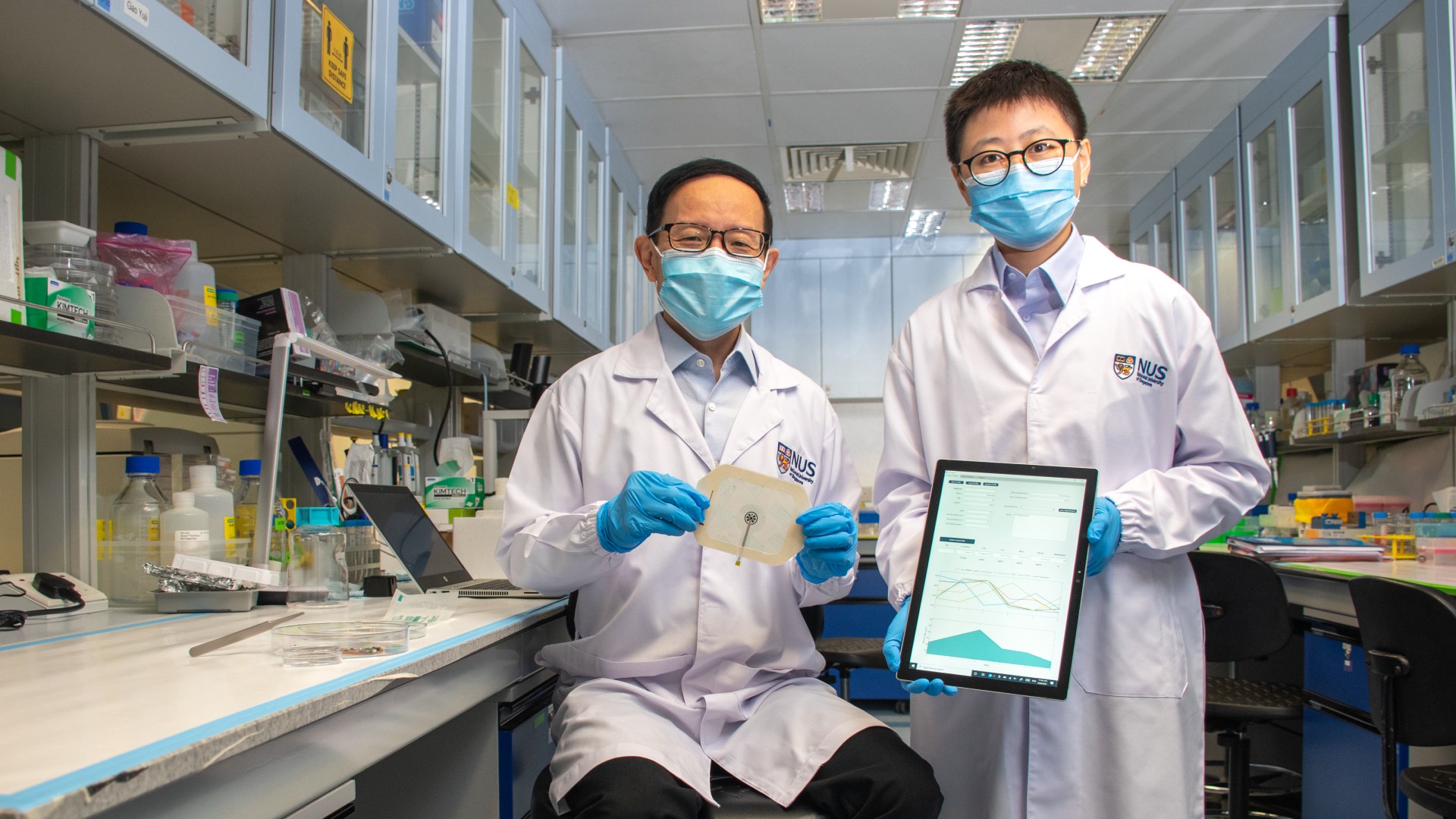
Prof Lim Chwee Teck (left) and Dr Gao Yuji (right) were the lead researchers of the NUS team that developed the VeCare platform to monitor chronic wounds.

A research team led by Professor Lim Chwee Teck from the National University of Singapore’s (NUS) Department of Biomedical Engineering and Institute for Health Innovation & Technology (iHealthtech), in collaboration with clinical partners from Singapore General Hospital, has developed a smart wearable sensor that can conduct real-time, point-of-care assessment of chronic wounds wirelessly via an app. A world’s first, the novel sensor technology can detect temperature, pH, bacteria type and inflammatory factors specific to chronic wounds within 15 minutes, hence enabling fast and accurate wound assessment.

With a rapidly ageing population, healthcare providers are seeing more patients suffering from non-healing wounds such as diabetic foot and chronic venous leg ulcers. It has been estimated that about two per cent of the world’s population suffer from chronic wounds. The healing processes for these chronic wounds are often interrupted due to reasons such as infection and repeated trauma, leading to severe stress, pain and discomfort to afflicted patients. For patients with diabetic foot ulcers, this can lead to more severe outcomes such as foot amputation. Timely care and proper treatment of chronic wounds are needed to speed up wound recovery. However, this requires multiple clinical visits for lengthy wound assessment and treatment, which adds to the healthcare cost. The NUS team’s innovation can help mitigate these consequences and relieve patients with chronic wounds from unnecessary distress.

The research was first published in the journal Science Advances on 21 May 2021.

2021 1021 Smart bandage 2
Credit: National University of Singapore

Applying digital health for personal healthcare

Current clinical assessments of wounds rely on visual inspection, or collecting and sending wound fluid to a centralised lab to detect and analyse specific biomarkers. The whole process usually takes about one to two days and may impede proper, timely and precise medical interventions. Although there are recent developments in flexible sensors designed for wound care, they can only probe a limited set of markers such as acidity, temperature, oxygen, uric acid, and impedance to diagnose wound inflammation.

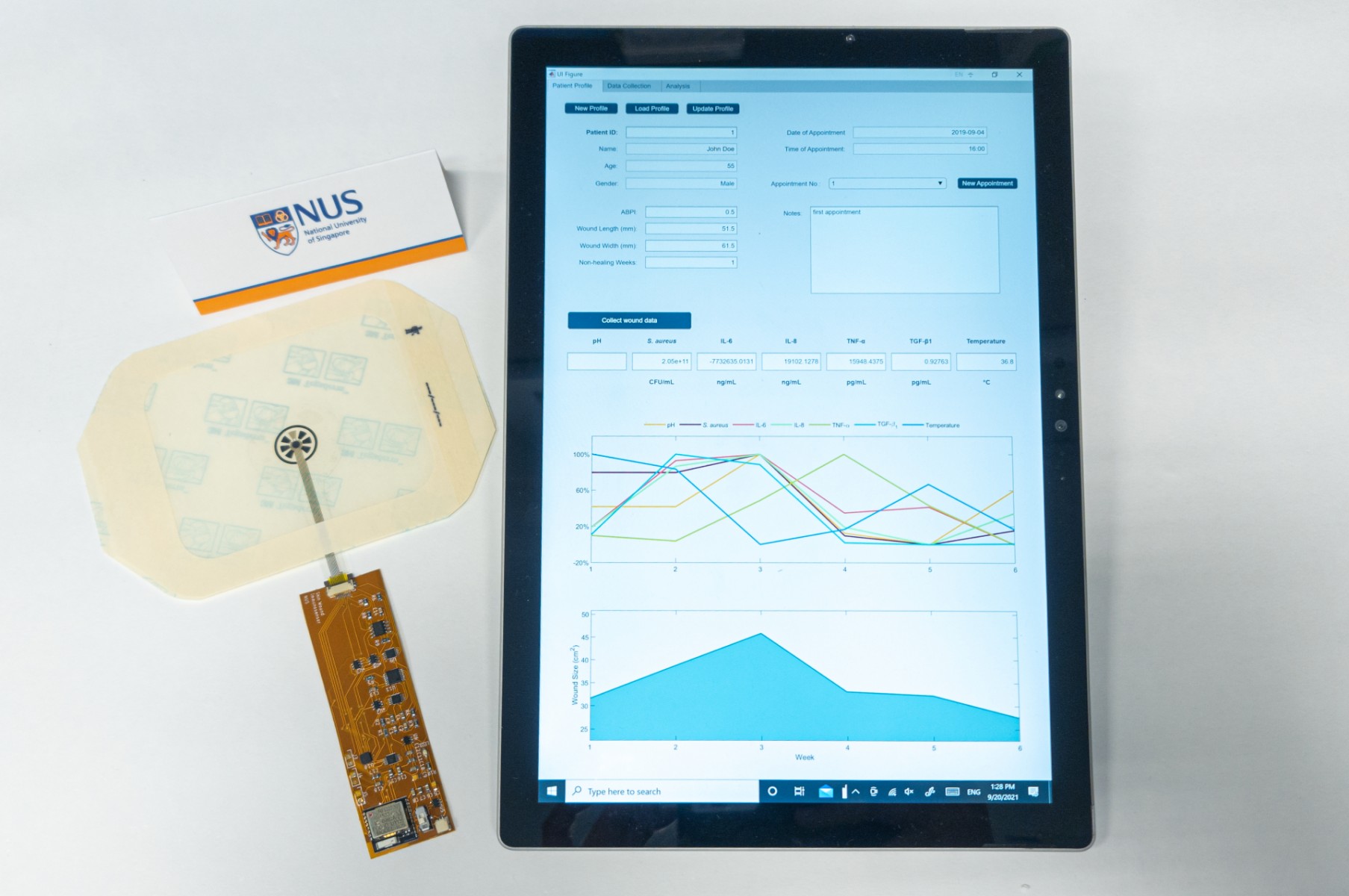
In response to these current limitations, the researchers developed VeCare, a point-of-care wound assessment platform consisting of an innovative wound sensing bandage, an electronic chip and a mobile app. The bandage comprises a wound contact layer, a breathable outer barrier, a microfluidic wound fluid collector and a flexible immunosensor. VeCare is the first wound assessment platform that can detect bacteria type and probe inflammatory factors, in addition to measuring acidity and temperature, within a single 15-minute test. The immunosensing bandage enables rapid assessment of wound microenvironment, inflammation, and infection state by detecting multiple chronic wound-specific biomarkers from wound fluid using an electrochemical system. The microfluidic wound fluid collector attached to the sensor directs and boosts wound fluid delivery to the sensor by up to 180 per cent. The design ensures reliable sensing performance regardless of the ulcer shape or size.

In addition, a chip integrated with flexible electronics is connected to the sensor to transmit data wirelessly to an app for convenient, real-time wound assessment and analysis onsite. The chip component, powered with a rechargeable battery, can be reused for subsequent applications.

2021 1021 Smart bandage 3
The VeCare platform comprises (clockwise from bottom left) a chip, wound sensor, bandage and app for real-time, point-of-care chronic wound monitoring.

The VeCare platform and mobile app enable doctors to monitor the condition of patients’ chronic wounds remotely, reducing the hassle for patients to travel to a clinic. The bandage complements the patient’s existing medical treatment while facilitating timely medical intervention for wound healing processes.

“Point-of-care devices coupled with telehealth or digital health capability can play a significant role in transforming the healthcare industry and our society, which is catalysed by the COVID-19 pandemic requirements for safe distancing. Our smart bandage technology is the first of its kind designed for chronic wound management to give patients the freedom to perform the test and monitor their wound conditions at home,” said Prof Lim, who is Director of iHealthtech at NUS.

In collaboration with the Singapore General Hospital, a small clinical test of VeCare was conducted on patients with chronic venous leg ulcers. They successfully demonstrated that the platform is effective in the assessment of chronic wounds and enabling monitoring of the progress of wound healing with timely medical intervention.

Using smart sensors for better clinical management

“The VeCare platform is easily scalable and customisable to accommodate different panels of biomarkers to monitor various types of wounds. The aim is to have an effective and easy to use diagnostic and prognostic tool for precise and data-driven clinical management of patients,” commented Prof Lim.

The next step for the research team is to further develop VeCare to meet safety, regulatory and mass production considerations. The team will explore the incorporation of other appropriate biomarkers suitable for other wound types and utilise data in existing clinical workflows to improve diagnosis and treatment. They hope to test the technology on a larger prospective randomised clinical trial with different types of non-healing chronic ulcers such as diabetic foot and pressure ulcers.

Total
0
Shares
Share
Tweet
Share
Share
Related Topics
  • iHealthtech
  • National University of Singapore
  • NUS
  • VeCare
  • Wounds
dotlah.com

Previous Article
  • Lah!
  • Technology

First Global Hydrographic Innovation And Technology Laboratory Established In Singapore

  • October 27, 2021
View Post
Next Article
  • Cities
  • Lah!

Keppel-NTU To Boost Development Of Advanced Low-Carbon Technologies

  • October 27, 2021
View Post
You May Also Like
Red Hat OpenShift
View Post
  • Artificial Intelligence
  • Technology

Red Hat Further Drives Digital Sovereignty for the AI Era with Red Hat OpenShift on Google Cloud Dedicated

  • Dean Marc
  • April 21, 2026
View Post
  • Artificial Intelligence
  • Technology

Here’s how to get the $7 trillion AI hardware buildout right

  • dotlah.com
  • April 18, 2026
totus-technologies-cover
View Post
  • Business
  • Technology
  • World Events

The Transatlantic Tech Rift and Why Data Sovereignty Is the New Industrial Imperative

  • Ackley Wyndam
  • April 16, 2026
View Post
  • Technology

Hon Hai Technology Group (Foxconn) Recognized As Top 100 Global Innovators 2026

  • Dean Marc
  • April 9, 2026
View Post
  • Artificial Intelligence
  • Technology

Kioxia Announces New SSD Model Optimized for AI GPU-Initiated Workloads

  • Dean Marc
  • March 17, 2026
View Post
  • Artificial Intelligence
  • Technology

U.S. Ski & Snowboard and Google Announce Collaboration to Build an AI-Based Athlete Performance Tool

  • Dean Marc
  • February 8, 2026
View Post
  • Artificial Intelligence
  • Technology

IBM to Support Missile Defense Agency SHIELD Contract

  • Dean Marc
  • February 5, 2026
Smartphone hero image
View Post
  • Gears
  • Technology

Zed Approves | Smartphones for Every Budget Range

  • Ackley Wyndam
  • January 29, 2026


Trending
  • 1
    • Lah!
    • Technology
    Singapore And The Republic Of Korea Launch Negotiations On Digital Partnership Agreement
    • June 23, 2020
  • 2
    • Lah!
    Top 18 Plants For Fresh Air Proven In Outer Space
    • September 14, 2019
  • 3
    • Cities
    CapitaLand Pledges Up To RMB1 Million In Donations To Support Flood Relief Efforts In Chongqing
    • August 25, 2020
  • 4
    • Cities
    • Lah!
    MPA Academy Relaunches Flagship Port Management Programme Virtually For 29 Maritime And Port Officials
    • September 3, 2021
  • the-cities-with-the-most-billionaires-3292 5
    • Cities
    Beijing Dethrones New York As The World’s Billionaire Capital
    • April 13, 2021
  • 6
    • Lah!
    • Technology
    NUS Researchers Bring Attack-Proof Quantum Communication Two Steps Forward
    • July 9, 2021
  • 7
    • Lah!
    NParks To Work With The Community To Transform Singapore Into A City In Nature
    • March 5, 2020
  • driving-jan-kronies-mpSeLIXMnpc-unsplash 8
    • Cities
    How To Drive Safely And Reduce Your Risk Of Accidents
    • March 19, 2021
  • 9
    • Cities
    • Lah!
    AVS Finalises Licensing Conditions For Pet Breeding And Boarding Industries, And Is Seeking Feedback For Dog Rehoming And Adoption Practices
    • October 9, 2021
  • 10
    • Cities
    To Achieve Net-Zero Carbon Cities And Buildings We Need Systemic Efficiency
    • February 8, 2020
  • sunset-hill-seattle-evan-tahler-odMN4BZzDSo-unsplash 11
    • Cities
    How 18 Million Americans Could Move Into Rural Areas – Without Leaving Home
    • March 11, 2021
  • 12
    • Lah!
    • Technology
    UOB And ADDX Collaborate On Sustainability-Linked Digital Bond
    • October 9, 2021
Trending
  • Red Hat OpenShift 1
    Red Hat Further Drives Digital Sovereignty for the AI Era with Red Hat OpenShift on Google Cloud Dedicated
    • April 21, 2026
  • Illustration of data storage 2
    The Splinternet Comes for European Supply Chains Why Fragmentation Is Now a Boardroom Problem
    • April 21, 2026
  • 3
    Here’s how to get the $7 trillion AI hardware buildout right
    • April 18, 2026
  • totus-technologies-cover 4
    The Transatlantic Tech Rift and Why Data Sovereignty Is the New Industrial Imperative
    • April 16, 2026
  • 5
    What will it take to get ships going through the Strait of Hormuz again?
    • April 13, 2026
  • 6
    Hon Hai Technology Group (Foxconn) Recognized As Top 100 Global Innovators 2026
    • April 9, 2026
  • 7
    3 lessons on the energy transition in an age of crisis
    • April 7, 2026
  • 8
    Samsung Unveils Galaxy A57 5G and Galaxy A37 5G, Packing Pro-Level Features at Awesome Price
    • March 25, 2026
  • 9
    The global price tag of war in the Middle East
    • March 24, 2026
  • 10
    Kioxia Announces New SSD Model Optimized for AI GPU-Initiated Workloads
    • March 17, 2026
Social Links
dotlah! dotlah!
  • Cities
  • Technology
  • Business
  • Politics
  • Society
  • Science
  • About
Connecting Dots Across Asia's Tech and Urban Landscape

Input your search keywords and press Enter.