For many years, Facebook’s internal slogan was “move fast and break things.” And that’s what the company did – along with most other Silicon Valley startups and the venture capitalists who fund them. Their general attitude is one of asking for forgiveness after the fact, rather than for permission in advance. Though this can allow for some bad behavior, it’s probably the right attitude, philosophically speaking.
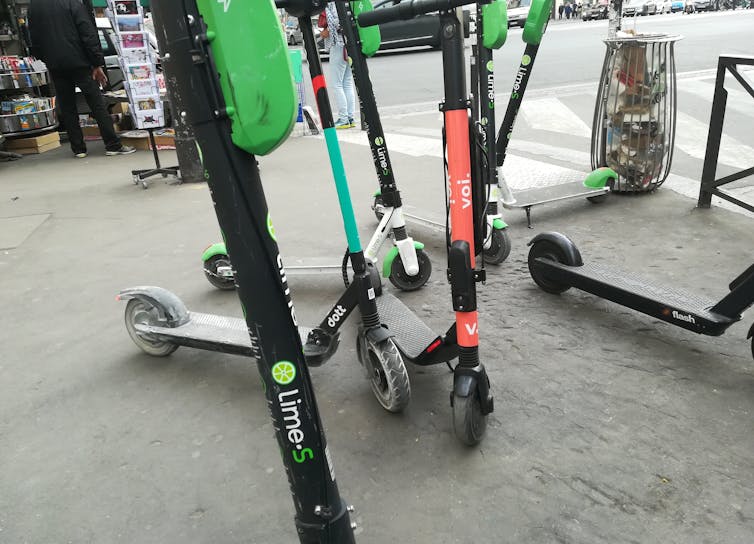
It’s true that the try-first mindset has frustrated the public. Take the Lime scooter company, for instance. The company launched its scooter sharing service in multiple cities without asking permission from local governments. Its electric scooters don’t need base stations or parking docks, so the company and its customers can leave them anywhere for the next person to pick up – even if that’s in the middle of a sidewalk. This general disruption has led to calls to ban the scooters in cities around the country.
Scooters are not alone. Ridesharing services, autonomous cars, artificial intelligence systems and Amazon’s cashless stores have also all been targets of bans (or proposed bans) in different states and municipalities before they’ve even gotten off the ground.
What these efforts have in common is what philosophers like me call the “precautionary principle,” the idea that new technologies, behaviors or policies should be banned until their supporters can demonstrate that they will not result in any significant harms. It’s the same basic idea Hippocrates had in ancient Greece: Doctors should “do no harm” to patients.
The precautionary principle entered the political conversation in the 1980s in the context of environmental protection. Damage to the environment is hard – if not impossible – to reverse, so it’s prudent to seek to prevent harm from happening in the first place. But as I see it, that’s not the right way to look at most new technologies. New technologies and services aren’t creating irreversible damage, even though they do generate some harms.
Precaution has its place
As a general concept, the precautionary principle is essentially conservative. It allows existing technologies, even if new ones – the ones that face preemptive bans – are safer overall.
This approach also runs counter to the most basic idea of liberalism, in which people are broadly allowed to do what they want, unless there’s a rule against it. This is limited only when our right to free action interferes with someone else’s rights. The precautionary principle reverses this, banning people from doing what they want, unless it is specifically allowed.
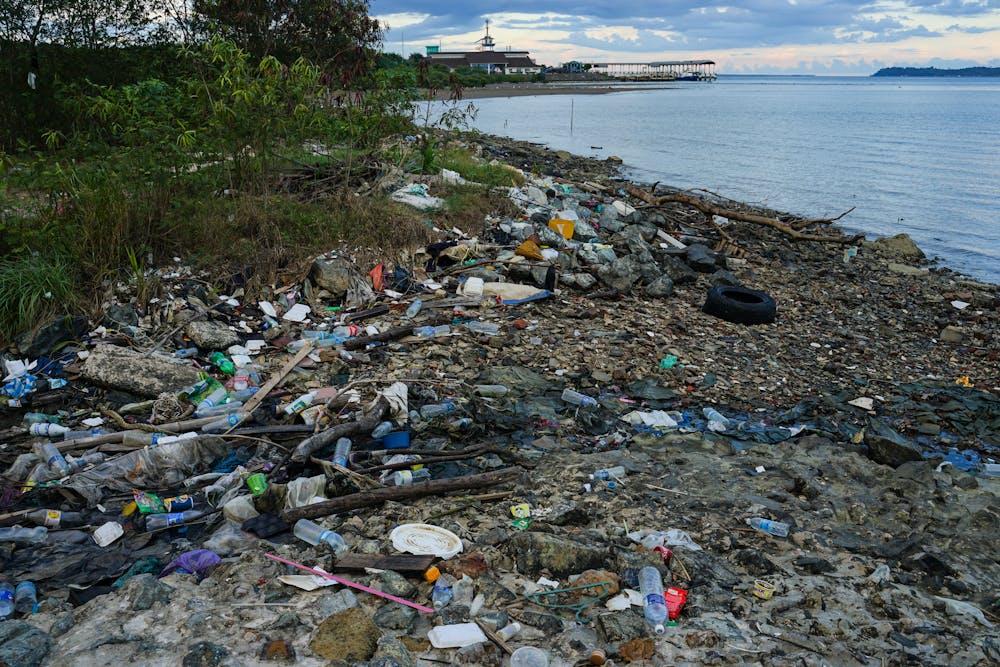
The precautionary principle makes sense when people are talking about some issues, like the environment or public health. It’s easier to avoid the problems of air pollution or dumping trash in the ocean than trying to clean up afterward. Similarly, giving children drinking water that’s contaminated with lead has effects that aren’t reversible. The children simply must deal with the health effects of their exposure for the rest of their lives.
But as much of a nuisance as dockless scooters might be, they aren’t the same as poisoned water.
Managing the effects
Of course, dockless scooters, autonomous cars and a whole host of new technologies do generate real harms. A Consumer Reports investigation in early 2019 found more than 1,500 injuries from electric scooters since the dockless companies were founded. That’s in addition to the more common nuisance of having to step over scooters carelessly left in the middle of the sidewalk – and the difficulties people using wheelchairs, crutches, strollers or walkers may have in getting around them.
Those harms are not nothing, and can help motivate arguments for banning scooters. After all, they can’t hurt anyone if they’re not allowed. What’s missing from those figures, however, is how many of those people riding scooters would have gotten into a car instead. Cars are far more dangerous and far worse for the environment.
Yet the precautionary principle isn’t right for cars, either. As the number of autonomous cars on the road climbs, they’ll be involved in an increasing number of crashes, which will no doubt get lots of media attention.
It is worth keeping in mind that autonomous cars will have been a wild technology success even if they are in millions of crashes every year, so long as they improve on the 6.5 million crashes and 1.9 million people who were seriously injured in a car crash in 2017.
Disruption brings benefits too
It may also be helpful to remember that dockless scooters and ridesharing apps and any other technology that displaces existing methods can really only become a nuisance if a lot of people use them – that is, if many people find them valuable. Injuries from scooters, and the number of scooters left lying around, have increased because the number of people using them has skyrocketed. Those 1,500 reported injuries are from 38.5 million rides.
This is not, of course, to say that these technologies and the firms that produce them should go unregulated. Indeed, a number of these firms have behaved quite poorly, and have legitimately created some harms, which should be regulated.
But instead of preemptively banning things, I suggest continuing to rely on the standard approach in the liberal tradition: See what kinds of harms arise, handle the early cases via the court system, and then consider whether a pattern of harms emerges that would be better handled upfront by a new or revised regulation. The Consumer Product Safety Commission, which looks out for dangerous consumer goods and holds manufacturers to account, is an example of this.
Indeed, laws and regulations already cover littering, abandoned vehicles, negligence and assault. New technologies may just introduce new ways of generating the same old harms, ones that are already reasonably well regulated. Genuinely new situations can of course arise: San Francisco’s ban on municipal use of facial recognition technologies may well be sensible, as people quite reasonably can democratically decide that the state shouldn’t be able to track their every move. People might well decide that companies shouldn’t be able to either.
Silicon Valley’s CEOs aren’t always sympathetic characters. And “disruption” really can be disruptive. But liberalism is about innovation and experimentation and finding new solutions to humanity’s problems. Banning new technologies – even ones as trivial as dockless scooters – embodies a conservatism that denies that premise. A lot of new ideas aren’t great. A handful are really useful. It’s hard to tell which is which until we try them out a bit.
Ryan Muldoon, Associate Professor of Philosophy, University at Buffalo, The State University of New York
This article is republished from The Conversation under a Creative Commons license. Read the original article.