dotlah! dotlah!
  • Cities
  • Technology
  • Business
  • Politics
  • Society
  • Science
  • About
Social Links
  • zedreviews.com
  • citi.io
  • aster.cloud
  • liwaiwai.com
  • guzz.co.uk
  • atinatin.com
0 Likes
0 Followers
0 Subscribers
dotlah!
  • Cities
  • Technology
  • Business
  • Politics
  • Society
  • Science
  • About
  • Technology

Most Innovation Originates From Customers, Not Companies

  • September 27, 2019
Total
0
Shares
0
0
0

The mountain bike wouldn’t exist if it wasn’t for disgruntled customers. In the 1970s, some cyclists wanted to ride off-road but were let down by existing bikes that weren’t suited to rugged terrain. They adapted road bikes, fitting them with strong frames, motorcycle drum brakes and balloon tyres, and so the mountain bike was born.

HAKINMHAN/Shutterstock

And the GoPro camera only exists because its creator, Nick Woodman, wanted to take photos of himself while surfing. He strapped a disposable camera to his wrist, but soon realised the limitations of this setup: the camera was too shaky and the casings weren’t waterproof. He locked himself away and started work on a GoPro prototype. What began with a frustrating surf trip led to a company valued at USD$3 billion at the initial public offering in 2014.

These are just two examples among many of customers – rather than research and development teams at large firms – driving innovation.

Small, waterproof cameras are mass-produced by businesses now, but they began as one photographer’s pet project. Maria Nelasova/Shutterstock

The share of user innovation varies by sector, but in some fields, such as kayaking equipment, off-label drug therapy and mobile banking services more than 50% of all innovations originate with the users of the products themselves. Another study found that 6.1% of the UK population had created a product from scratch or modified an existing product. Each of these people invested £1098 on average each year in these projects.

This amounts to total consumer investments of £3.2 billion in improving and inventing new products – more than 1.4 times the annual £2.2 billion that UK firms spend on research and development of consumer products. With the rise of information technology and the internet, people can share their designs for free while 3D printing and public workshops lets people create them.

Despite this, the role of ordinary people in innovation is largely overlooked. A recent study in Germany asked managers and politicians to estimate the respective share of different sources of innovation – producer firms, universities and the users of products themselves – in nine different fields, including scientific instruments, medical apps and windsurfing equipment. They underestimated the share of user innovation by more than half.

Bottling untapped potential

Why do some people innovate? According to researcher Eric von Hippel, users spot problems with existing products and new needs while using them in their daily lives. They push the boundaries of what existing products can do and realise that what’s out there isn’t good enough for what they want to do.

Still, the study reports that user innovation is a largely invisible phenomenon because people rarely share their work. If their problem with the original product is solved, they usually stop. Not everyone sees that many other people might actually benefit from their innovations.
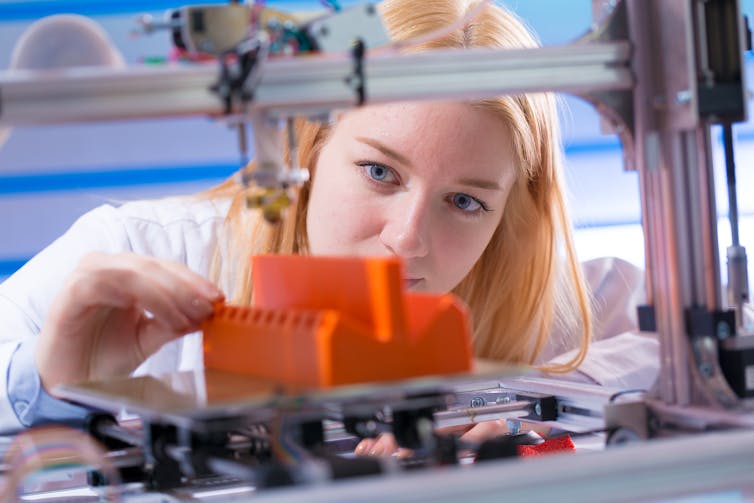
3D printers have decentralised manufacturing, so that ordinary people can experiment with designs and create their own products. Science photo/Shutterstock

Firms might later pick up these ideas or prototypes and develop a product around them before eventually selling it. After some years in the development pipeline, it’s likely forgotten that the new product originated with a regular customer. Firms may hide the origin of user innovation as they seek to protect their own intellectual property too.

Our research suggests that an easy way to find and tap into user innovation is involving employees in product development who also use the firm’s products outside of work. These people could be the tennis player who’s employed by a racket firm or the gamer who works for a videogame developer. These workers test these products in their own time and bring their ideas into the business. If the ingenuity of these people is then recognised and rewarded, then the business will learn to tap into the 50% of innovations that would otherwise remain undiscovered.The Conversation


Tim Schweisfurth, Associate Professor for Technology and Innovation Management, University of Southern Denmark

This article is republished from The Conversation under a Creative Commons license. Read the original article.


Total
0
Shares
Share
Tweet
Share
Share
Related Topics
  • Consumers
  • Innovation
  • Inventors
majulah

Previous Article
  • Lah!

Two New Hawker Centres To Be Developed At Choa Chu Kang Town

  • September 27, 2019
View Post
Next Article
  • Cities

Moshie Safdie: How To Reinvent The Apartment Building

  • September 30, 2019
View Post
You May Also Like
Red Hat OpenShift
View Post
  • Artificial Intelligence
  • Technology

Red Hat Further Drives Digital Sovereignty for the AI Era with Red Hat OpenShift on Google Cloud Dedicated

  • Dean Marc
  • April 21, 2026
View Post
  • Artificial Intelligence
  • Technology

Here’s how to get the $7 trillion AI hardware buildout right

  • dotlah.com
  • April 18, 2026
totus-technologies-cover
View Post
  • Business
  • Technology
  • World Events

The Transatlantic Tech Rift and Why Data Sovereignty Is the New Industrial Imperative

  • Ackley Wyndam
  • April 16, 2026
View Post
  • Technology

Hon Hai Technology Group (Foxconn) Recognized As Top 100 Global Innovators 2026

  • Dean Marc
  • April 9, 2026
View Post
  • Artificial Intelligence
  • Technology

Kioxia Announces New SSD Model Optimized for AI GPU-Initiated Workloads

  • Dean Marc
  • March 17, 2026
View Post
  • Artificial Intelligence
  • Technology

U.S. Ski & Snowboard and Google Announce Collaboration to Build an AI-Based Athlete Performance Tool

  • Dean Marc
  • February 8, 2026
View Post
  • Artificial Intelligence
  • Technology

IBM to Support Missile Defense Agency SHIELD Contract

  • Dean Marc
  • February 5, 2026
Smartphone hero image
View Post
  • Gears
  • Technology

Zed Approves | Smartphones for Every Budget Range

  • Ackley Wyndam
  • January 29, 2026


Trending
  • 1
    • Cities
    Supporting Cleaner And Greener Vehicles For A Sustainable Land Transport Sector
    • February 20, 2020
  • 2
    • Business
    • People
    Fast Loans With Bad Credit: 5 Best Companies To Go To
    • August 27, 2020
  • Points, Lines and a Question 3
    • Engineering
    • Op-Ed
    • People
    What Is The Point In Making Points?
    • November 27, 2025
  • 4
    • Cities
    Singapore Airlines Makes Significant Capacity Cuts And Grounds Aircraft
    • March 25, 2020
  • 5
    • Lah!
    Essential Vector Control Services Must Continue Amidst Circuit Breaker For Covid-19 To Prevent Surge In Mosquito Population
    • April 30, 2020
  • 6
    • Lah!
    NTU Ranked Top 10 globally In 10 Subjects By Shanghai Ranking
    • May 27, 2021
  • 7
    • Science
    • Technology
    Space Exploration Is Still The Brightest Hope-Bringer We Have
    • May 27, 2020
  • mpa-singapore 8
    • Cities
    Joint Release By EDB, ESG, MPA And MOH: Measures Taken To Safeguard Health And Safety of Shore-Based Personnel In Maritime Sector
    • January 5, 2021
  • 9
    • Technology
    Six In Ten Consumers In Singapore Have Been Targeted By Tech Support Scams In The Last 12 Months: Microsoft Survey
    • September 19, 2021
  • 10
    • Features
    • People
    The Role of the Youth in Socio-Economic Development
    • March 10, 2020
  • Halloween Deals 11
    • Gears
    31 Spooky Deals for October 31! Halloween Specials!
    • October 31, 2025
  • Building, Institution and People 12
    • Features
    • People
    Hierarchy and Beyond – Organisational Structures for Any Institution
    • June 28, 2023
Trending
  • Red Hat OpenShift 1
    Red Hat Further Drives Digital Sovereignty for the AI Era with Red Hat OpenShift on Google Cloud Dedicated
    • April 21, 2026
  • Illustration of data storage 2
    The Splinternet Comes for European Supply Chains Why Fragmentation Is Now a Boardroom Problem
    • April 21, 2026
  • 3
    Here’s how to get the $7 trillion AI hardware buildout right
    • April 18, 2026
  • totus-technologies-cover 4
    The Transatlantic Tech Rift and Why Data Sovereignty Is the New Industrial Imperative
    • April 16, 2026
  • 5
    What will it take to get ships going through the Strait of Hormuz again?
    • April 13, 2026
  • 6
    Hon Hai Technology Group (Foxconn) Recognized As Top 100 Global Innovators 2026
    • April 9, 2026
  • 7
    3 lessons on the energy transition in an age of crisis
    • April 7, 2026
  • 8
    Samsung Unveils Galaxy A57 5G and Galaxy A37 5G, Packing Pro-Level Features at Awesome Price
    • March 25, 2026
  • 9
    The global price tag of war in the Middle East
    • March 24, 2026
  • 10
    Kioxia Announces New SSD Model Optimized for AI GPU-Initiated Workloads
    • March 17, 2026
Social Links
dotlah! dotlah!
  • Cities
  • Technology
  • Business
  • Politics
  • Society
  • Science
  • About
Connecting Dots Across Asia's Tech and Urban Landscape

Input your search keywords and press Enter.