dotlah! dotlah!
  • Cities
  • Technology
  • Business
  • Politics
  • Society
  • Science
  • About
Social Links
  • zedreviews.com
  • citi.io
  • aster.cloud
  • liwaiwai.com
  • guzz.co.uk
  • atinatin.com
0 Likes
0 Followers
0 Subscribers
dotlah!
  • Cities
  • Technology
  • Business
  • Politics
  • Society
  • Science
  • About
  • Science

NUS Researchers Uncover How Fish Get Their Shape

  • December 23, 2019
Total
0
Shares
0
0
0

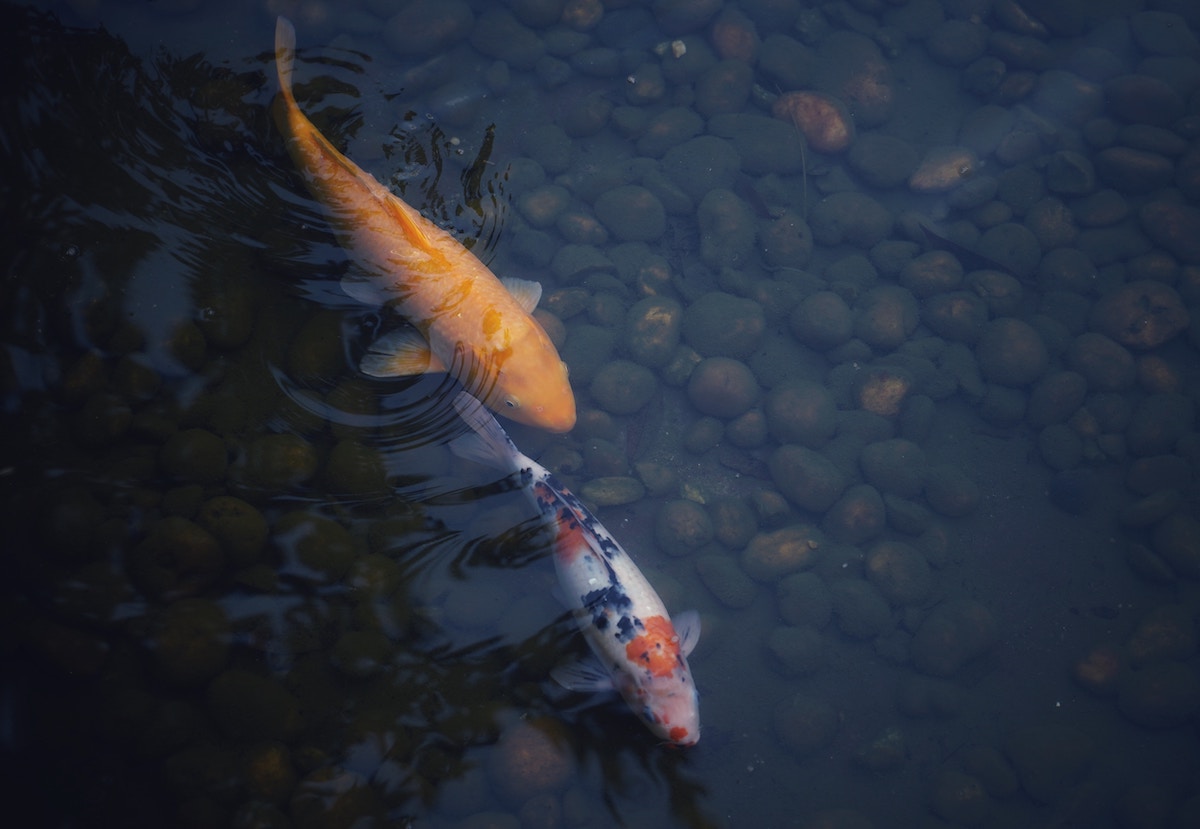
The diverse colours, shapes and patterns of fish are captivating. Despite such diversity, a general feature that we can observe in fish such as salmon or tuna once they are served in a dish like sushi, is the distinct ‘V’ patterns in their meat. While this appears to be genetically observed in the muscle arrangement of most fish species, how such a generic ‘V’ pattern arises is puzzling.
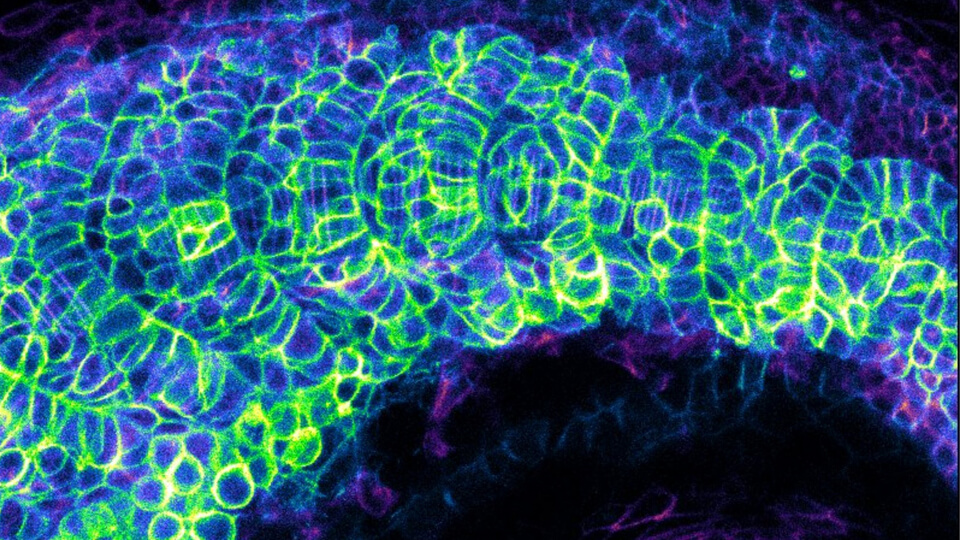
Researchers from NUS Mechanobiology Institute found that the formation of the ‘V’ patterns – also known as chevron patterns – in the swimming muscles of fish do not simply arise from genetic instruction or biochemical pathways but actually require physical forces to correctly develop.

A team of researchers from NUS Mechanobiology Institute (MBI) investigated the science behind the formation of the ‘V’ patterns — also known as chevron patterns — in the swimming muscles of fish. The study focused on the myotome (a group of muscles served by a spinal nerve root) that makes up most of the fish body. These fish muscles power the fish’s side-to-side swimming motion and the chevron pattern is thought to increase swimming efficiency. Above is a microscope image of chevron patterns in zebrafish myotome.

The research team found that these patterns do not simply arise from genetic instruction or biochemical pathways but actually require physical forces to correctly develop. The findings of the study were published in the journal Proceedings of the National Academy of Sciences of the United States of America on 26 November 2019.
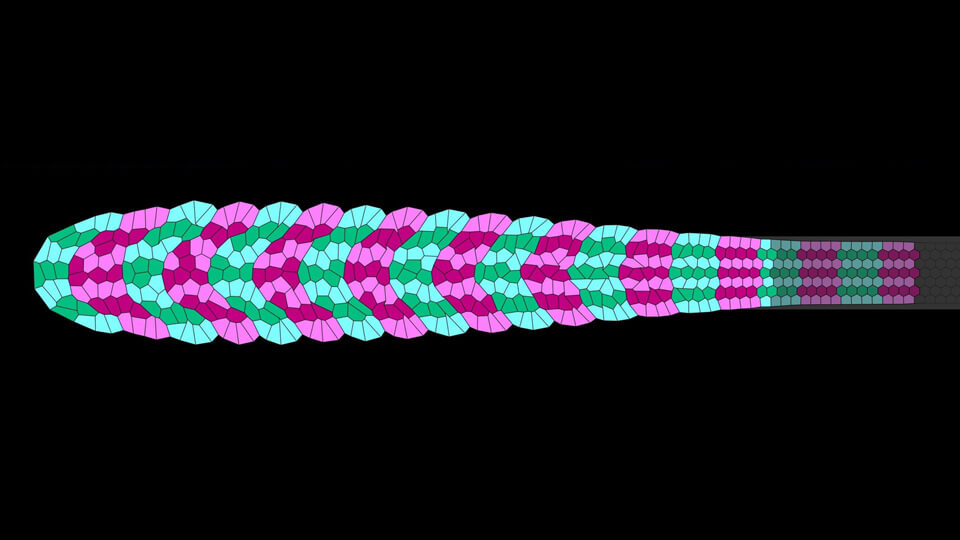
A computer simulation of chevron formation. New cells progressively arrive from the tailbud on the right. Due to differential friction with neighbouring tissues, each segment of cells deforms into a ‘U’-shape, which is then sharpened by active stress into a ‘V’-shape pattern.

Friction and stress combine to shape patterns in fish muscle

The chevron pattern is not unique to salmon and tuna; it is also present in other fish species such as the zebrafish, as well as in some amphibian species like salamanders and frogs during development. The ‘V’ shape first appears in the somites — the precursor building blocks of the myotome, which forms the skeletal muscles. The somites typically form during the first few days of fish development or morphogenesis.

A team of scientists led by MBI Postdoctoral Fellow Dr Sham Tlili and Principal Investigator Assistant Professor Timothy Saunders studied chevron formation in the myotome of zebrafish embryos. Initially, each future developing myotome segment is cuboidal in shape. However, over the course of five hours, it deforms into a pointed ‘V’ shape. To find out how this deformation actually takes place, the team adopted a combination of different techniques — imaging of the developing zebrafish myotome at single-cell resolution; quantitative analysis of the imaging data; and fitting the quantitative data into biophysical models.

Based on findings from their experimental as well as theoretical studies, the MBI scientists identified certain physical mechanisms that they thought might be guiding chevron formation during fish development.

Firstly, the developing myotomes are physically connected to other embryonic tissues such as the neural tube, notochord, skin and ventral tissues. The strength of their connection to these different tissues varies at different time points of myotome formation, and accordingly, different amounts of friction are generated across the tissue. Effectively, the side regions of the developing myotome are under greater friction than the central region. As new segments push the myotome forward, this leads to the formation of a shallow ‘U’ shape in the myotome tissue.

Secondly, cells within the future myotome begin to elongate as they form muscle fibres. The research team revealed that this transformation process generates an active, non-uniform force along certain directions within the somite tissue, which results in the ‘U’ shape sharpening into the characteristic ‘V’-shaped chevron. Lastly, orientated cell rearrangements within the future myotome help to stabilise the newly acquired chevron shape.

Deciphering the patterns guiding organ formation

Asst Prof Saunders, a theoretical physicist who applies physical principles to characterise biological processes that take place during development, said, “This work reveals how a carefully balanced interplay between cell morphology and mechanical interactions can drive the emergence of complex shapes during development. We are excited to see if the principles we have revealed are also acting in the shaping of other organs.”

It is common to attribute anything ‘appearance-related’ to the genetics of an organism. Through this study, the MBI scientists show how temporally and spatially varying biophysical forces play a role in determining the form of an organism.

Total
0
Shares
Share
Tweet
Share
Share
Related Topics
  • Biology
  • Fish
  • NUS
majulah

Previous Article
  • Lah!
  • Science

Top 10 Must-See Museums In Singapore

  • December 23, 2019
View Post
Next Article
  • Lah!

7 Must-See Christmas Events In Singapore

  • December 23, 2019
View Post
You May Also Like
View Post
  • Cities
  • Climate Change
  • Science

New research may help scientists predict when a humid heat wave will break

  • dotlah.com
  • January 6, 2026
Semiconductor
View Post
  • Computing
  • Science

Decoding The Digital. Distinguishing Computer Science And Information Technology In Society And Industry.

  • Dean Marc
  • May 2, 2024
View Post
  • Artificial Intelligence
  • Data
  • Research
  • Science

Generative AI Could Offer A Faster Way To Test Theories Of How The Universe Works

  • dotlah.com
  • March 17, 2024
Mercury
View Post
  • Science
  • Technology

Study: Global Deforestation Leads To More Mercury Pollution

  • dotlah.com
  • February 14, 2024
View Post
  • Science
  • Technology

Higher, Faster: What Influences The Aerodynamics Of A Football?

  • dotlah.com
  • February 11, 2024
View Post
  • Artificial Intelligence
  • Science
  • Technology

A Glimpse Of The Next Generation Of AlphaFold

  • dotlah.com
  • November 6, 2023
View Post
  • Artificial Intelligence
  • Machine Learning
  • Science
  • Technology

AI in the Classroom: Amii’s K-12 Pilot Program

  • dotlah.com
  • October 23, 2023
View Post
  • Science
  • Technology

Learning How To Learn

  • John Francis
  • October 23, 2023


Trending
  • 1
    • Cities
    How bus stops and bike lanes can make or break your festive city trip
    • December 29, 2025
  • 2
    • Science
    Oppenheimer The Actor: The Curious 1946 Film Atomic Power Featuring The Scientist As Himself
    • July 27, 2023
  • 3
    • Artificial Intelligence
    • Technology
    Google Opens Singapore Engineering Center to Build and Export Enterprise Cloud and AI to the World
    • September 15, 2026
  • 4
    • Lah!
    Asia Produces Half The Plastic In The World
    • July 16, 2020
  • 5
    • People
    Black Americans Mostly Left Behind By Progress Since Dr. King’s Death
    • January 20, 2020
  • 6
    • Lah!
    Microsoft And Lee Kuan Yew School Of Public Policy Launch APAC Leaders Digital Alliance
    • December 7, 2021
  • 7
    • Lah!
    Changi Airport Concessionaires To Receive 50% Rental Rebates
    • February 27, 2020
  • 8
    • Artificial Intelligence
    • People
    • Technology
    Why Some Celebrities Are Embracing Artificial Intelligence Deepfakes
    • July 20, 2023
  • 9
    • Cities
    • Lah!
    Empowering Cloud Sustainability With The Microsoft Emissions Impact Dashboard
    • October 16, 2021
  • Food 10
    • People
    • Technology
    Farmers In India Are Using AI For Agriculture – Here’s How They Could Inspire The World
    • January 24, 2024
  • 11
    • Lah!
    Designing Sustainable Seascapes For New Coasts
    • August 30, 2019
  • Greener spaces would allow children to be more connected with nature. Image credit - Fas Khan / Unsplash 12
    • Cities
    Cities that connect people and nature are a post-pandemic priority, conference hears
    • July 7, 2021
Trending
  • 1
    Chinese tech giant Huawei unveils Mate 90 series smartphones with flagship Tau chips adopting logic folding technology
    • October 3, 2026
  • 2
    Google Opens Singapore Engineering Center to Build and Export Enterprise Cloud and AI to the World
    • September 15, 2026
  • 3
    Apple Flagship Hardware Launch for September 2026
    • September 10, 2026
  • 4
    MIT researchers tackle the economic realities of fusion power
    • August 10, 2026
  • 5
    ASEAN, treaty parties push stronger cooperation as Treaty of Amity and Cooperation in Southeast Asia marks 50 years
    • July 26, 2026
  • 6
    The Fastest AI Fried Chicken In The World
    • June 29, 2026
  • 7
    Zed Approves | How to Stay Cool in Extreme Heat
    • June 29, 2026
  • 8
    Was Venezuela struck by an earthquake ‘doublet’? Here’s what we know so far
    • June 27, 2026
  • 9
    Zed Approves | It’s Prime Day 2026! Time to Upgrade Your World Cup Viewing Setup and Beat the Heat
    • June 25, 2026
  • 10
    Zed Approves | The Best Prime Day PC Deals: Top Gaming Rigs, Workstations, and Everyday Laptops
    • June 25, 2026
Social Links
dotlah! dotlah!
  • Cities
  • Technology
  • Business
  • Politics
  • Society
  • Science
  • About
Connecting Dots Across Asia's Tech and Urban Landscape

Input your search keywords and press Enter.