dotlah! dotlah!
  • Cities
  • Technology
  • Business
  • Politics
  • Society
  • Science
  • About
Social Links
  • zedreviews.com
  • citi.io
  • aster.cloud
  • liwaiwai.com
  • guzz.co.uk
  • atinatin.com
0 Likes
0 Followers
0 Subscribers
dotlah!
  • Cities
  • Technology
  • Business
  • Politics
  • Society
  • Science
  • About
  • Cities
  • Society

Wuhan, The Coronavirus And The World: Thinking Beyond Isolation

  • February 3, 2020
Photo: AFP
Total
0
Shares
0
0
0

Public fear seems inevitable given the alarming updates on the coronavirus outbreak, and isolation — in the forms of lockdown and quarantine — has become our default response.
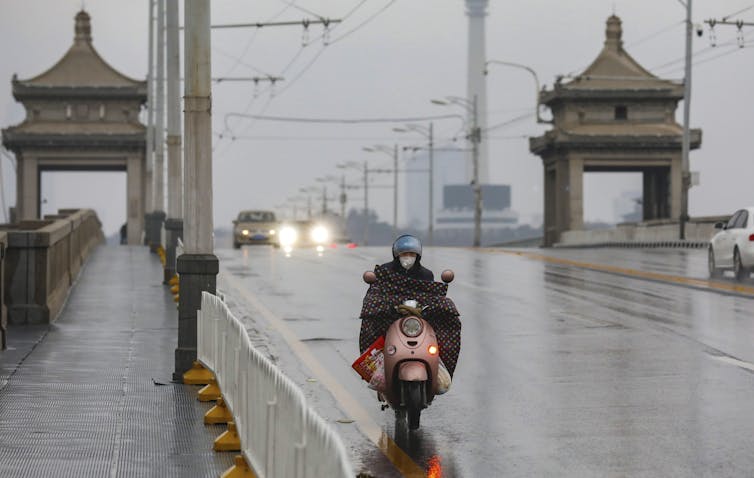
A motorcyclist rides across a bridge in Wuhan, China, in January 2020. The city as banned most vehicle use downtown in an effort to contain the spread of the novel coronavirus. Chinatopix via AP, File

As a social scientist in globalization studies, I am interested in the role some of the less visible layers of globalization — such as awareness of our connections with the lives of people elsewhere — have in shaping our responses, including emotional responses, to global threats, like this one and those to come.

For example, while the massive lockdowns in China have aimed to decelerate the spread of the virus, have we asked ourselves what has been going on in Wuhan, the epicentre of the 2019-nCoV outbreak and the first city to be locked-down, and what it may mean for the rest of the world?

Temporal aspects

The initial response to the epidemic in Wuhan appears to have been delayed by as much as a month, in part by its timing. The “largest human migration” that occurs annually during the Lunar New Year means there was an increased risk of widespread contagion and a potential threat to social and political stability.

In China’s system, a disease like this can never be only a public health issue; it is also one that requires careful political calculation. After the central government’s frustration in other international arenas, such as Taiwan’s election and the trade war with the United States, the epidemic is its biggest test and, therefore, a priority.
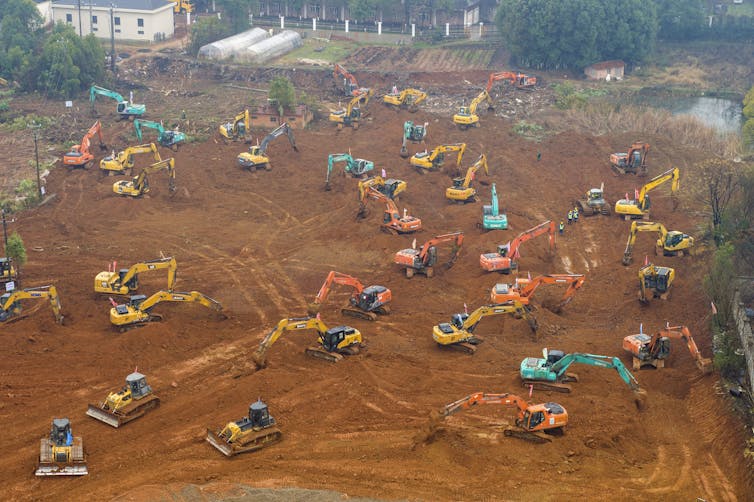
A construction site for a field hospital in Wuhan, on Jan. 24, 2020. China is quickly building a 1,000-bed hospital dedicated to patients infected with the new coronavirus, 2019-nCoV. Chinatopix via AP

After Chinese President Xi Jinping’s public remarks on Jan. 20, the country began taking immediate action. Authorities cancelled planes and trains leaving Wuhan and curtailed transit within the city on Jan. 23, and other cities and provinces swiftly followed. As of Jan. 25, the movement of 56 million people had been restricted.

Policies targeting the spread of the novel coronavirus included free medical care for infected patients, free travelling ticket cancellation, rumour control and the extension of the Lunar New Year holiday. Free apps for self-screening and public education on self-quarantine and face mask use rapidly became available online.

A spectacle of lightning-fast activity similar to what occurred during the SARS epidemic was repeated: Construction crews broke ground on Jan. 24 on a 1,000-bed hospital that is expected to be in use by Feb. 3; another will open shortly after.

Geospatial aspects

Although Wuhan, with its 11 million people, has a larger population than New York City, it is merely the seventh-largest city in China and a beta city in the world city networks (equivalent to Calgary).

In a way, it is fortunate that 2019-nCoV did not start in Beijing, Shanghai or Hong Kong, all of which are highly ranked world cities (second only to London and New York City) with direct daily flights to other global cities, including Toronto and Vancouver. Had it begun in one of those major centres, the global landscape of the new coronavirus might today look very different.
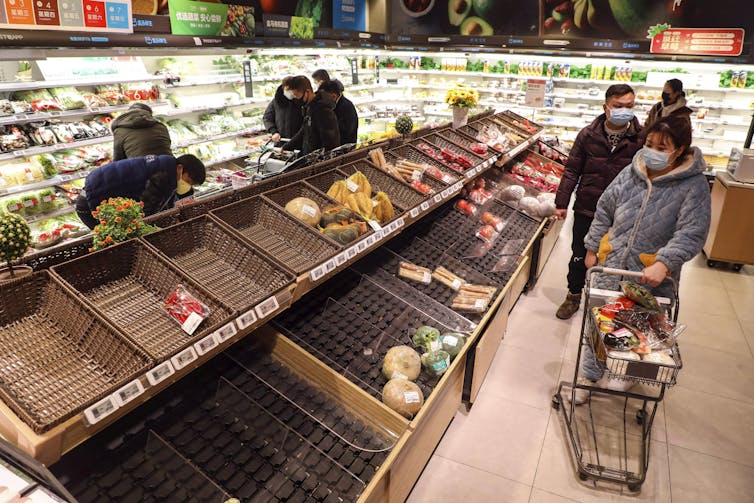
Shoppers wearing face masks look for groceries at a supermarket with many empty shelves in Wuhan, China, on Jan. 25, 2020. Chinatopix via AP

On a domestic level, though, Wuhan’s location as a historical transportation hub in central China confers additional risk, considering its easy access through multiple routes, including water (the Yangtze River) and high-speed trains, to many other provinces. The destinations of the five million who left Wuhan before the lockdown cover many provinces in China.

Wuhan’s capacity to respond to the epidemic — reflected by, for example, the city’s governing capacity, access to decision-making power and ability to mobilize resources — seems hardly to compare with that of Beijing.

Societal aspects

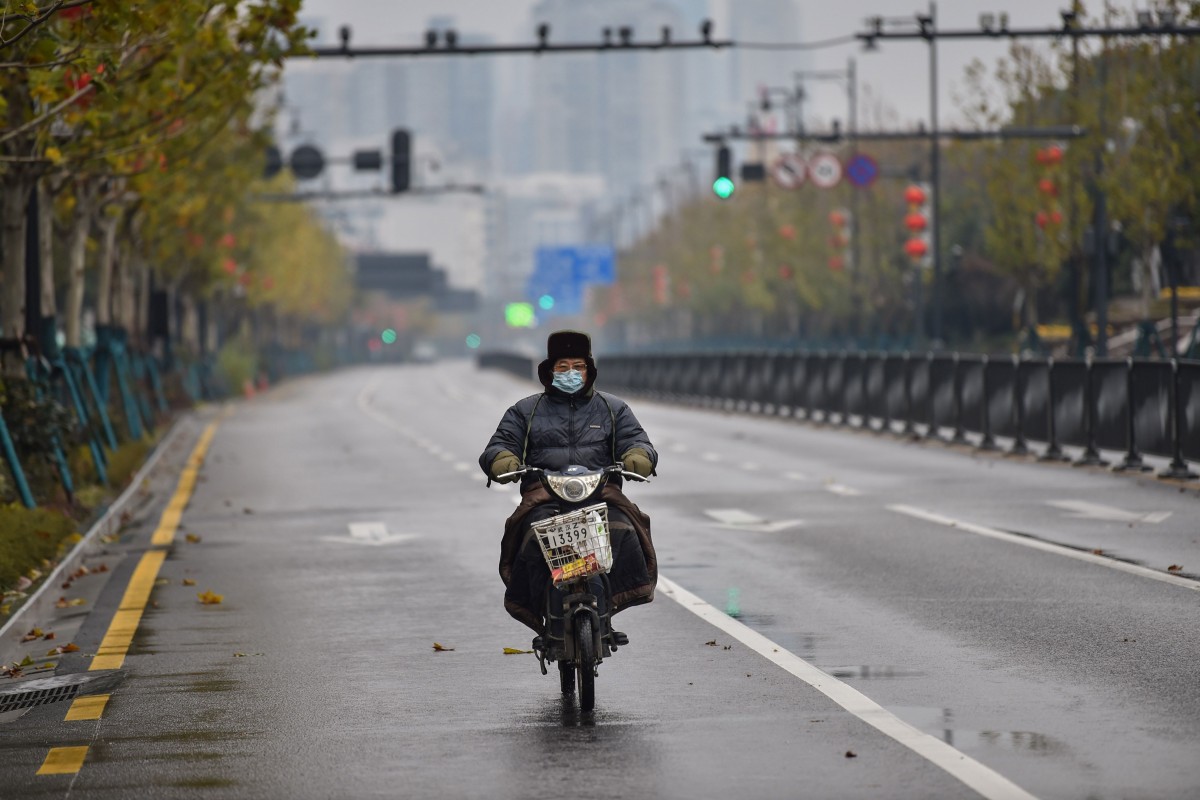
The lockdown, a place-based containment strategy, has transformed Wuhan into a dystopian city. Public transit is not running, streets are empty, flights have been cancelled and foreign residents have been evacuated.

Despite their acceptance of the lockdown for a bigger cause, people are complaining about many things on social media: the lack of transportation, overcrowded hospitals, shortages of face masks and other protective gear (even in hospitals) and an inability to re-enter Wuhan.

The spread of the virus within China has been accompanied by wide reports of discrimination against people from that city, although lists of hotels willing to host Wuhan people travelling outside the city are also being circulated online.

Social media such as Weixin (WeChat) did not exist at the time of SARS. It has become a key medium and tool for people to survive isolation, seek help, co-ordinate donations and push the local government for information transparency. Five days after the lockdown, residents in several high-rise buildings in Wuhan mobilized themselves through social media to lift their spirits by simultaneously opening their apartment windows to chant “stay strong (jiāyóu), Wuhan” and sing the national anthem.

Humorous memes have also figured prominently on social media, offering some relief from the increasingly intense worries: “Staying at home is helping the world” and “It feels great that I can finally contribute to society by lying on the couch and doing nothing.”

Although Wuhan, like other Chinese cities, is now under quarantine, it is important that the world — including Canadians — should continue to bear witness to them, their affliction, their challenges, their efforts and their autonomy. Seeing them beyond isolation will also help us to think about our own connections in this globalized world and, thus, to act beyond our self-centred fears.The Conversation


Yanqiu Rachel Zhou, Professor, Social Sciences, McMaster University

This article is republished from The Conversation under a Creative Commons license. Read the original article.

Total
0
Shares
Share
Tweet
Share
Share
Related Topics
  • 2019-nCoV
  • China
  • Coronavirus
  • Infectious diseases
  • Isolation
  • Quarantine
  • Wuhan
  • Wuhan Coronavirus
majulah

Previous Article
  • Lah!

Asia Leads The Cashless Revolution

  • February 3, 2020
View Post
Next Article
  • Cities
  • People
  • World Events

Wuhan, The Coronavirus And The World: Thinking Beyond Isolation

  • February 3, 2020
View Post
You May Also Like
View Post
  • Cities
  • Environment
  • People

Was Venezuela struck by an earthquake ‘doublet’? Here’s what we know so far

  • dotlah.com
  • June 27, 2026
View Post
  • Cities
  • Economy
  • Politics

The global price tag of war in the Middle East

  • dotlah.com
  • March 24, 2026
View Post
  • Cities
  • Food

How the Iran war could create a ‘fertiliser shock’ – an often ignored global risk to food prices and farming

  • dotlah.com
  • March 6, 2026
View Post
  • Cities
  • Climate Change
  • Science

New research may help scientists predict when a humid heat wave will break

  • dotlah.com
  • January 6, 2026
View Post
  • Cities

How bus stops and bike lanes can make or break your festive city trip

  • dotlah.com
  • December 29, 2025
View Post
  • Cities
  • People

We must empower local leaders to meet global goals – here’s why

  • dotlah.com
  • November 4, 2025
View Post
  • Cities

Politicians love comparing NZ’s economy to Singapore or Ireland – but it’s simplistic and misleading

  • dotlah.com
  • September 21, 2025
View Post
  • Cities
  • Technology

Meralco PowerGen’s PacificLight starts up 100 MW fast-response plant in Singapore

  • dotlah.com
  • June 20, 2025


Trending
  • 1
    • Society
    Do Face Masks Really Prevent You From Catching Coronavirus?
    • March 13, 2020
  • 2
    • Cities
    • Technology
    Dyson Car: Electrifying Transport Needs A Lot More Than Another High-End Vehicle
    • October 30, 2019
  • winter 3
    • People
    • World Events
    7 Steps To Stay COVID-Safe This Winter
    • October 21, 2020
  • dubai-zq-lee-DcyL0IoCY0A-unsplash 4
    • Cities
    • Technology
    How blockchain can empower smart cities – and why interoperability will be crucial
    • April 14, 2021
  • 5
    • Lah!
    NUS Computing Launches Centre For Computing For Social Good & Philanthropy To Nurture Tech Leaders With A Heart For The Community
    • July 1, 2021
  • Modius Sleep 6
    • Technology
    Neurovalens Wins National Sleep Foundation’s 2024 SleepTech® Award
    • January 6, 2025
  • 7
    • Lah!
    • Technology
    Connecting Our Content Creators To Global Media Players And Audiences Singapore Media Festival 2021: Connecting Our Content Creators To Global Media Players And Audiences
    • October 27, 2021
  • 8
    • Technology
    All Businesses To Get Access To 5G Innovation With Four 5G Open Testbeds
    • October 21, 2021
  • 9
    • Cities
    • Lah!
    Close To 3,000 Premises Have Pledged To Say Yes To Waste Less This Year Despite Tough COVID-19 Situation
    • September 28, 2021
  • green-grass-petar-tonchev-c-5-QE5kBYk-unsplash 10
    • Cities
    Sponge Parks And Vertical Gardens – How Cities Are Using Nature To Overcome Extreme Weather
    • April 30, 2021
  • 11
    • Cities
    Land Transport Measures During Stabilisation Phase From 27 September To 24 October 2021
    • September 28, 2021
  • 12
    • Lah!
    • Technology
    Changi Recommends Unveils Changi Mobile Under New MVNO Partnership With M1
    • September 21, 2021
Trending
  • 1
    Chinese tech giant Huawei unveils Mate 90 series smartphones with flagship Tau chips adopting logic folding technology
    • October 3, 2026
  • 2
    Google Opens Singapore Engineering Center to Build and Export Enterprise Cloud and AI to the World
    • September 15, 2026
  • 3
    Apple Flagship Hardware Launch for September 2026
    • September 10, 2026
  • 4
    MIT researchers tackle the economic realities of fusion power
    • August 10, 2026
  • 5
    ASEAN, treaty parties push stronger cooperation as Treaty of Amity and Cooperation in Southeast Asia marks 50 years
    • July 26, 2026
  • 6
    The Fastest AI Fried Chicken In The World
    • June 29, 2026
  • 7
    Zed Approves | How to Stay Cool in Extreme Heat
    • June 29, 2026
  • 8
    Was Venezuela struck by an earthquake ‘doublet’? Here’s what we know so far
    • June 27, 2026
  • 9
    Zed Approves | It’s Prime Day 2026! Time to Upgrade Your World Cup Viewing Setup and Beat the Heat
    • June 25, 2026
  • 10
    Zed Approves | The Best Prime Day PC Deals: Top Gaming Rigs, Workstations, and Everyday Laptops
    • June 25, 2026
Social Links
dotlah! dotlah!
  • Cities
  • Technology
  • Business
  • Politics
  • Society
  • Science
  • About
Connecting Dots Across Asia's Tech and Urban Landscape

Input your search keywords and press Enter.