dotlah! dotlah!
  • Cities
  • Technology
  • Business
  • Politics
  • Society
  • Science
  • About
Social Links
  • zedreviews.com
  • citi.io
  • aster.cloud
  • liwaiwai.com
  • guzz.co.uk
  • atinatin.com
0 Likes
0 Followers
0 Subscribers
dotlah!
  • Cities
  • Technology
  • Business
  • Politics
  • Society
  • Science
  • About
  • Environment
  • People
  • Technology
  • World Events

A Plasma Reactor Zaps Airborne Viruses – And Could Help Slow The Spread Of Infectious Diseases

  • February 7, 2020
Total
0
Shares
0
0
0

The big idea: It’s the enduring media image of infectious disease outbreaks, including the current coronavirus outbreak from Wuhan, China: people in public spaces with faces half-hidden by surgical masks.

Filters have long been used to remove particles, including viruses and bacteria, from the air we breathe. Particle filters are key components of building and aircraft ventilation systems. Unfortunately, viruses are much smaller than the smallest particles those filters typically capture reliably.
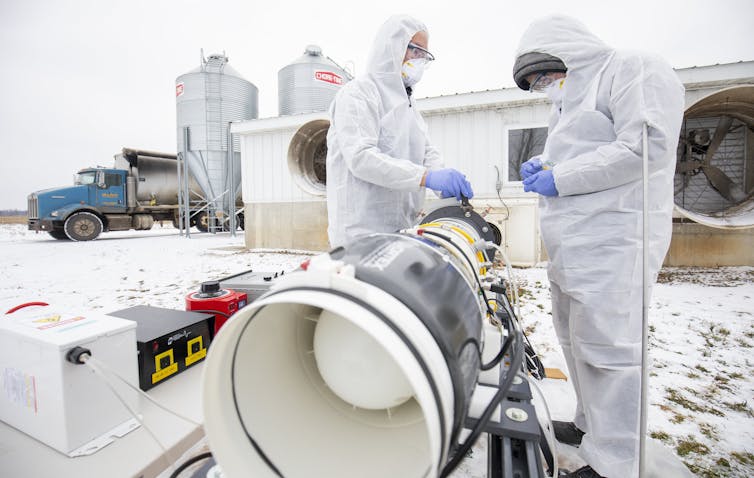
Researchers Tian Xia and Zijie Lin test a plasma prototype for preventing airborne transmission of porcine reproductive and respiratory syndrome virus at a Michigan pig farm. Robert Coelius/Michigan Engineering, Communications & Marketing, CC BY-ND

One possibility for curbing the spread of airborne pathogens is a nonthermal plasma reactor. Plasma is the fourth state of matter, a gas composed of electrically charged ions and electrons rather than neutral atoms and molecules. Nonthermal means the plasma isn’t formed at high temperatures. At the University of Michigan, my colleagues and I developed a nonthermal plasma reactor that leaves airborne pathogens unable to infect host organisms, including people. The plasma oxidizes the viruses, which disables their mechanism for entering cells.

After testing in the lab and at livestock facilities, we’ve shown that the reactor reduces the numbers of infectious viruses in an air stream by more than 99%. We’re developing the technology for use in animal agriculture, but it might also be useful where people are concentrated in enclosed spaces, including commercial aircraft.

Why it matters

Scientists don’t know what makes some viruses and bacteria more resilient in air than others. Tuberculosis and measles have long been known to be highly contagious, while a recent study proved that influenza can also remain infectious in air longer than an hour, something that researchers had previously thought unlikely. Enclosed or crowded spaces reduce opportunities for virus degradation or dilution in air, increasing the chances that an exposure will lead to infection.

Infectious diseases that have airborne transmission routes, including swine flu and avian flu, have affected pork, poultry and egg producers. Porcine Reproductive and Respiratory Syndrome alone has been estimated to cost more than US$600 million annually in the U.S. In 2015, more than 50 million chickens and turkeys were culled to stop the spread of highly pathogenic avian flu because of its potential to infect humans.

What we don’t know

There are several theories of how nonthermal plasmas kill bacteria, but airborne viruses aren’t “alive” like bacteria and therefore can’t be “killed” in the same way. Also, researchers’ understanding of nonthermal plasma sterilization is mostly based on sterilizing contaminated surfaces using minutes-long plasma exposures, much longer than the subsecond exposures studied in our tests and an earlier similar study.

In our tests, the plasma reduced how many infectious viruses were in the air by more than 99%, but the viruses themselves remained with their DNA largely unchanged. This means that the plasma didn’t destroy the virus but rather altered its ability to infect. We’re working to understand how this happens, which will help us engineer, or “tune,” the reactor.

What’s next

My colleagues and I are currently evaluating how ammonia, ever-present around animals as a byproduct of their waste, affects the plasma generated by the reactor.

We’re also considering how to use nonthermal plasma reactors in aircraft. Long-distance flights can transport infected passengers all over the world, as is immediately clear from maps showing confirmed cases of the new coronavirus. Less clear is the risk to fellow passengers. There are many aspects of virus transmission in aircraft cabins, including passenger movement during flights. Cabin air circulation patterns are important in determining how far and where a virus can be transported once shed by an infected passenger.

Scientists will need to better understand these variables before aircraft makers and operators can use nonthermal plasma reactors to help fight the spread of infectious diseases.

The Conversation

Herek Clack, Associate Professor of Civil & Environmental Engineering, University of Michigan

This article is republished from The Conversation under a Creative Commons license. Read the original article.


Total
0
Shares
Share
Tweet
Share
Share
Related Topics
  • 2019-nCoV
  • Coronavirus
  • Infectious diseases
  • Plasma
  • Viruses
  • Wuhan Coronavirus
dotlah.com

Previous Article
  • Science
  • Society

A Plasma Reactor Zaps Airborne Viruses – And Could Help Slow The Spread Of Infectious Diseases

  • February 7, 2020
View Post
Next Article
  • Lah!

Coronavirus Outbreak: Singapore Introduces Additional Measures With DORSCON Orange

  • February 7, 2020
View Post
You May Also Like
View Post
  • Artificial Intelligence
  • Technology

Google Opens Singapore Engineering Center to Build and Export Enterprise Cloud and AI to the World

  • Dean Marc
  • September 15, 2026
View Post
  • Research
  • Technology

MIT researchers tackle the economic realities of fusion power

  • dotlah.com
  • August 10, 2026
View Post
  • Cities
  • Environment
  • People

Was Venezuela struck by an earthquake ‘doublet’? Here’s what we know so far

  • dotlah.com
  • June 27, 2026
zedreviews-valerion
View Post
  • Gears
  • Technology

Father’s Day Outdoors – Build Dad the Ultimate Backyard Watch Party

  • Dean Marc
  • June 21, 2026
zedreviews-fathers-day-50830
View Post
  • Gears
  • Technology

Father’s Day Outdoors, Round Two – Gear for the Action, the Tailgate, and Beating the Heat

  • Dean Marc
  • June 21, 2026
zedreviews-fathers-day-21306
View Post
  • Gears
  • Technology

A Father’s Day Gift Guide for Every Dad – Timepieces and Travel Gear

  • Dean Marc
  • June 21, 2026
View Post
  • Gears
  • Technology

Samsung Art Store Brings Art Basel to Homes Worldwide With New Curated Collection

  • Dean Marc
  • June 15, 2026
View Post
  • Artificial Intelligence
  • Technology

The consequences of relying on AI for accurate news

  • dotlah.com
  • June 10, 2026


Trending
  • Bluetooth speakers 1
    • Gears
    Best Bluetooth Speakers Under $200 (2025 Edition)
    • October 16, 2025
  • 2
    • Lah!
    IMF Reaffirms Singapore’s Financial Sector Oversight As “Among the Best Globally”
    • July 16, 2019
  • 3
    • Lah!
    • Society
    Community And Mentorship Help Women Entrepreneurs Thrive
    • November 23, 2021
  • singapore-street-from-above-chuttersnap-d271d_SOGR8-unsplash 4
    • Cities
    Cities Are At The Heart Of Our Journey To Net Zero. Here’s Why
    • March 12, 2021
  • 5
    • Cities
    • Lah!
    MPA Launches Notation For Singapore Registry Of Ships (SRS)
    • October 9, 2021
  • 6
    • Science
    Singapore Scientists Simplify Lithium-Sulfur Battery Production to Meet Future Energy Storage Needs
    • October 10, 2019
  • 7
    • Cities
    • Lah!
    Know Your Tree – NParks Launches Interactive Map Of Trees Across Singapore
    • February 5, 2018
  • pandemic-crowd-macau-photo-agency-4yXV0JIK-yo-unsplash 8
    • People
    • World Events
    How many people need to get a COVID-19 vaccine in order to stop the coronavirus?
    • January 17, 2021
  • city skyline sunset 9
    • Cities
    How Cities Can Combat The Dangerous Combination Of Extreme Heat And COVID
    • September 6, 2020
  • 10
    • Cities
    Urban Redevelopment Authority (URA) Updates Online Geospatial Map With More Comprehensive Information
    • October 3, 2017
  • 11
    • Lah!
    • Technology
    World’s First Digital Trade Financing Pilot Between MLETR-Harmonised Jurisdictions
    • November 14, 2021
  • 12
    • Cities
    • People
    How Pandemics Have Changed American Cities – Often For The Better
    • June 25, 2020
Trending
  • 1
    Chinese tech giant Huawei unveils Mate 90 series smartphones with flagship Tau chips adopting logic folding technology
    • October 3, 2026
  • 2
    Google Opens Singapore Engineering Center to Build and Export Enterprise Cloud and AI to the World
    • September 15, 2026
  • 3
    Apple Flagship Hardware Launch for September 2026
    • September 10, 2026
  • 4
    MIT researchers tackle the economic realities of fusion power
    • August 10, 2026
  • 5
    ASEAN, treaty parties push stronger cooperation as Treaty of Amity and Cooperation in Southeast Asia marks 50 years
    • July 26, 2026
  • 6
    The Fastest AI Fried Chicken In The World
    • June 29, 2026
  • 7
    Zed Approves | How to Stay Cool in Extreme Heat
    • June 29, 2026
  • 8
    Was Venezuela struck by an earthquake ‘doublet’? Here’s what we know so far
    • June 27, 2026
  • 9
    Zed Approves | It’s Prime Day 2026! Time to Upgrade Your World Cup Viewing Setup and Beat the Heat
    • June 25, 2026
  • 10
    Zed Approves | The Best Prime Day PC Deals: Top Gaming Rigs, Workstations, and Everyday Laptops
    • June 25, 2026
Social Links
dotlah! dotlah!
  • Cities
  • Technology
  • Business
  • Politics
  • Society
  • Science
  • About
Connecting Dots Across Asia's Tech and Urban Landscape

Input your search keywords and press Enter.