dotlah! dotlah!
  • Cities
  • Technology
  • Business
  • Politics
  • Society
  • Science
  • About
Social Links
  • zedreviews.com
  • citi.io
  • aster.cloud
  • liwaiwai.com
  • guzz.co.uk
  • atinatin.com
0 Likes
0 Followers
0 Subscribers
dotlah!
  • Cities
  • Technology
  • Business
  • Politics
  • Society
  • Science
  • About
  • People
  • World Events

As China Suffers From Coronavirus, Some Wonder: Is It Really That Serious?

  • February 10, 2020
Total
0
Shares
0
0
0

The coronavirus outbreak continues to worsen in China. The Chinese government has announced even stricter measures to stop the spread of the disease, including the rounding up of people in Wuhan, the city where the outbreak began, for mass quarantine. And the doctor who warned authorities about the disease has died. Just how bad might this outbreak become? Virologist and public health expert John A. Lednicky explains.
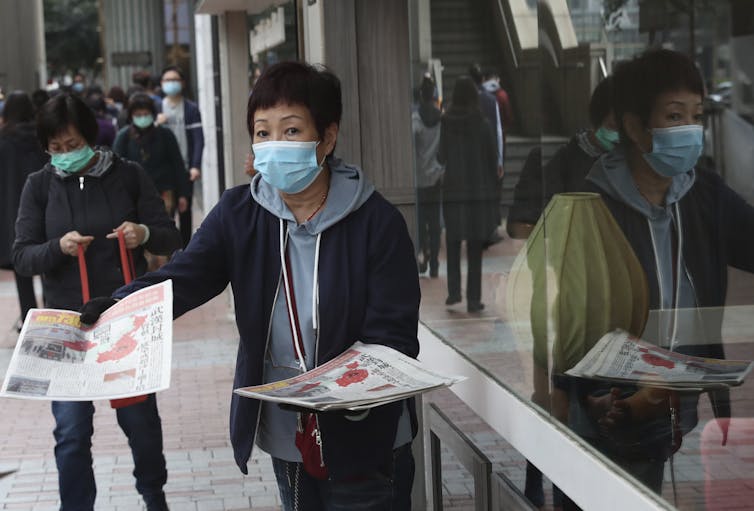
A women wearing a protective face mask delivers a leaflet on coronavirus, in Hong Kong, Friday, Jan 24, 2020. AP Photo.Achmad Ibrahim

1. Is this outbreak really that serious?

Epidemics are spreading more quickly and farther in the 21st century than in previous centuries due to globalization and air travel. When outbreaks occur, there is a predictable pattern that can be summarized as: (a) There is a delay in recognizing that an outbreak is occurring; (b) a significant impact on trade and travel typically occurs due to quarantine measures; (c) the public panics due to misinformation and fear of the unknown, and this can be exacerbated by media coverage.

This outbreak is serious to China, to millions of people there, to its economy and potentially to the world’s economy. China’s main concern is for its own citizens. It has experience controlling outbreaks of different types of influenza viruses, SARS coronavirus, and so on, and the resources to effectively deal with large outbreaks.

China’s government can exert stringent outbreak control measures, such as shutting down public transportation, and take unprecedented moves, such as imposing a citywide quarantine, which would not be easy to do in other countries. Because it is a wealthy country, China is also able to respond to large areas affected by an outbreak, whereas many countries would not be able to afford to do this.

Unlike country-specific responses to outbreaks, the World Health Organization provides guidance on how to control outbreaks worldwide. Its stated primary purpose is to direct international health within the United Nations’ system and to lead partners in global health responses.

The WHO does not have the financial resources to cover all the expenses of a public health response to an epidemic or pandemic. It does provide a limited supply of materials needed for the performance of diagnostic tests to qualified laboratories. The major benefit to the world community is that the WHO releases information regarding the status and severity of an outbreak, and guidance on how to control the outbreak.

The manner in which individual countries respond to outbreaks, whether epidemic or pandemic, is less predictable, especially for those that lack the resources, infrastructure and trained personnel needed for an adequate response.

If the outbreaks are effectively controlled and people remain quarantined for the near-term, the major impacts to the people of China will revolve around issues related to loss of wages, and quality of life issues, such as obtaining sufficient food. If the outbreaks are not controlled, the consequences will be severe. Businesses and school systems will be adversely impacted, and public attitudes toward the government could lead to general discontent and civil disorder.

2. Have there been previous quarantines on this scale?

Small-scale quarantine has been practiced since ancient times, exemplified by the Israelites’ confinement of lepers to specific living areas, onto the present, such as some of the quarantine measures undertaken to control Ebola outbreaks. The quarantine procedures being imposed in China in response to the new coronavirus are unprecedented in scale and complexity. They will be intensively analyzed by scientists and epidemiologists and will inform the next generation of infection control practitioners.

3. Is there an end in sight?

It is too early to predict an end in sight. Many public health specialists are optimistic that the outbreak will burn out as a consequence of stringent infection control and quarantine practices. And as that happens, the hope is that the virus will be eradicated, as was the case for SARS coronavirus. We also hope that the virus does not mutate to a form that is well-adapted to complete its life cycle in humans; that is, that it does not become a common human respiratory virus such as what is thought to have occurred with human coronavirus NL63, a virus that appears to have jumped species from bats to humans.

The Conversation

John A. Lednicky, Research Professor, Environmental and Global Health, University of Florida

This article is republished from The Conversation under a Creative Commons license. Read the original article.

Total
0
Shares
Share
Tweet
Share
Share
Related Topics
  • 2019-nCoV
  • China
  • Coronavirus
  • Quarantine
dotlah.com

Previous Article
  • Cities

MAS Advises Financial Institutions To Adopt Recommended Measures For DORSCON Orange

  • February 9, 2020
View Post
Next Article
  • Cities

Aeroflot To Launch Inaugural Moscow-Singapore Service

  • February 10, 2020
View Post
You May Also Like
View Post
  • Cities
  • Environment
  • People

Was Venezuela struck by an earthquake ‘doublet’? Here’s what we know so far

  • dotlah.com
  • June 27, 2026
View Post
  • People

Singapore Airlines to Add Services Across Europe, Launch New Flights to Madrid in October 2026

  • Dean Marc
  • May 8, 2026
Illustration of data storage
View Post
  • Business
  • Featured
  • Features
  • World Events

The Splinternet Comes for European Supply Chains Why Fragmentation Is Now a Boardroom Problem

  • Ackley Wyndam
  • April 21, 2026
totus-technologies-cover
View Post
  • Business
  • Technology
  • World Events

The Transatlantic Tech Rift and Why Data Sovereignty Is the New Industrial Imperative

  • Ackley Wyndam
  • April 16, 2026
View Post
  • People
  • Working Life

About 23,000 community care sector employees could get at least 7% pay raise as part of new salary guidelines

  • dotlah.com
  • February 18, 2026
View Post
  • People
  • Technology

This is what the new frontier of AI-powered financial inclusion looks like

  • dotlah.com
  • January 2, 2026
View Post
  • People
  • Working Life

Skills development is critical to bridging the global digital talent gap

  • dotlah.com
  • December 22, 2025
Points, Lines and a Question
View Post
  • Engineering
  • Op-Ed
  • People

What Is The Point In Making Points?

  • Dean Marc
  • November 27, 2025


Trending
  • 1
    • Cities
    • Technology
    How The Internet Of Things Is Building Smarter Cities
    • June 15, 2020
  • 2
    • Lah!
    Air Pollution Drives Residential Electricity Demand
    • August 18, 2020
  • 3
    • Lah!
    • Technology
    IPOS And SGX Launch Pilot Programme To Help Companies Identify And Communicate The Value of Intangible Assets Information To Stakeholders
    • February 5, 2020
  • 4
    • Cities
    Renewable energy, carbon credits are priority areas of cooperation for Singapore, Philippines: Lawrence Wong
    • June 4, 2025
  • 5
    • Lah!
    • Technology
    Sustainable Urban Farming – Lighting Up Our Local Farms
    • March 12, 2021
  • 6
    • Lah!
    Changi Airport Begins Terminal 2 Expansion Works To Increase Capacity And Enhance Passenger Experience
    • January 17, 2020
  • 7
    • Technology
    Who Really Owns Our Data?
    • August 1, 2019
  • 8
    • People
    Pope Benedict XVI: A man at odds with the modern world who leaves a legacy of intellectual brilliance and controversy
    • January 1, 2023
  • Man walking on pedestrian by Ryoji Iwata 9
    • Artificial Intelligence
    • Featured
    • People
    Behind The AI Revolution – Then, Now, And The Future – Are People.
    • July 17, 2023
  • 10
    • Lah!
    Singapore Navy’s Information Fusion Centre Takes Part In Multilateral Exercise SEACAT To Enhance Regional Cooperation In Maritime Security
    • August 22, 2021
  • we-are-all-collateral-damage 11
    • Op-Ed
    • People
    • Politics
    • World Events
    From Suffering To Uprising. The Inevitability Of Violent Protests In Societies We Are Creating.
    • June 30, 2023
  • usa_china_and_russia_fighting_for_global_hegemony_as_ches_6ef192b8-750f-4d9d-adaa-75485efccca8 12
    • Cities
    • Economy
    • Politics
    The Trinity Of Global Power Unfolding The New World Order
    • August 22, 2023
Trending
  • 1
    Chinese tech giant Huawei unveils Mate 90 series smartphones with flagship Tau chips adopting logic folding technology
    • October 3, 2026
  • 2
    Google Opens Singapore Engineering Center to Build and Export Enterprise Cloud and AI to the World
    • September 15, 2026
  • 3
    Apple Flagship Hardware Launch for September 2026
    • September 10, 2026
  • 4
    MIT researchers tackle the economic realities of fusion power
    • August 10, 2026
  • 5
    ASEAN, treaty parties push stronger cooperation as Treaty of Amity and Cooperation in Southeast Asia marks 50 years
    • July 26, 2026
  • 6
    The Fastest AI Fried Chicken In The World
    • June 29, 2026
  • 7
    Zed Approves | How to Stay Cool in Extreme Heat
    • June 29, 2026
  • 8
    Was Venezuela struck by an earthquake ‘doublet’? Here’s what we know so far
    • June 27, 2026
  • 9
    Zed Approves | It’s Prime Day 2026! Time to Upgrade Your World Cup Viewing Setup and Beat the Heat
    • June 25, 2026
  • 10
    Zed Approves | The Best Prime Day PC Deals: Top Gaming Rigs, Workstations, and Everyday Laptops
    • June 25, 2026
Social Links
dotlah! dotlah!
  • Cities
  • Technology
  • Business
  • Politics
  • Society
  • Science
  • About
Connecting Dots Across Asia's Tech and Urban Landscape

Input your search keywords and press Enter.