dotlah! dotlah!
  • Cities
  • Technology
  • Business
  • Politics
  • Society
  • Science
  • About
Social Links
  • zedreviews.com
  • citi.io
  • aster.cloud
  • liwaiwai.com
  • guzz.co.uk
  • atinatin.com
0 Likes
0 Followers
0 Subscribers
dotlah!
  • Cities
  • Technology
  • Business
  • Politics
  • Society
  • Science
  • About
  • Lah!
  • Technology

What Singapore Can Teach About An Effective Coronavirus Response

  • April 9, 2020
Total
0
Shares
0
0
0

Singapore was one of the first countries hit by the coronavirus, COVID-19. The city state’s early response, which included cash incentives to work from home, chatbots and a national Whatsapp channel to educate and inform citizens, has earned praise from the World Health Organization and in scientific research.

The COVID-19 response was greatly helped by Singapore’s extensive digital transformation work, which has accelerated since the launch of the Singapore Smart Nation initiative in 2014.

Singapore’s digital approach addressed all four stages of an epidemic; surveillance, prevention and containment, diagnosis, and treatment.

Digital signatures

Disease surveillance is about identifying the source. In Singapore, the government employed extensive contact-tracing using digital technology. ‘Digital signatures’ or the trail of tech-related crumbs we leave during the course of our daily life, including cash withdrawals and card payments, are being tracked to identify individuals who have been in contact with those infected with COVID-19. However, any such monitoriing must be founded on a commitment to accountability and transparency.

Geographic and demographic data of confirmed cases is also published online in order to limit panic, and to encourage those who think they’ve been exposed to the virus to seek healthcare.

Extensive surveillance isn’t always successful; so you must also prevent further transmission, and containment of the infected to stop wider spread.

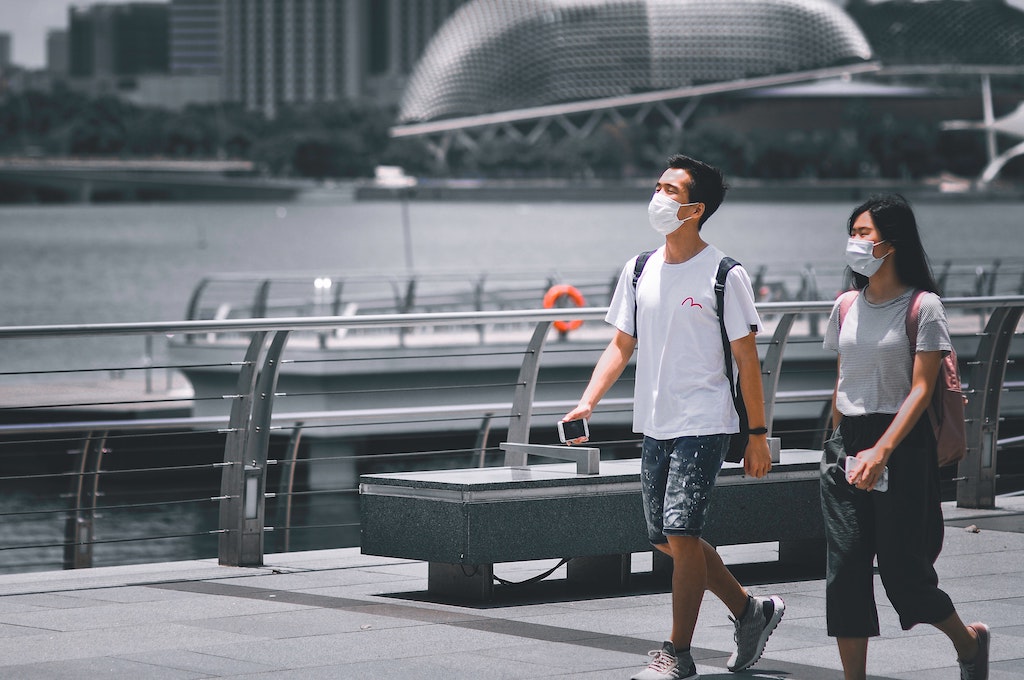
Singapore has introduced a wide range of digital interventions to improve public health. This includes using online tools to direct citizens to locations dispensing government-issued surgical masks (MaskGoWhere) and highlighting healthcare facilities focusing on respiratory illnesses (FluGoWhere). These two sites received more than 1.4 million visits in just a few days.

Handling COVID-19 related inquiries

A national  WhatsApp  channel has more than 630,000 subscribers, whilst chatbots for  citizens  and  businesses have answered more than 75,000 COVID-19 related queries. The government has also mandated use of SMS and web-based platforms to ensure that those in quarantine stay at home.

Technology has played a key role in COVID-19 diagnosis. The trial of an AI-driven smartphone-based temperature checker, which drastically increases the amount of possible simultaneous temperature measurements, moved to larger-scale trials in major public areas in just a matter of days.

The government also targeted research and development to develop their own nucleic acid testing kits which shorten the results processing time, and allows testing of suspected cases at priority locations such as airports. Communication has also been important, particularly in tackling misinformation.

Short and long term response

Singapore’s COVID-19 treatment efforts can be split into the short and long term. More immediately, the country is focusing on research into effective treatment options, including remaining alert to novel drug candidates, and potential vaccine candidates.

These efforts align with Singapore’s focus on becoming a global leader in DeepTech, a strategy being driven by the Global Centre’s partner, SGInnovate.

In the longer term, the government is also engaging with the consequences of COVID-19, including relaxing hiring restrictions in manufacturing and services industries, and expanding reskilling efforts into sectors particularly affected by the disease. They’ve even developed a Pacman-esque online game to discourage panic-buying.

The UNDP Global Centre for Technology, Innovation, and Sustainable Development, based in Singapore, has seen this response up close.

Global implications

We are partnering with the Smart Nation Programme Office in Singapore to better understand the fundamentals of Singapore’s response plan, and the potential implications for UNDP’s work around the world.

The real time lessons will continue to shape the global disease response, particularly as the pandemic spreads.

Scientific research has highlighted that potentially 2.8 times the number of COVID-19 cases could have been recognized worldwide, and therefore managed better, if all the countries coping with the virus now had taken this approach.

Singapore’s response was built on robust digital foundations. It has also been driven by the incredible efforts of people, start-ups and institutions. Technology is not a panacea in any situation. But when applied strategically it can catalyze human talent, dedication and leadership. Such an approach is important to consider as countries continue to tackle COVID-19, and in future responses to other global challenges.

Original article: United Nations Development Programme

Total
0
Shares
Share
Tweet
Share
Share
Related Topics
  • Coronavirus
  • COVID-19
  • SGInnovate
  • Singapore
  • Smart City
dotlah.com

Previous Article
  • Lah!

DBS Further Boosts Its Cash Flow Support For SMEs, Upsizes Collateral-free Digital Business Loan To SGD 200,000

  • April 9, 2020
View Post
Next Article
  • Lah!
  • Technology

Supporting National Efforts To Stay Home, Go Digital, And Stem COVID-19 Infections

  • April 9, 2020
View Post
You May Also Like
Red Hat OpenShift
View Post
  • Artificial Intelligence
  • Technology

Red Hat Further Drives Digital Sovereignty for the AI Era with Red Hat OpenShift on Google Cloud Dedicated

  • Dean Marc
  • April 21, 2026
View Post
  • Artificial Intelligence
  • Technology

Here’s how to get the $7 trillion AI hardware buildout right

  • dotlah.com
  • April 18, 2026
totus-technologies-cover
View Post
  • Business
  • Technology
  • World Events

The Transatlantic Tech Rift and Why Data Sovereignty Is the New Industrial Imperative

  • Ackley Wyndam
  • April 16, 2026
View Post
  • Technology

Hon Hai Technology Group (Foxconn) Recognized As Top 100 Global Innovators 2026

  • Dean Marc
  • April 9, 2026
View Post
  • Artificial Intelligence
  • Technology

Kioxia Announces New SSD Model Optimized for AI GPU-Initiated Workloads

  • Dean Marc
  • March 17, 2026
View Post
  • Artificial Intelligence
  • Technology

U.S. Ski & Snowboard and Google Announce Collaboration to Build an AI-Based Athlete Performance Tool

  • Dean Marc
  • February 8, 2026
View Post
  • Artificial Intelligence
  • Technology

IBM to Support Missile Defense Agency SHIELD Contract

  • Dean Marc
  • February 5, 2026
Smartphone hero image
View Post
  • Gears
  • Technology

Zed Approves | Smartphones for Every Budget Range

  • Ackley Wyndam
  • January 29, 2026


Trending
  • 1
    • Lah!
    • Technology
    Cisco And NUS Launch S$54 Million Corporate Laboratory To Boost Innovation And Research And Accelerate Singapore’s Digital Economy
    • November 7, 2021
  • crowded train 2
    • Cities
    • People
    How Has Our Urban World Made Pandemics More Likely?
    • January 10, 2021
  • Humans, Futurism, Intelligence and AI 3
    • People
    AI Embodies Gardner’s Vision: A Look at Multiple Intelligences
    • June 27, 2023
  • 4
    • Cities
    Singapore Polytechnic Graduates Respond To COVID-19 Pandemic With Love And Empathy
    • April 28, 2020
  • 5
    • Lah!
    SGX Introduces S$5 Million Care Package To Provide Support Amid COVID-19
    • March 17, 2020
  • 6
    • Technology
    Singapore International Cyber Week 2020 – Highlights And Testimonials
    • October 21, 2020
  • 7
    • Lah!
    SGX Welcomes Nanofilm Technologies International Limited To Mainboard
    • November 2, 2020
  • 8
    • Technology
    UOB Asset Management Sees Surge In Online Corporate Investing As Companies, Especially SMEs, Reap The Benefits Of Digitalisation
    • July 15, 2021
  • 9
    • Lah!
    • Science
    New Crab Species With Asymmetrical Reproductive Units Identified
    • June 22, 2021
  • 10
    • Technology
    Dyson To Build Electric Cars In Singapore – With 2021 Launch Planned
    • October 25, 2018
  • damir-spanic-09znJJdtZFc-unsplash 11
    • Cities
    • People
    Sleep And The City: How To Improve Your Sleep When Living In A City
    • September 7, 2021
  • 12
    • Cities
    • Lah!
    9.6km Of New Cycling Paths In Taman Jurong And Tampines
    • November 3, 2021
Trending
  • Red Hat OpenShift 1
    Red Hat Further Drives Digital Sovereignty for the AI Era with Red Hat OpenShift on Google Cloud Dedicated
    • April 21, 2026
  • Illustration of data storage 2
    The Splinternet Comes for European Supply Chains Why Fragmentation Is Now a Boardroom Problem
    • April 21, 2026
  • 3
    Here’s how to get the $7 trillion AI hardware buildout right
    • April 18, 2026
  • totus-technologies-cover 4
    The Transatlantic Tech Rift and Why Data Sovereignty Is the New Industrial Imperative
    • April 16, 2026
  • 5
    What will it take to get ships going through the Strait of Hormuz again?
    • April 13, 2026
  • 6
    Hon Hai Technology Group (Foxconn) Recognized As Top 100 Global Innovators 2026
    • April 9, 2026
  • 7
    3 lessons on the energy transition in an age of crisis
    • April 7, 2026
  • 8
    Samsung Unveils Galaxy A57 5G and Galaxy A37 5G, Packing Pro-Level Features at Awesome Price
    • March 25, 2026
  • 9
    The global price tag of war in the Middle East
    • March 24, 2026
  • 10
    Kioxia Announces New SSD Model Optimized for AI GPU-Initiated Workloads
    • March 17, 2026
Social Links
dotlah! dotlah!
  • Cities
  • Technology
  • Business
  • Politics
  • Society
  • Science
  • About
Connecting Dots Across Asia's Tech and Urban Landscape

Input your search keywords and press Enter.