dotlah! dotlah!
  • Cities
  • Technology
  • Business
  • Politics
  • Society
  • Science
  • About
Social Links
  • zedreviews.com
  • citi.io
  • aster.cloud
  • liwaiwai.com
  • guzz.co.uk
  • atinatin.com
0 Likes
0 Followers
0 Subscribers
dotlah!
  • Cities
  • Technology
  • Business
  • Politics
  • Society
  • Science
  • About
  • Science
  • Technology

To Make An Atom-sized Machine, You Need A Quantum Mechanic

  • May 5, 2020
Total
0
Shares
0
0
0

Here’s a new chapter in the story of the miniaturisation of machines: researchers in a laboratory in Singapore have shown that a single atom can function as either an engine or a fridge. Such a device could be engineered into future computers and fuel cells to control energy flows.

“Think about how your computer or laptop has a lot of things inside it that heat up. Today you cool that with a fan that blows air. In nanomachines or quantum computers, small devices that do cooling could be something useful,” says Dario Poletti from the Singapore University of Technology and Design (SUTD).

This work gives new insight into the mechanics of such devices. The work is a collaboration involving researchers at the Centre for Quantum Technologies (CQT) and Department of Physics at the National University of Singapore (NUS), SUTD and at the University of Augsburg in Germany. The results were published in the peer-reviewed journal npj Quantum Information on 1 May.

Engines and refrigerators are both machines described by thermodynamics, a branch of science that tells us how energy moves within a system and how we can extract useful work. A classical engine turns energy into useful work. A refrigerator does work to transfer heat, reducing the local temperature. They are, in some sense, opposites.

People have made small heat engines before using a single atom, a single molecule and defects in diamond. A key difference about this device is that it shows quantumness in its action. “We want to understand how we can build thermodynamic devices with just a few atoms. The physics is not well understood so our work is important to know what is possible,” says Manas Mukherjee, a Principal Investigator at CQT, NUS, who led the experimental work.

The researchers studied the thermodynamics of a single barium atom. They devised a scheme in which lasers move one of the atom’s electrons between two energy levels as part of a cycle, causing some energy to be pushed into the atom’s vibrations. Like a car engine consumes petrol to both move pistons and charge up its battery, the atom uses energy from lasers as fuel to increase its vibrating motion. The atom’s vibrations act like a battery, storing energy that can be extracted later. Rearrange the cycle and the atom acts like a fridge, removing energy from the vibrations.

In either mode of operation, quantum effects show up in correlations between the atom’s electronic states and vibrations. “At this scale, the energy transfer between the engine and the load is a bit fuzzy. It is no longer possible to simply do work on the load, you are bound to transfer some heat,” says Poletti. He worked out the theory with collaborators Jiangbin Gong at NUS Physics and Peter Hänggi in Augsburg. The fuzziness makes the process less efficient, but the experimentalists could still make it work.

Mukherjee and colleagues Noah Van Horne, Dahyun Yum and Tarun Dutta used a barium atom from which an electron (a negative charge) is removed. This makes the atom positively charged, so it can be more easily held still inside a metal chamber by electrical fields. All other air is removed from around it. The atom is then zapped with lasers to move it through a four-stage cycle.

The researchers measured the atom’s vibration after applying 2 to 15 cycles. They repeated a given number of cycles up to 150 times, measuring on average how much vibrational energy was present at the end. They could see the vibrational energy increasing when the atom was zapped with an engine cycle, and decreasing when the zaps followed the fridge cycle.
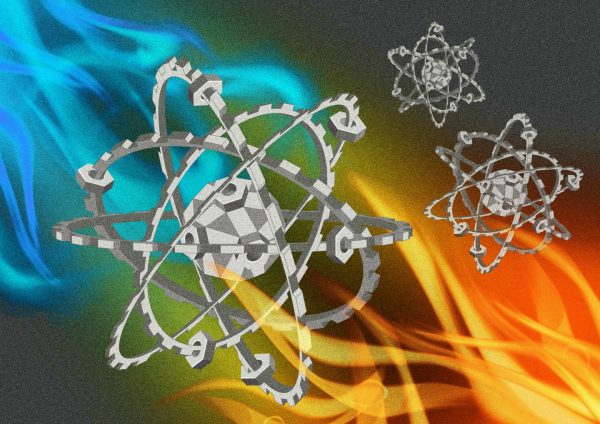
 Experiments with a single-atom device help researchers understand what quantum effects come into play when machinery shrinks to the atomic scale. (Aki Honda / Centre for Quantum Technologies, National University of Singapore)

Understanding the atom-sized machine involved both complicated calculations and observations. The team needed to track two thermodynamic quantities known as ergotropy, which is the energy that can be converted to useful work, and entropy, which is related to disorder in the system. Both ergotropy and entropy increase as the atom-machine runs. There’s still a simple way of looking at it, says first author and PhD student Van Horne, “Loosely speaking, we’ve designed a little machine that creates entropy as it is filled up with free energy, much like kids when they are given too much sugar.”


Reference:

“Single-atom energy-conversion device with a quantum load”

npj Quantum Information, DOI:10.1038/s41534-020-0264-6 (2020)

https://www.nature.com/articles/s41534-020-0264-6

Total
0
Shares
Share
Tweet
Share
Share
Related Topics
  • National University of Singapore
  • NUS
  • Quantum Mechanics
  • Singapore University of Technology and Design
dotlah.com

Previous Article
  • Lah!

OCBC Bank Places All Individual Secured And Unsecured Loans Under Its Singapore Covid-19 Relief Programme With S$4 Billion Approved To Date

  • May 5, 2020
View Post
Next Article
  • Science
  • Society

The Mysterious Disappearance Of The First SARS Virus, And Why We Need A Vaccine For The Current One But Didn’t For The Other

  • May 5, 2020
View Post
You May Also Like
View Post
  • Artificial Intelligence
  • Technology

Google Opens Singapore Engineering Center to Build and Export Enterprise Cloud and AI to the World

  • Dean Marc
  • September 15, 2026
View Post
  • Research
  • Technology

MIT researchers tackle the economic realities of fusion power

  • dotlah.com
  • August 10, 2026
zedreviews-valerion
View Post
  • Gears
  • Technology

Father’s Day Outdoors – Build Dad the Ultimate Backyard Watch Party

  • Dean Marc
  • June 21, 2026
zedreviews-fathers-day-50830
View Post
  • Gears
  • Technology

Father’s Day Outdoors, Round Two – Gear for the Action, the Tailgate, and Beating the Heat

  • Dean Marc
  • June 21, 2026
zedreviews-fathers-day-21306
View Post
  • Gears
  • Technology

A Father’s Day Gift Guide for Every Dad – Timepieces and Travel Gear

  • Dean Marc
  • June 21, 2026
View Post
  • Gears
  • Technology

Samsung Art Store Brings Art Basel to Homes Worldwide With New Curated Collection

  • Dean Marc
  • June 15, 2026
View Post
  • Artificial Intelligence
  • Technology

The consequences of relying on AI for accurate news

  • dotlah.com
  • June 10, 2026
pope-leo-xiv-cq5dam-1500.844
View Post
  • Artificial Intelligence
  • Technology

Pope Leo XIV to Publish First Encyclical on Artificial Intelligence and Human Dignity on 25 May

  • dotlah.com
  • May 23, 2026


Trending
  • work-from-home-pexels-nataliya-vaitkevich-5412175 1
    • Features
    • People
    5 Tips To Succeed Working From Home
    • May 6, 2021
  • 2
    • People
    • World Events
    5 Lessons We Must Take From The Coronavirus Crisis
    • August 25, 2020
  • 3
    • Artificial Intelligence
    • Technology
    Google Opens Singapore Engineering Center to Build and Export Enterprise Cloud and AI to the World
    • September 15, 2026
  • 4
    • Lah!
    • Technology
    Using Pollen For 3D Printing
    • August 31, 2021
  • 5
    • Lah!
    • Technology
    Infor And DBS Bank Partner To Integrate Digital Trade Financing Into Global Supply Chains
    • July 24, 2020
  • 6
    • Features
    • People
    Effective Ways For Teaching Children With Autism
    • August 8, 2020
  • 7
    • Technology
    Microsoft Celebrates The 3rd Anniversary Of Teams: The Hub For Teamwork And Productivity
    • March 22, 2020
  • 8
    • People
    Has The World Gone Far Enough In Women’s Rights?
    • April 1, 2020
  • town-square-people-nico-benedickt-T6y2QE9IIfI-unsplash 9
    • Cities
    How Local Municipalities Can Manage Themselves More Efficiently
    • March 17, 2021
  • 10
    • Science
    Infection Method Behind ‘Crop Killer’ Bacteria Revealed
    • August 19, 2021
  • 11
    • Lah!
    DBS Launches World’s First Sustainable And Transition Finance Framework And Taxonomy To Help Clients Advance On Sustainability Agenda
    • July 1, 2020
  • 12
    • Cities
    DBS Named Asia’s Safest Bank For 12th Consecutive Year
    • October 21, 2020
Trending
  • 1
    Chinese tech giant Huawei unveils Mate 90 series smartphones with flagship Tau chips adopting logic folding technology
    • October 3, 2026
  • 2
    Google Opens Singapore Engineering Center to Build and Export Enterprise Cloud and AI to the World
    • September 15, 2026
  • 3
    Apple Flagship Hardware Launch for September 2026
    • September 10, 2026
  • 4
    MIT researchers tackle the economic realities of fusion power
    • August 10, 2026
  • 5
    ASEAN, treaty parties push stronger cooperation as Treaty of Amity and Cooperation in Southeast Asia marks 50 years
    • July 26, 2026
  • 6
    The Fastest AI Fried Chicken In The World
    • June 29, 2026
  • 7
    Zed Approves | How to Stay Cool in Extreme Heat
    • June 29, 2026
  • 8
    Was Venezuela struck by an earthquake ‘doublet’? Here’s what we know so far
    • June 27, 2026
  • 9
    Zed Approves | It’s Prime Day 2026! Time to Upgrade Your World Cup Viewing Setup and Beat the Heat
    • June 25, 2026
  • 10
    Zed Approves | The Best Prime Day PC Deals: Top Gaming Rigs, Workstations, and Everyday Laptops
    • June 25, 2026
Social Links
dotlah! dotlah!
  • Cities
  • Technology
  • Business
  • Politics
  • Society
  • Science
  • About
Connecting Dots Across Asia's Tech and Urban Landscape

Input your search keywords and press Enter.