World AIDS Day this year finds us still deep amid another pandemic – COVID-19.
The highly infectious novel coronavirus has swept across the world, devastating health systems and laying waste to economies as governments introduced drastic measures to contain the spread. Not since the HIV/AIDS pandemic of the 1990s have countries faced such a common health threat.
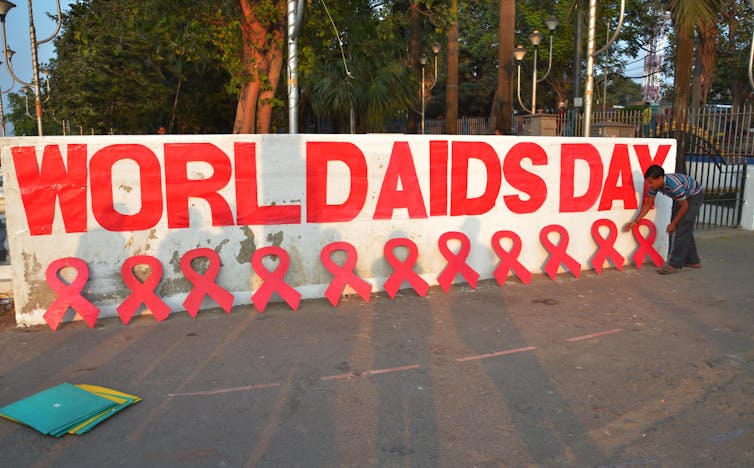
This explains why UNAIDS has selected the theme “Global Solidarity, Shared Responsibility” for this year’s World AIDS Day.
Infectious diseases such as these remain a major threat to human health and prosperity. Around 32.7 million people have died from AIDS-related illnesses in the last 40 years. At the time of writing, 1.4 million people had already died from COVID-19 in just one year.
These diseases take incredible expertise, collaboration and dedication from all levels of society to track, understand, treat and prevent.
The HIV/AIDS response played out over a much longer trajectory than COVID-19. But it is, in some respects, a shining example of what can be achieved when countries and people work together. The work of organisations such as the World Health Organisation, UNAIDS and the International AIDS Society help to coordinate rapid sharing of information and resources between healthcare providers and communities.
The Global Fund and PEPFAR have mobilised resources that have helped to reduce morbidity and mortality in low- and middle-income regions. AIDS-related deaths have declined worldwide by 39% since 2010.
These and other groups have also fought against high drug prices that would render medication inaccessible to many in the developing world. In South Africa, the epicentre of the HIV epidemic, a day’s supply of the simplest antiretrovirals cost about R250 in 2002. Today easier, more palatable treatment taken once per day costs a few rands.
Collaboration and co-ordination has also meant that medications have been developed and tested in populations across the world. And once available, global guidelines and training opportunities ensure that healthcare provision and quality is standardised.
Many of these achievements did not come without a fight. Dedicated and sustained activism, at a political and community level were required to drive down drug pricing for the global South and is constantly required to ensure inclusive distribution of resources.
The corollary is also true – areas where the world continues to struggle arise predominantly where there’s a lack of solidarity and agreement. These include a lack of political support to implement evidence-based protection mechanisms for vulnerable or stigmatised populations. For example the legalisation of homosexuality. This results in continued but avoidable HIV infection and related mortality.
These lessons need to be taken on board as the world prepares for the next phase of managing COVID-19. All the interventions that helped contain and manage HIV and AIDS are critical in ensuring that no country, regardless of developmental status, and no population, especially those that face stigma and battle to access healthcare services, are left behind.
Building on existing systems
The lessons learnt from HIV and AIDS can be used to inform the COVID-19 response as the challenges are similar.
Many of the ongoing COVID-19 vaccine trials are taking place in multiple countries, including South Africa. The capacity to conduct these studies, including the clinical staff and trial sites, are well established as a result of decades of HIV/AIDS research. There are fears that developing nations might be excluded from accessing an effective COVID-19 vaccine. But global mechanisms are now in place to avoid this and to, instead, encourage and enable global solidarity, some of which were championed by the HIV/AIDS response.
The Access to COVID-9 Tools (ACT)-Accelerator, established by the World Health Organisation in April 2020 in collaboration with many other global organisations, governments, civil society and industry, have committed through the pillar known as Covax, to equitable distribution of a COVID-19 vaccine as well as diagnostic tests and treatments. These global institutions and mechanisms require continued support.
With the deployment of an effective vaccine, an end to COVID-19 might soon be in sight. For HIV, vaccine development has been more complex and disappointing. The global community needs to remain committed to promoting access and support for the many incredible prevention and treatment options that are available. The unprecedented effort on the part of private industry in the COVID-19 vaccine response shines a light on what can be achieved when all interested parties engage. The HIV and TB vaccine endeavours need a similar effort.
These are not the only pandemics the world will face. In fact, there are strong predictions that the emergence of new pandemics will increase in the future. This is due to the effects of globalisation, climate change and proximity to wildlife.
The best hope for humanity is to not lose sight of what these pandemics cost us in terms of loved ones, in terms of freedom and economically. We must prepare now collectively across countries and across all levels of society. These preparations need to be grounded in the lessons learnt from HIV/AIDS and re-learnt from COVID-19.
Social solidarity
The success of the global response to current and emerging pandemics will rely on the ability of the less vulnerable to acknowledge their shared responsibility and respond to those calls.
An important truth of the HIV epidemic is that it doesn’t discriminate. No infectious disease acknowledges political borders and everybody is at risk of being infected or affected. If nothing else, because of this we need to continue to work together on a global scale knowing that “no one is safe, until everyone is safe”.
Carey Pike, Executive Research Assistant at the Desmond Tutu Health Foundation contributed to this article.
Linda-Gail Bekker, Professor of medicine and deputy director of the Desmond Tutu HIV Centre at the Institute of Infectious Disease and Molecular Medicine, University of Cape Town
This article is republished from The Conversation under a Creative Commons license. Read the original article.