
Singapore’s Quantum Engineering Programme (QEP) will start conducting nationwide trials of quantum-safe communication technologies that promise robust network security for critical infrastructure and companies handling sensitive data. Supported by the National Research Foundation, Singapore (NRF), the project kicks off with 15 private and government collaborators on board.
Network security is a cornerstone of today’s digital society. The public-key encryption that protects some of the billions of bits of data exchanged each day is known to be vulnerable to attacks by quantum computers, which have the potential to be millions of times more powerful than classical computers at some tasks. While today’s quantum computers are too small to break encryption, calls to address the cybersecurity threat become more urgent as the technology advances.
Quantum-safe communication technologies are designed to counter the threat of quantum computing with specialised hardware and new cryptographic algorithms. They could secure communication systems for governments, critical infrastructure such as energy grids, and companies handling sensitive data in areas such as healthcare and finance.
The new National Quantum-Safe Network (NQSN) will deploy commercial technologies for trials with government agencies and private companies, conduct in-depth evaluation of security systems, and develop guidelines to support companies in adopting such technologies.
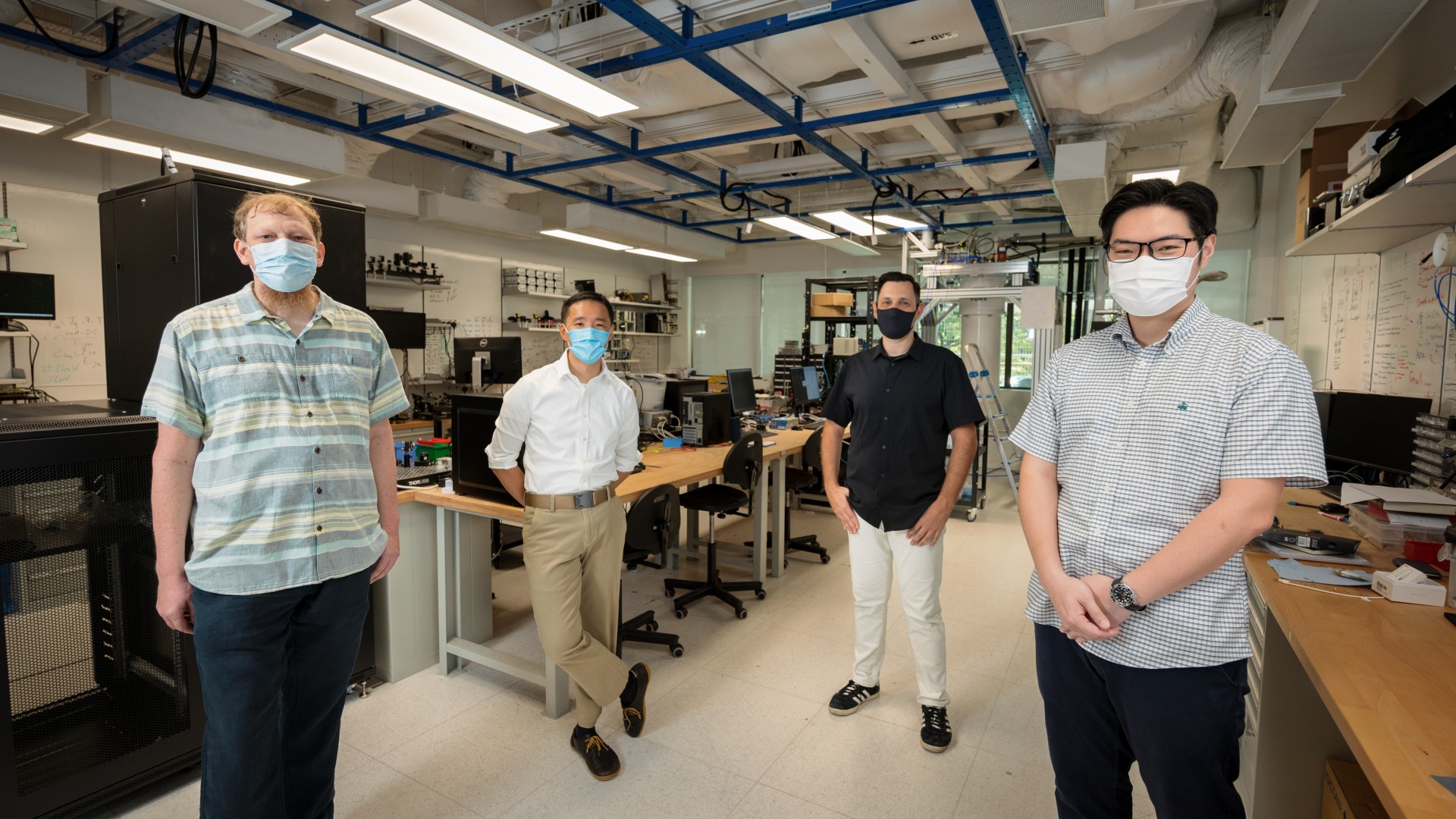
“Singapore can build on its heritage in quantum science, optics and cybersecurity engineering to become a trusted global provider of quantum network technology and services. In NQSN, we will bring quantum innovation to deployed optical networks, where we can study operational issues such as a quantum network’s reliability and resilience together with our industry partners,” said Assistant Professor Charles Lim, lead Principal Investigator (PI) for the NQSN, from the Department of Electrical and Computer Engineering and Centre for Quantum Technologies at the National University of Singapore (NUS). He will work with three co-PIs to deliver the network goals.
Hosted by NUS, the initiative will receive S$8.5 million over three years. Collaborators will bring expertise, equipment and use-cases to the project.
Mr Ling Keok Tong, Director (Smart Nation & Digital Economy), NRF, said, “The new National Quantum-Safe Network aims to enhance network security for critical infrastructure with superior quantum technology and solutions, while also serving as a robust platform for public-private collaboration. This is a hallmark of translational research excellence and is also one of the key initiatives under the RIE2025 plan that bolsters Singapore’s ongoing transition into a trusted digital innovation hub.”
Dr Ong Chen Hui, Cluster Director (BizTech Group), Infocomm Media Development Authority (IMDA), said, “A National Quantum-Safe Network is an important step forward as we explore advances of quantum computing and network technologies. IMDA will continue to push the boundaries in frontier technologies, to architect Singapore’s digital future. Together with the NRF, NUS, as well as our industry and research partners, we will look into ways to operationalise and implement the quantum key distribution network on Singapore’s extensive fibre network infrastructures.”
The joint research team expects to have the first nodes up within a year. In parallel, they will establish a Quantum Security Lab to commence advanced quantum security vulnerability research and secure design. They will also organise workshops with potential end-users to better understand their needs and build awareness of the new technologies available.
Quantum-Safe Living Lab
Initial plans for the deployment are for 10 network nodes to be installed across Singapore connected to fibre, including two at NUS, two at the Nanyang Technological University, Singapore (NTU Singapore), and others at government and private company premises.
The nodes will be connected to provide a public network that can act as a living lab for organisations wanting to experience quantum-safe communication technologies, and separable government and private networks trialling dedicated users’ applications.
A further experimental node at NUS will make a free-space connection to the public network, developing technologies that could extend secure links to locations that cannot be connected to fibre or may even be moving, such as boats.
The network will provide the following technologies:
i) Quantum key distribution – a hardware approach to quantum-safe communication requiring the installation of devices to create and receive quantum signals; and
ii) Post-quantum cryptography – upgrading software to run new cryptographic algorithms perceived to be resistant to attacks by quantum computers.
Comprehensive Public-Private Partnerships
The project kicks off with more than 15 collaborators and will welcome new partners as work progresses. This also includes an earlier announcement by NUS on their collaborations for QEP with Amazon Web Services (AWS)[1] and with Thales[2] that will contribute to the NQSN.
Participating organisations will contribute in different ways to the network:
- NUS, NTU Singapore and Fraunhofer Singapore will provide expertise, coordination and locations for hardware.
- NetLink Trust will provide access to Singapore’s optical fibre network.
- AWS, Government Technology Agency of Singapore, the National Supercomputing Centre (NSCC) Singapore and ST Telemedia Global Data Centres will contribute to development of use-cases.
- ST Engineering and Thales will work on network security, providing hardware for integration into the network.
- The Cyber Security Agency of Singapore (CSA) will work along with its approved Common Criteria testing labs T-Systems and UL towards formal security certification of quantum-safe technologies.
- The Defence Science and Technology Agency, HTX (Home Team Science and Technology Agency), DSO National Laboratories and Horizon Quantum Computing will participate in quantum network research projects.
- IMDA will collaborate with Institutes of Higher Learning, industry and research partners to find ways to operate and implement the NQSN on Singapore’s fibre network infrastructures.
The NQSN plans were developed in consultation with a working group also involving the Singapore Economic Development Board Singapore (EDB).
Michael Kasper, co-coordinator for the NQSN and Department Director for Cyber- and Information Security at Fraunhofer Singapore, said, “Quantum-safe communication can play a crucial role in long-term information security. With NQSN, we aim to demonstrate crypto-agile connectivity for our partners and support the deployment of quantum networks for broader use in industry and society.”
[1] https://news.nus.edu.sg/quantum-engineering-programme-teams-with-amazon-web/