dotlah! dotlah!
  • Cities
  • Technology
  • Business
  • Politics
  • Society
  • Science
  • About
Social Links
  • zedreviews.com
  • citi.io
  • aster.cloud
  • liwaiwai.com
  • guzz.co.uk
  • atinatin.com
0 Likes
0 Followers
0 Subscribers
dotlah!
  • Cities
  • Technology
  • Business
  • Politics
  • Society
  • Science
  • About
  • Featured
  • Science
  • Technology

Dedekind Number, Mathematics, Number Theory, Paderborn University, Real Numbers,

  • July 13, 2023
9th-dedekind-number-feature
Total
0
Shares
0
0
0

Making history with 42 digits: Scientists at Paderborn University and KU Leuven have unlocked a decades-old mystery of mathematics with the so-called ninth Dedekind number. Experts worldwide have been searching for the value since 1991. The Paderborn scientists arrived at the exact sequence of numbers with the help of the Noctua supercomputer located there. The results will be presented in September at the International Workshop on Boolean Functions and their Applications (BFA) in Norway.

What started as a master’s thesis project by Lennart Van Hirtum, then a computer science student at KU Leuven and now a research associate at the University of Paderborn, has become a huge success. The scientists join an illustrious group with their work: Earlier numbers in the series were found by mathematician Richard Dedekind himself when he defined the problem in 1897, and later by greats of early computer science such as Randolph Church and Morgan Ward. “For 32 years, the calculation of D(9) was an open challenge, and it was questionable whether it would ever be possible to calculate this number at all,” Van Hirtum says.

The previous number in the Dedekind sequence, the 8th Dedekind number, was found in 1991 using a Cray 2, the most powerful supercomputer at the time. “It therefore seemed conceivable to us that it should be possible by now to calculate the 9th number on a large supercomputer,” says Van Hirtum, describing the motivation for the ambitious project, which he initially implemented jointly with the supervisors of his master’s thesis at KU Leuven.
Image-Fotos Forschung Universitaet Paderborn +++ Zeitlich einfache und unbegrenzte Nutzungsrechte der Fotos fuer die Website der Universitaet bzw. der Fakultaeten und fuer hauseigene Print- und Onlinemedien sowie fuer die Oeffentlichkeitsarbeit, z.B. Bildmaterial für Pressemitteilungen etc., der Universitaet. Das Nutzungsrecht beinhaltet das Recht, die Fotos (elektronisch) zu bearbeiten und zum Zwecke der Oeffentlichkeitsarbeit der Universitaet zu vervielfaeltigen, zu verbreiten und zu veroeffentlichen. Bei Verwendung bitte stets Quellenangabe Foto: Universitaet Paderborn/Besim Mazhiqi angeben.
symbolic image (Paderborn University, Besim Mazhiqi)

Grains of sand, chess and supercomputers

The main subject of Dedekind numbers are so-called monotone Boolean functions. Van Hirtum explains, “Basically, you can think of a monotone Boolean function in two, three, and infinite dimensions as a game with an n-dimensional cube. You balance the cube on one corner and then color each of the remaining corners either white or red. There is only one rule: you must never place a white corner above a red one. This creates a kind of vertical red-white intersection. The object of the game is to count how many different cuts there are. Their number is what is defined as the Dedekind number. Even if it doesn’t seem like it, the numbers quickly become gigantic in the process: the 8th Dedekind number already has 23 digits.”

Comparably large – but incomparably easier to calculate – numbers are known from a legend concerning the invention of the game of chess. “According to this legend, the inventor of the chess game asked the king for only a few grains of rice on each square of the chess board as a reward: one grain on the first square, two grains on the second, four on the third, and twice as many on each of the following squares. The king quickly realized that this request was impossible to fulfill, because so much rice does not exist in the whole world. The number of grains of rice on the complete board would have 20 digits – an unimaginable amount, but still less than D(8). When you realize these orders of magnitude, it is obvious that both an efficient computational method and a very fast computer would be needed to find D(9),” Van Hirtum said.
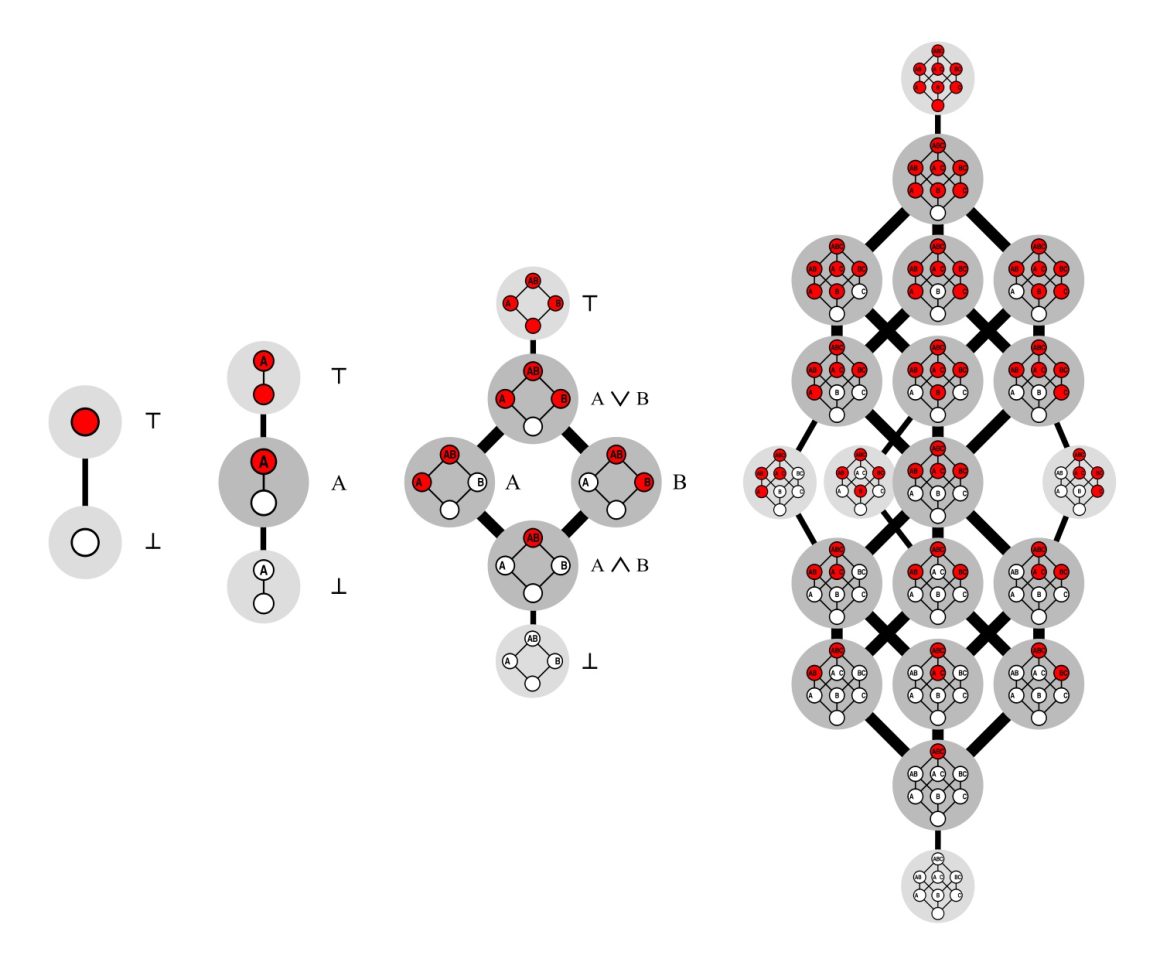
The figure shows all possible cuts for dimensions 0, 1, 2, and 3. The number of these colored 2D, 3D, - N-dimensional cuts that can be formed is what is defined as the Dedekind number.
The figure shows all possible cuts for dimensions 0, 1, 2, and 3. The number of these colored 2D, 3D, – N-dimensional cuts that can be formed is what is defined as the Dedekind number.

Milestone: Years become months

To calculate D(9), the scientists used a technique developed by master’s thesis advisor Patrick De Causmaecker known as the P-coefficient formula. It provides a way to calculate Dedekind numbers not by counting, but by a very large sum. This allows D(8) to be decoded in just eight minutes on a normal laptop. But, “What takes eight minutes for D(8) becomes hundreds of thousands of years for D(9). Even if you used a large supercomputer exclusively for this task, it would still take many years to complete the calculation,” Van Hirtum points out. The main problem is that the number of terms in this formula grows incredibly fast. “In our case, by exploiting symmetries in the formula, we were able to reduce the number of terms to ‘only’ 5.5*10^18 – an enormous amount. By comparison, the number of grains of sand on Earth is about 7.5*10^18, which is nothing to sneeze at, but for a modern supercomputer, 5.5*10^18 operations are quite manageable,” the computer scientist said. The problem: The calculation of these terms on normal processors is slow and also a use of GPUs as currently the fastest hardware accelerator technology for many AI applications is not efficient for this algorithm.

The solution: application-specific hardware using highly specialized and parallel arithmetic units – so-called FPGAs (field programmable gate arrays). Van Hirtum developed an initial prototype for the hardware accelerator and began looking for a supercomputer that had the necessary FPGA cards. In the process, he became aware of the Noctua 2 computer at the “Paderborn Center for Parallel Computing (PC2)” at the University of Paderborn, which has one of the world’s most powerful FPGA systems.

Prof. Dr. Christian Plessl, head of PC2, explains: “When Lennart Van Hirtum and Patrick De Causmaeker contacted us, it was immediately clear to us that we wanted to support this moonshot project. Solving hard combinatorial problems with FPGAs is a promising field of application and Noctua 2 is one of the few supercomputers worldwide with which the experiment is feasible at all. The extreme reliability and stability requirements also pose a challenge and test for our infrastructure. The FPGA expert consulting team worked closely with Lennart to adapt and optimize the application for our environment.”

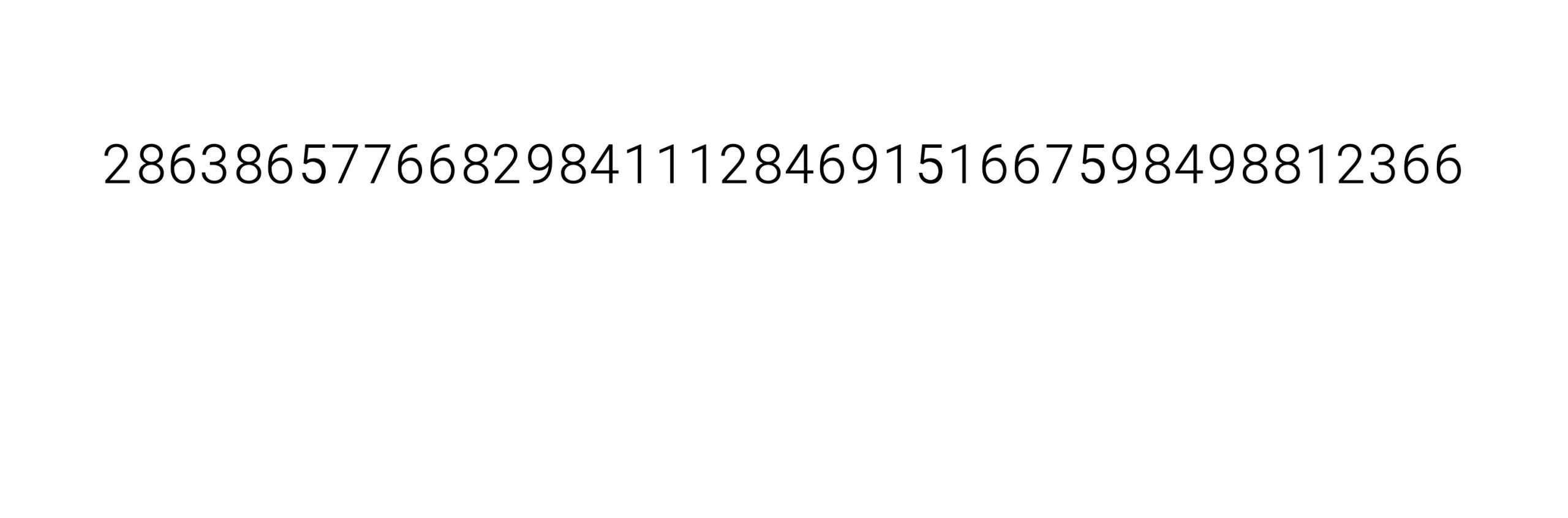
After several years of development, the program ran on the supercomputer for about five months. And then the time had come: on March 8, the scientists found the 9th Dedekind number: 286386577668298411128469151667598498812366.

Source: Paderborn University

Total
0
Shares
Share
Tweet
Share
Share
Related Topics
  • Dedekind Number
  • Mathematics
  • Number Theory
  • Paderborn University
  • Real Numbers
dotlah.com

Previous Article
The-Infinity_of_Numbers___by_Johimja__e1abe88e-12df-4a5c-b256-763b9a131ce6
  • Science
  • Technology

Exploring Dedekind Numbers – Infinite Patterns in Mathematics

  • July 13, 2023
View Post
Next Article
Man walking on pedestrian by Ryoji Iwata
  • Artificial Intelligence
  • Featured
  • People

Behind The AI Revolution – Then, Now, And The Future – Are People.

  • July 17, 2023
View Post
You May Also Like
View Post
  • Artificial Intelligence
  • Technology

Google Opens Singapore Engineering Center to Build and Export Enterprise Cloud and AI to the World

  • Dean Marc
  • September 15, 2026
View Post
  • Research
  • Technology

MIT researchers tackle the economic realities of fusion power

  • dotlah.com
  • August 10, 2026
zedreviews-valerion
View Post
  • Gears
  • Technology

Father’s Day Outdoors – Build Dad the Ultimate Backyard Watch Party

  • Dean Marc
  • June 21, 2026
zedreviews-fathers-day-50830
View Post
  • Gears
  • Technology

Father’s Day Outdoors, Round Two – Gear for the Action, the Tailgate, and Beating the Heat

  • Dean Marc
  • June 21, 2026
zedreviews-fathers-day-21306
View Post
  • Gears
  • Technology

A Father’s Day Gift Guide for Every Dad – Timepieces and Travel Gear

  • Dean Marc
  • June 21, 2026
View Post
  • Gears
  • Technology

Samsung Art Store Brings Art Basel to Homes Worldwide With New Curated Collection

  • Dean Marc
  • June 15, 2026
View Post
  • Business
  • dotZero
  • Featured
  • Features
  • Op-Ed

You Do Not Need to Invest in the IPO of SpaceX, Anthropic, and OpenAI

  • Dean Marc
  • June 10, 2026
View Post
  • Artificial Intelligence
  • Technology

The consequences of relying on AI for accurate news

  • dotlah.com
  • June 10, 2026


Trending
  • 1
    • Lah!
    Environmental Sanitation Standards To Be Made Mandatory For Various Types of Premises To Raise Public Hygiene Standards
    • March 5, 2020
  • usa-flag-jason-leung-mmth0KV0oFQ-unsplash 2
    • Cities
    2022’s Most Independent States In America
    • July 5, 2022
  • smart-fortwo-ev-share-now-S6q25Py7fyE-unsplash 3
    • Cities
    • Gears
    Top 8 Compact Electric Vehicles for City Driving
    • April 17, 2023
  • 4
    • Lah!
    Singapore Night Festival: Revelry And Recreation At Bras Basah.Bugis District
    • August 29, 2019
  • 5
    • Cities
    The Biggest Economies In The World
    • August 11, 2020
  • ufo-albert-antony-HWQXIYbs8PM-unsplash 6
    • People
    One Third of Americans Believe in Aliens
    • June 3, 2021
  • 7
    • Technology
    NASA’s Plan To Build A Base Camp On The Moon Sounds Like Sci-Fi, But It’s Real
    • May 25, 2020
  • 8
    • Gears
    Apple debuts iPhone 17
    • September 9, 2025
  • 9
    • Science
    Will We Ever Cure Cancer?
    • October 31, 2019
  • 10
    • Technology
    5 Tips To Boost Security And Privacy When Using WhatsApp
    • May 30, 2019
  • 11
    • Cities
    • Lah!
    Singaporean Firm To Launch A One-Seater Flying Vehicle In The USA
    • May 8, 2019
  • 12
    • Science
    Bill & Melinda Gates Foundation Dedicates Additional Funding To The Novel Coronavirus Response
    • February 10, 2020
Trending
  • 1
    Chinese tech giant Huawei unveils Mate 90 series smartphones with flagship Tau chips adopting logic folding technology
    • October 3, 2026
  • 2
    Google Opens Singapore Engineering Center to Build and Export Enterprise Cloud and AI to the World
    • September 15, 2026
  • 3
    Apple Flagship Hardware Launch for September 2026
    • September 10, 2026
  • 4
    MIT researchers tackle the economic realities of fusion power
    • August 10, 2026
  • 5
    ASEAN, treaty parties push stronger cooperation as Treaty of Amity and Cooperation in Southeast Asia marks 50 years
    • July 26, 2026
  • 6
    The Fastest AI Fried Chicken In The World
    • June 29, 2026
  • 7
    Zed Approves | How to Stay Cool in Extreme Heat
    • June 29, 2026
  • 8
    Was Venezuela struck by an earthquake ‘doublet’? Here’s what we know so far
    • June 27, 2026
  • 9
    Zed Approves | It’s Prime Day 2026! Time to Upgrade Your World Cup Viewing Setup and Beat the Heat
    • June 25, 2026
  • 10
    Zed Approves | The Best Prime Day PC Deals: Top Gaming Rigs, Workstations, and Everyday Laptops
    • June 25, 2026
Social Links
dotlah! dotlah!
  • Cities
  • Technology
  • Business
  • Politics
  • Society
  • Science
  • About
Connecting Dots Across Asia's Tech and Urban Landscape

Input your search keywords and press Enter.