NASA/Bill Ingalls, CC BY-NC
Mariel Borowitz, Georgia Institute of Technology and Teasel Muir-Harmony, Georgetown University
Most Americans (69%) believe it is essential that the United States continue to be a world leader in space. But only a subsection of that group believes NASA should prioritize sending people to the Moon, according to a new report released by the Pew Research Center. The study surveyed over 10,000 U.S. adults on their attitudes toward NASA and their expectations for the space industry over the next few decades.
As scholars who study international relations in space and the history of the space program, we are interested in understanding how Americans view space activities, and how their perspectives might affect the future of both U.S. and global space developments.
US dominance in space
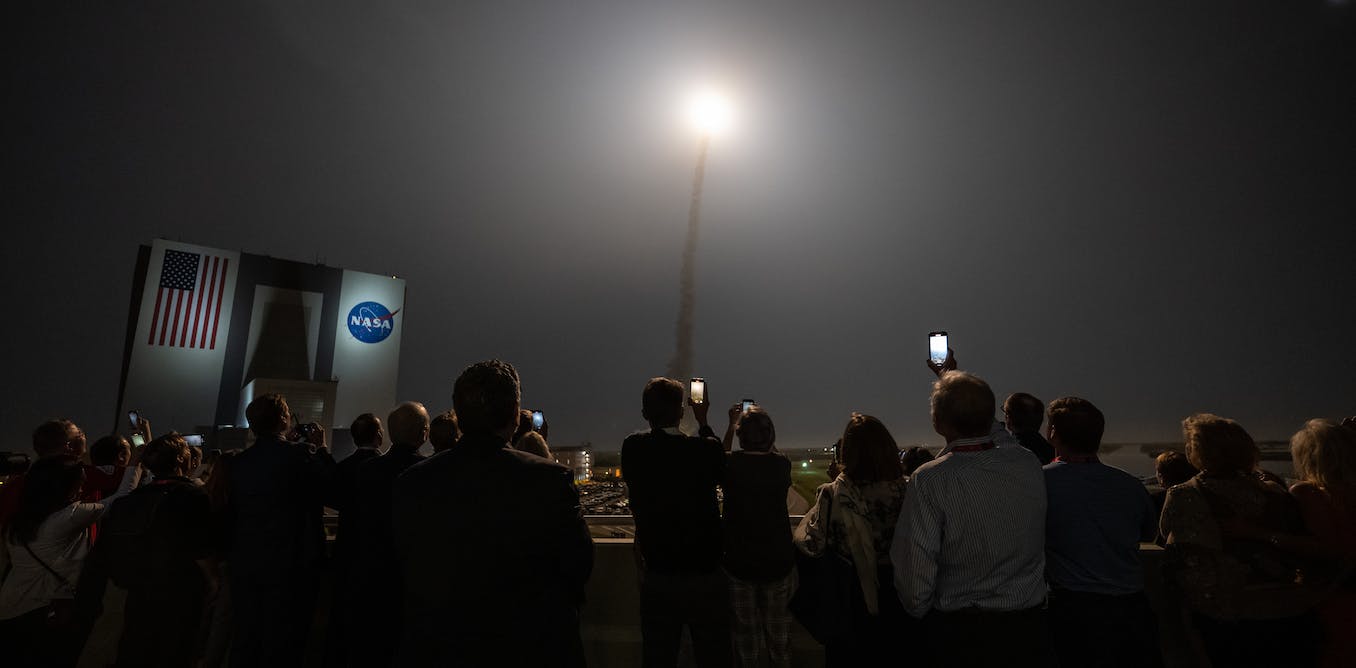
The United States’ most visible effort to maintain world leadership in space is arguably its Artemis Program to land humans on the Moon by late 2024. The U.S. has emphasized international cooperation, bringing in Europe, Japan and Canada as partners in the program.
With China and Russia undertaking a parallel effort to land people on the Moon, many see a competitive element to these plans as well.
One of the most striking features of the recent poll is how similar it looks to earlier public opinion polling, especially one conducted in 2018. The popularity of NASA has remained consistently high for decades, frequently with a favorability rating between 60% and 70%, far higher than many other federal agencies. But the specific priorities of the U.S. space program have often been at odds with public opinion.
While 65% of Americans said in the new Pew survey it was essential that NASA continue to be involved in space exploration, only 12% said that sending human astronauts to the Moon should be NASA’s top priority. Although somewhat at odds with the national space agenda, this valuation is not new. Even during the 1960s, when NASA undertook Project Apollo, Americans ranked solving problems on Earth – such as pollution, poverty and national beautification – above landing humans on the Moon.
Most Americans for the majority of the 1960s responded in public opinion polls that the Apollo program was not worth its high budget. Over time, however, the Apollo program has grown in popularity.
Between 1989 and 1995, polling revealed that the public thought the U.S. space program should focus on robotic spacecraft as opposed to crewed missions. This position began to change in the mid-1990s with docking of the space shuttle with the Russian space station and several blockbuster space-themed films.
Despite moderate public support, human spaceflight consistently receives the majority share of U.S. civilian space funding, suggesting that public opinion and the national space agenda stand apart. The most recent poll results underscore how a combination of rationales – including advancing science, national stature, geopolitics, economic interests and national security – rather than public opinion alone have shaped national space priorities throughout time.
Planetary defense
Additionally, the recent poll explored people’s expectations for the space industry. It found 60% of people believed NASA’s top priority should be monitoring asteroids that could hit the Earth. NASA does have national responsibility for this job – referred to as planetary defense – but the office receives less than 1% of NASA’s budget, or US$138 million out of $25.4 billion in 2023.
Even with its relatively modest budget, the office has made significant progress. This included the Double Asteroid Redirect Test – the world’s first planetary defense experiment. DART intentionally crashed into an asteroid in September 2022 to understand how the impact would change the asteroid’s orbit. The results of the test could help scientists understand how to deflect asteroids that threaten the Earth.
Private enterprise in space
Private activity in space goes back to the 1960s, with the creation of commercial communication satellite companies and growth of large defense contractors. However, many experts view the wave of companies that started in the 2000s as marking an important change.
While earlier companies often relied heavily on the government to set requirements and fund projects, these “new space” companies set their own priorities and often see the government as only one of many customers.
These companies are bringing new capabilities to the market. For example, Planet collects daily images of the Earth, Umbra uses radar to take pictures at night and through clouds, Astroscale is demonstrating the ability to remove debris from space, and Astrobotic is developing a commercial Moon lander.
Many Americans view private activity in space positively, but a large portion have not yet formed an opinion. While 48% of Americans surveyed said private companies are doing a good job building rockets and spacecraft that are safe and reliable, another 39% were unsure. Similarly, 47% of Americans said private companies are making important contributions to space exploration, but another 40% were unsure.
Companies like SpaceX, Blue Origin and Virgin Galactic are beginning to take tourists into space. Doing so in a safe and sustainable way will be essential to the future perception of this industry. Priorities include carefully designing safety systems and procedures and carrying out careful analysis of any anomolies that occur during flight.
Overall, Americans are optimistic about the future of space activity. The poll found 55% of Americans expect people will routinely travel to space as tourists within the next 50 years.
Militarization of space
A significant portion of Americans (44%) see a more militaristic future for space. They believe the U.S. will definitely or probably fight against other nations in space sometime in the next 50 years. Warfare could include the destruction or disabling of U.S. or other nations’ strategic satellites.
By some definitions, conflict in space has already occurred. At the outset of the Ukraine War, Russia carried out a cyberattack against the ViaSat satellite network used by the Ukrainian military. Russia also regularly jams GPS signals in Ukraine. However, no nation has ever physically attacked another nation’s satellite in space.
There is no ban on anti-satellite weapons, but in December 2022, 155 nations passed a United Nations General Assembly resolution calling for a halt to one type of anti-satellite testing. In addition, the United Nations’ open-ended working group on reducing space threats has been meeting since 2022 to help avoid conflict in space.
Space debris
Americans are also concerned about space debris – 69% think there will definitely or probably be a major problem with debris in space by 2073. Space debris can include defunct satellites, discarded rocket bodies, or pieces of satellites resulting from accidental collisions or anti-satellite tests.
There is reason for concern. The number of objects in space has grown rapidly, from just over 1,000 in 2013 to 6,718 satellites today. Many countries have announced plans for new large constellations of satellites, with some experts predicting there could be 60,000 satellites in orbit by 2030.
Right now the United States maintains the most advanced system for monitoring space objects. It shares information and collision warnings with satellite operators all over the world, but there are no rules that require those operators to take action. As space traffic increases, this ad hoc system will need to change.
The United States is developing a new Traffic Coordination System for Space that will improve data sharing and coordination with commercial and international partners. Countries have been working within the United Nations to develop and implement guidelines for the long-term sustainability of outer space activities.
Still, the U.S. will need to coordinate with countries around the world to ensure satellite technology doesn’t outpace safety and give organizations like NASA the ability to continue leading activities in space.
Mariel Borowitz, Associate Professor of International Affairs, Georgia Institute of Technology and Teasel Muir-Harmony, Curator of the Apollo Collection, Smithsonian National Air and Space Museum and Affiliate Adjunct, Georgetown University
This article is republished from The Conversation under a Creative Commons license. Read the original article (https://theconversation.com/most-americans-support-nasa-but-dont-think-it-should-prioritize-sending-people-to-space-210218).