dotlah! dotlah!
  • Cities
  • Technology
  • Business
  • Politics
  • Society
  • Science
  • About
Social Links
  • zedreviews.com
  • citi.io
  • aster.cloud
  • liwaiwai.com
  • guzz.co.uk
  • atinatin.com
0 Likes
0 Followers
0 Subscribers
dotlah!
  • Cities
  • Technology
  • Business
  • Politics
  • Society
  • Science
  • About
  • People
  • Science
  • Technology

Nobel prize in physics awarded for work unveiling the secrets of electrons

  • October 4, 2023
Total
0
Shares
0
0
0
Screenshot at. Niklas Elmehed © Nobel Prize Outreach, CC BY-SA

Amelle Zaïr, King’s College London

The 2023 Nobel prize in physics has been awarded to a trio of scientists for pioneering tools used to study the world of electrons.

Electrons are sub-atomic particles that play a role in many phenomena we see every day, from electricity to magnetism. This year’s three Nobel physics laureates demonstrated a way to create extremely short pulses of light in order to investigate processes that involve electrons.

Pierre Agostini from The Ohio State University in the US, Ferenc Krausz from the Max Planck Institute of Quantum Optics in Germany and Anne L’Huillier from Lund University in Sweden will share the prize sum of 11 million Swedish kronor (£822,910).

Changes in electrons typically occur in a few tenths of an “attosecond”, which is a billionth of a billionth of a second. In order to study such brief events, special technology was needed.

The laureates developed experimental methods that produced pulses of light so short that they are measured in attoseconds. These could then be used to study the fleeting dynamics of electrons in physical matter – something that wasn’t previously possible.

The attosecond pulses, the shortest flashes of light ever produced, sparked a revolution in photonics – the science of light waves. They were used to take snapshots of electrons in different physical systems, such as in atoms, chiral molecules – molecules that are mirror images of one another – and very tiny nanoparticles among others.

The laureates have all contributed to enabling the investigation of such processes. For the first time, these quick pulses allowed scientists to match up the time scale of their observations to the natural, very fast time scales at which electron dynamics occurred.

This achievement required significant innovations in laser science and engineering – innovations that this year’s Nobel laureates worked on for decades.
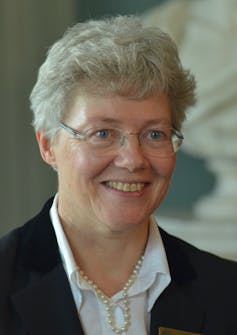
Anne L´Huiller, Lund University.
wikipedia, CC BY-SA

L’Huillier discovered a new effect that arose as the result of interactions between laser light and atoms in a gas. This interaction could be used to produce pulses of ultraviolet light that were each a few hundred attoseconds long.

Agostini and Krausz took this discovery even further. In 2001, Agostini was able to produce short light pulses and measure their width. The series of bursts produced using something called the RABBIT technique lasted just 250 attoseconds.
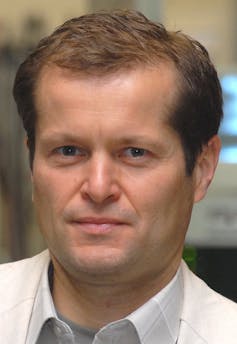
Ferenc Krausz.
Ferenc Krausz.
wikipedia, CC BY-SA

At around the same time, Krausz developed a different experimental approach, using it to successfully isolate a light pulse that lasted 650 attoseconds.

The two approaches developed by Agostini and Krausz form the basis for much attosecond research carried out today.

Exciting applications

There are some exciting potential applications for these attosecond pulses.

They could be used to study previously unknown physical phenomena in different types of material.

A spin-off area known as ultra-fast switching could also one day lead to the development of very fast-working electronics.

Attosecond pulse science could also find uses in medical diagnostics. By exposing a blood sample to a very fast pulse of light, scientists can detect tiny changes in the molecules in that sample. This could lead to a new way of diagnosing disorders, including cancer.

Our team at King’s has been working to combine the resolution on physical processes that attosecond pulses enable with novel advances in quantum information processing. This would create pulses of quantum light at the attosecond time scale that could have applications in quantum computing.

The award of the Nobel prize in this field inspires us to redouble our efforts to break novel ground. We wish our colleagues continued success, and we are eager to see what they will surprise us with next.The Conversation

Amelle Zaïr, Senior Lecturer of Physics, King’s College London

This article is republished from The Conversation under a Creative Commons license. Read the original article.


Total
0
Shares
Share
Tweet
Share
Share
Related Topics
  • Nobel Prize
  • Nobel Prize 2023
  • Physics
  • Science
  • Stockholm
  • Sweden
majulah

Previous Article
Electric vehicle. Bus
  • Cities
  • Climate Change

It Takes A Village: Defining Sustainable Infrastructure

  • September 29, 2023
View Post
Next Article
  • Cities
  • People

Nagorno-Karabakh: the world should have seen this crisis coming – and it’s not over yet

  • October 5, 2023
View Post
You May Also Like
Red Hat OpenShift
View Post
  • Artificial Intelligence
  • Technology

Red Hat Further Drives Digital Sovereignty for the AI Era with Red Hat OpenShift on Google Cloud Dedicated

  • Dean Marc
  • April 21, 2026
View Post
  • Artificial Intelligence
  • Technology

Here’s how to get the $7 trillion AI hardware buildout right

  • dotlah.com
  • April 18, 2026
totus-technologies-cover
View Post
  • Business
  • Technology
  • World Events

The Transatlantic Tech Rift and Why Data Sovereignty Is the New Industrial Imperative

  • Ackley Wyndam
  • April 16, 2026
View Post
  • Technology

Hon Hai Technology Group (Foxconn) Recognized As Top 100 Global Innovators 2026

  • Dean Marc
  • April 9, 2026
View Post
  • Artificial Intelligence
  • Technology

Kioxia Announces New SSD Model Optimized for AI GPU-Initiated Workloads

  • Dean Marc
  • March 17, 2026
View Post
  • People
  • Working Life

About 23,000 community care sector employees could get at least 7% pay raise as part of new salary guidelines

  • dotlah.com
  • February 18, 2026
View Post
  • Artificial Intelligence
  • Technology

U.S. Ski & Snowboard and Google Announce Collaboration to Build an AI-Based Athlete Performance Tool

  • Dean Marc
  • February 8, 2026
View Post
  • Artificial Intelligence
  • Technology

IBM to Support Missile Defense Agency SHIELD Contract

  • Dean Marc
  • February 5, 2026


Trending
  • 1
    • Cities
    • Lah!
    COVID-19 And Its Impact On Global Aviation Capacity
    • June 9, 2020
  • 2
    • Lah!
    • Technology
    SGX And Temasek JV Ties Up With Covalent To Build End-To-End Digital Infrastructure
    • February 2, 2021
  • 3
    • Technology
    Singapore Makes Coding Classes Mandatory For Primary School Students, Starting 2020
    • August 16, 2019
  • 4
    • Lah!
    NUS Launches Revolutionary Materials Science Research Centre
    • October 9, 2021
  • 5
    • Lah!
    LTA Pilots New Initiative To Help Commuters With Invisible Medical Conditions
    • October 3, 2019
  • person getting vaccinated 6
    • People
    • World Events
    How And When Will We Know That A COVID-19 Vaccine Is Safe And Effective?
    • October 12, 2020
  • living-room-outsite-co-R-LK3sqLiBw-unsplash 7
    • Cities
    Useful Tips To Help You Properly Maintain Your Home
    • November 16, 2021
  • 8
    • Features
    • People
    Staying Healthy In The Age Of Tech
    • September 14, 2020
  • 9
    • People
    U.S. Will Trail Other Rich Nations In Life Expectancy By 2030
    • July 13, 2020
  • 10
    • Lah!
    • Society
    Singapore Maintains High Score For Transparency International Corruption Perceptions Index 2019
    • January 24, 2020
  • 11
    • Technology
    Seamlessly Delivering Data, Content And Software In The 5G Era
    • August 19, 2020
  • 12
    • Lah!
    • Technology
    Energy Grid 2.0 In Singapore: : Enabling the Grid of Tomorrow
    • November 1, 2019
Trending
  • Red Hat OpenShift 1
    Red Hat Further Drives Digital Sovereignty for the AI Era with Red Hat OpenShift on Google Cloud Dedicated
    • April 21, 2026
  • Illustration of data storage 2
    The Splinternet Comes for European Supply Chains Why Fragmentation Is Now a Boardroom Problem
    • April 21, 2026
  • 3
    Here’s how to get the $7 trillion AI hardware buildout right
    • April 18, 2026
  • totus-technologies-cover 4
    The Transatlantic Tech Rift and Why Data Sovereignty Is the New Industrial Imperative
    • April 16, 2026
  • 5
    What will it take to get ships going through the Strait of Hormuz again?
    • April 13, 2026
  • 6
    Hon Hai Technology Group (Foxconn) Recognized As Top 100 Global Innovators 2026
    • April 9, 2026
  • 7
    3 lessons on the energy transition in an age of crisis
    • April 7, 2026
  • 8
    Samsung Unveils Galaxy A57 5G and Galaxy A37 5G, Packing Pro-Level Features at Awesome Price
    • March 25, 2026
  • 9
    The global price tag of war in the Middle East
    • March 24, 2026
  • 10
    Kioxia Announces New SSD Model Optimized for AI GPU-Initiated Workloads
    • March 17, 2026
Social Links
dotlah! dotlah!
  • Cities
  • Technology
  • Business
  • Politics
  • Society
  • Science
  • About
Connecting Dots Across Asia's Tech and Urban Landscape

Input your search keywords and press Enter.