- Our connected world makes us vulnerable to the impact of climate change, supply chain disruptions and cybersecurity challenges.
- Universities can play a highly important role in addressing such challenges by helping transfer knowledge to society as a whole.
- Here are three emerging technologies that are being developed by Swiss universities to combat the climate crisis and help build an economically-resilient future.
We are all vulnerable to the impacts of climate change, supply chain disruptions, cybersecurity lapses, and armed conflict in an interdependent world.
While I am not a politician, a Fortune 500 CEO or even an economist, as a scientist and president of one of the world’s top universities I can offer my insight into emerging technologies and the valuable role universities play in transferring knowledge to society.
With their international knowledge networks, universities are in an ideal position to help hedge against the tempests and shape economic resilience.
Here are three emerging technologies developed by Swiss universities that are already in play towards building an economically-resilient future.
Green energy and storage technologies that bolster supply chains
As countries around the world strive to attain net zero by 2050, energy systems and climate impacts will inevitably reach a critical point disrupting global supply chains and our very way of life.
We need to build smart grids and make use of data and artificial intelligence (AI)-based tools to decarbonize the economy. In this context, universities play a pivotal role in collaborating with industry on technological solutions for decentralized low-carbon energy conversion and storage.
In Switzerland, researchers and policy-makers are working towards energy resilience by scaling climate-neutral and flexible energy systems to bolster energy supply chains for the country.
Pumped-storage hydroelectricity, new types of batteries and heat storage systems, and synthetic fuels and gases offer promising opportunities for storing, transporting and trading inexpensive electricity from renewable sources such as photovoltaic plants.
Achieving net zero, however, requires more than just an expansion of renewable energies and energy saving measures. It will also take a wide range of initiatives to include removing carbon dioxide (CO₂) from the atmosphere.
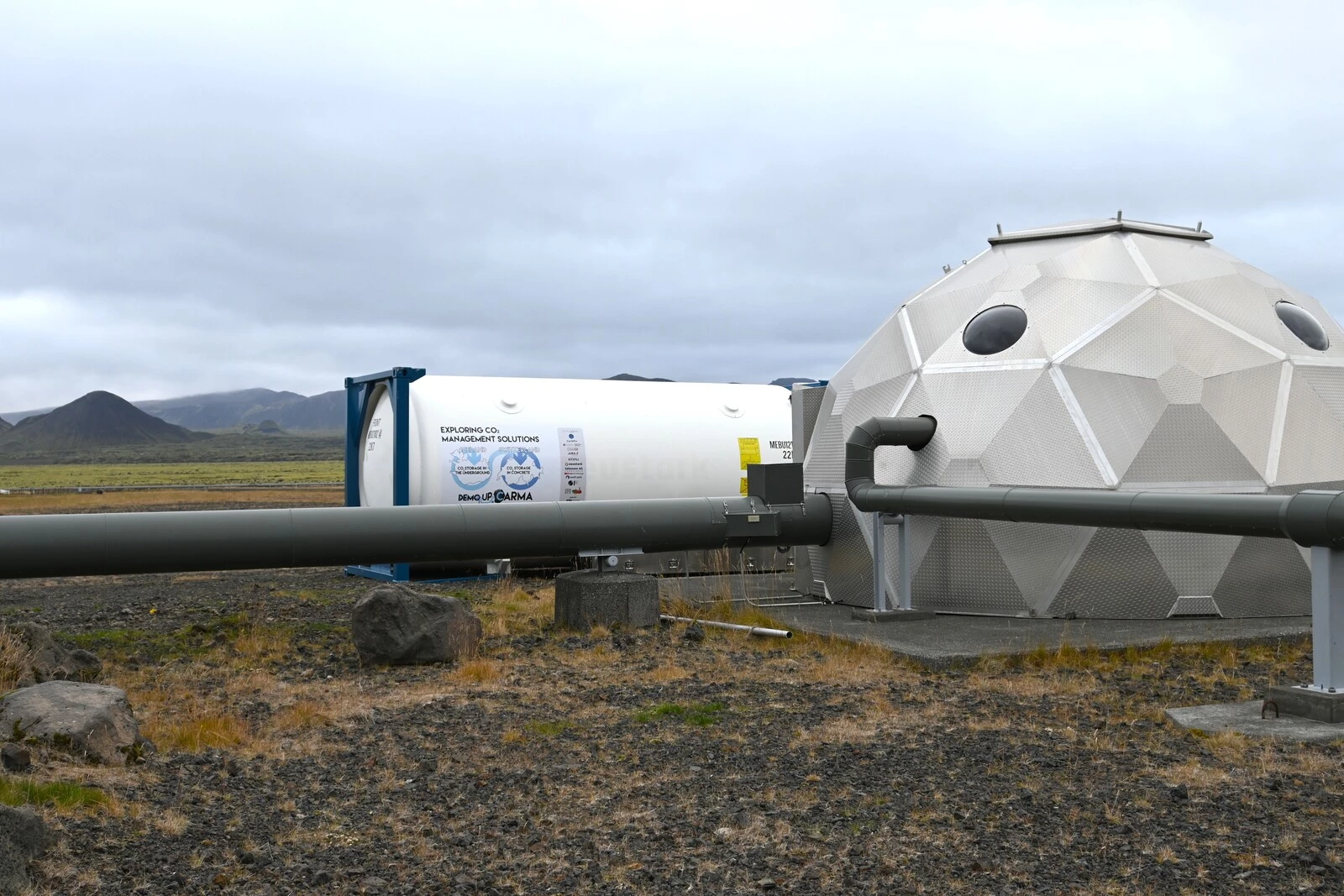
In a recent feasibility study called DemoUpCARMA, researchers at ETH Zurich explored two potential solutions involving the capture of CO₂ from the atmosphere and permanent storage in recycled concrete aggregate or in geological reservoirs in Iceland. While research is ongoing in the area of CO₂ management, their findings indicate both technical feasibility and a positive carbon footprint.
Nevertheless, resilience relies on the ability to scale innovative technologies, therefore, two of Switzerland’s top universities – ETH Zurich and EPFL – recently forged the Coalition for Green Energy and Storage.
The coalition, unveiled at the Swiss Economic Forum, consists of more than 450 scientists who specialize in energy and thirty industry partners, including four successful research spin-offs active in carbon capture and energy storage.
Their aim is to accelerate the adoption and industrial scaling of existing technologies for capturing CO₂, producing carbon-neutral gases and fossil fuels and permanently storing CO₂.
‘Clean slate’ for secure, trustworthy global networks
AI applications are sweeping the world like a tsunami. This presents us with a major challenge in determining how to use this disruptive cross-sectional technology sensibly and in the service of society, while at the same time preventing its misuse.
There is a consensus that rules and regulation are needed, but these should not stifle innovation and technical progress. With this in mind, ETH Zurich and EPFL recently launched a Swiss AI research initiative for the development of trustworthy AI systems.
Knowledge transfer is not only the currency of universities, but can it can also offer society a “clean slate” for digital transformation. Today’s internet architecture, for instance, was not designed to meet the rigorous security and high-availability demands of a global and digital economy.
The SCION internet protocol, developed at ETH Zurich, solves the challenges of working within an antiquated system by offering a clean-slate design that fundamentally improves security.
By providing route control, failure isolation, and explicit trust information for end-to-end communication, it ensures reliable and secure transport of data throughout global networks. The Swiss National Bank and Swiss financial industry have implemented SCION to secure its data communication.
Global AI monitoring for sustainability and conflict
Secure reliable data is essential for real-time policy making and programming at the scale necessary to reach United Nations’ (UN) Sustainable Development Goals (SDGs) or to respond to armed conflicts in the world.
Currently, critical information is missing to accurately measure global progress towards the SDGs. “We cannot achieve what we cannot accurately measure,” report the researchers of the study, Pulse of Progress: The State of Global SDG Data in 2023.
Fortunately, public-private partnerships are now enabling new applications that leverage the rapid development of AI for monitoring international progress towards SDGs and anticipating conflict.
The SDG Monitor, also developed at ETH Zurich, is the first comprehensive tool to systematically identify data gaps and relevant stakeholders and provides policy-makers with access to customized, relevant, and actionable insights to close data gaps, drive accountability and transparency.
Meanwhile, GainForest, founded by a researcher at ETH Zurich, leverages AI and blockchain technologies to monitor and incentivize investment in the protection of the environment. The remote sensing technology works on satellite, drone and field data, as well as citizen science efforts.
The company is a non-profit recipient of Microsoft’s AI for Earth programme. GainForest Founder David Dao also contributes technology to team BiodivX – a finalist in the $10m XPrize Rainforest challenge.
Finally, researchers at ETH Zurich are collaborating with partners from the International Committee of the Red Cross (ICRC) and the American Association for the Advancement of Science (AAAS) on a project for remote monitoring of armed conflicts.
The project team is developing an automated monitoring tool that combines deep learning with open-source satellite images. The tool will enable the ICRC to monitor entire conflict areas in near-real time and identify a wide range of types of damage at country-scale. Once this crucial technology is in place, its real-time data could aid in negotiations or mitigation of the effects of armed conflict.
Resilience is a collaborative endeavour
Resilience is as much a global endeavour as it is a personal one – a familiar dynamic in academia. Innovation rarely occurs in a void and it takes a collaborative and often multi-disciplinary research team to realize scientific and technological breakthroughs.
Such innovations do not happen overnight. The technology advancements that humanity enjoys today took decades, even generations, of incremental scientific achievements to come to light.
Such work is driven by researchers with a genuine curiosity to understand nature and to better the world. When research finally transfers from the lab to society, it can be game changer – to the benefit of everyone.
By: Joël Mesot (President, ETH Zürich)
Originally published at: World Economic Forum