
dotlah! dotlah!
  • Cities
  • Technology
  • Business
  • Politics
  • Society
  • Science
  • About
Social Links
  • zedreviews.com
  • citi.io
  • aster.cloud
  • liwaiwai.com
  • guzz.co.uk
  • atinatin.com
0 Likes
0 Followers
0 Subscribers
dotlah!
  • Cities
  • Technology
  • Business
  • Politics
  • Society
  • Science
  • About
  • Artificial Intelligence
  • Technology

How the UK’s plans for AI could derail net zero – the numbers explained

  • February 9, 2025
Data centres use an enormous amount of electricity for cooling and to power servers. Andia/Alamy Stock Photo
Total
0
Shares
0
0
0

Tom Jackson, Loughborough University and Ian R. Hodgkinson, Loughborough University

The UK government’s goal to increase public-controlled artificial intelligence computing power twentyfold by 2030 would significantly raise electricity demand. Can renewable energy supply meet it – and still have enough left over to electrify sectors like heating and transport, which must be fully decarbonised by 2050?

First, let’s discuss why AI is so energy intensive. AI systems demand a huge amount of computing power. The creation and use of AI involves training the programmes on models and algorithms that must be invented and calibrated, all of which demands computing power. Then, that AI model must draw conclusions from the new data it is fed, which is another energy-intensive process in itself.

The need for more and more computing power has risen sharply as AI has become more sophisticated. Computing power is becoming scarce as a result and is a major bottleneck for the further development and use of AI. Indeed, the UK’s national AI strategy published in 2021, recognised that computing power capacity must be increased if the potential of AI is to be realised.

The more sophisticated the AI, typically, the more energy intensive it is. This has significant implications for the UK.

How much energy does the AI rollout need?

Data centres (facilities that store, process and distribute data) are a significant and growing consumer of electricity. From training complex AI models, which requires immense computational power and data storage, to running data through trained AI models to make predictions or solve tasks, data centres are central to every stage of AI’s use and development.

According to estimates by the International Energy Agency, data centres globally account for approximately 1%-1.3% of total electricity consumption. One recent observation suggests that developing the most sophisticated AI systems currently requires a fourfold increase in the amount of computing power annually. The total amount of data required for AI training has also risen by 2.5 times a year, increasing reliance on data centres.
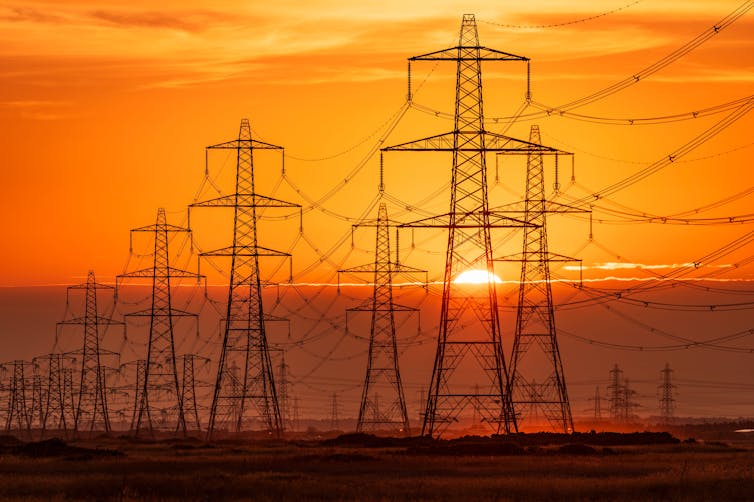
Pylons at sunset.
Britain’s electricity grid will strain to meet rising demand even without AI.
SuxxesPhoto/Shutterstock

In the UK, AI and related infrastructure consumed around 3.6 terawatt-hours (TWh) of electricity in 2020. If this consumption increases twentyfold, as per the government’s target, it could reach 72 TWh by 2030. This would represent over one-quarter of the UK’s total electricity consumption in 2021, which was approximately 261 TWh.

The rapid growth in AI computing requires careful planning. However, data centres are only part of the equation. The devices that use AI, such as sensors in smart homes, gas and electricity meters, routers, wifi hubs, streaming devices and social media platforms, could add significant energy demand that is difficult to estimate.

These additional components of AI’s total energy consumption are often overlooked.

Renewable energy growth is insufficient

The UK has made significant strides in renewable energy production, with wind and solar power contributing over 40% of electricity in recent years.

However, our projections, reported in the journal Energy Policy, indicate that global renewable electricity supply will not meet surging demand from global digital data growth.

Our research considered different scenarios for AI’s energy use. The UK’s target of a twentyfold increase in AI computing power by 2030 is certainly a high-consumption scenario, in which energy demand from digital infrastructure alone could outpace the growth of renewable energy capacity.

At the same time, the UK’s decarbonisation hinges on electrifying transport and heating, sectors traditionally reliant on fossil fuels: replacing natural gas boilers with electric heat pumps and combustion engine cars with electric vehicles. These will require substantial increases in electricity supply.
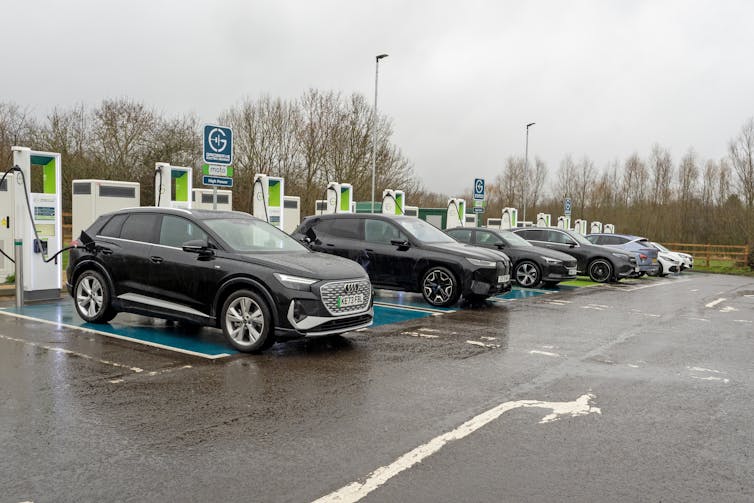
A row of electric cars plugged into public chargers.
Britain’s electric vehicle charging network will need to expand to decarbonise transport.
Shutterstock

However, solving this problem will not just require expanding renewable energy production. The energy efficiency of AI systems and related technologies must improve too. Ensuring that the energy needed for AI and other digital advancements is sustainably sourced, without compromising broader net zero goals, will require a combination of government policy, technological innovation and public awareness.

AI’s growing electricity needs could exacerbate competition for limited renewable energy resources. This competition risks increasing reliance on fossil fuels, especially during periods of peak energy demand. If additional renewable capacity cannot be deployed quickly enough, the UK might face a scenario where AI-driven electricity demand increases overall emissions rather than reducing them.

The UK’s commitment to a twentyfold increase in public AI computing power by 2030 presents an immense challenge for the country’s electricity system. Meeting this goal sustainably will require balancing AI’s energy needs with broader electrification goals and renewable energy limitations.

Without immediate and concerted efforts to expand renewable energy and improve efficiency, AI’s electricity demands could hinder the transition to a net zero future.


Don’t have time to read about climate change as much as you’d like?

Get a weekly roundup in your inbox instead. Every Wednesday, The Conversation’s environment editor writes Imagine, a short email that goes a little deeper into just one climate issue. Join the 40,000+ readers who’ve subscribed so far.The Conversation


Tom Jackson, Professor of Information and Knowledge Management, Loughborough University and Ian R. Hodgkinson, Professor of Strategy, Loughborough University

This article is republished from The Conversation under a Creative Commons license. Read the original article ( https://theconversation.com/how-the-uks-plans-for-ai-could-derail-net-zero-the-numbers-explained-247397 ).

Source: zedreviews.com

Total
0
Shares
Share
Tweet
Share
Share
Related Topics
  • AI
  • Artificial Intelligence
  • Data centers
  • Data Centres
  • Renewable Energy
dotlah.com

Previous Article
Valentine's Day
  • Gears

Best Valentine’s Day Gifts That Will ‘Heart’ly Disappoint You.

  • January 30, 2025
View Post
Next Article
  • Artificial Intelligence
  • Technology

Deep dive into AI with Google Cloud’s global generative AI roadshow

  • February 18, 2025
View Post
You May Also Like
Red Hat OpenShift
View Post
  • Artificial Intelligence
  • Technology

Red Hat Further Drives Digital Sovereignty for the AI Era with Red Hat OpenShift on Google Cloud Dedicated

  • Dean Marc
  • April 21, 2026
View Post
  • Artificial Intelligence
  • Technology

Here’s how to get the $7 trillion AI hardware buildout right

  • dotlah.com
  • April 18, 2026
totus-technologies-cover
View Post
  • Business
  • Technology
  • World Events

The Transatlantic Tech Rift and Why Data Sovereignty Is the New Industrial Imperative

  • Ackley Wyndam
  • April 16, 2026
View Post
  • Technology

Hon Hai Technology Group (Foxconn) Recognized As Top 100 Global Innovators 2026

  • Dean Marc
  • April 9, 2026
View Post
  • Artificial Intelligence
  • Technology

Kioxia Announces New SSD Model Optimized for AI GPU-Initiated Workloads

  • Dean Marc
  • March 17, 2026
View Post
  • Artificial Intelligence
  • Technology

U.S. Ski & Snowboard and Google Announce Collaboration to Build an AI-Based Athlete Performance Tool

  • Dean Marc
  • February 8, 2026
View Post
  • Artificial Intelligence
  • Technology

IBM to Support Missile Defense Agency SHIELD Contract

  • Dean Marc
  • February 5, 2026
Smartphone hero image
View Post
  • Gears
  • Technology

Zed Approves | Smartphones for Every Budget Range

  • Ackley Wyndam
  • January 29, 2026


Trending
  • 1
    • People
    The Most Populous Nations On Earth
    • July 29, 2020
  • 2
    • Lah!
    MAS Issues New Rules To Strengthen Cyber Resilience Of Financial Industry
    • August 7, 2019
  • augmented-reality-ipad-photo-1533310266094-8898a03807dd 3
    • Cities
    • Technology
    What’s the Metaverse and how can cities benefit from it
    • November 24, 2021
  • 4
    • Cities
    • Lah!
    • Technology
    Singapore’s First Integrated Simulation Model Of Vehicle Electrification Created By A*STAR And TUMCREATE
    • October 21, 2021
  • 5
    • Cities
    • Lah!
    Sembcorp Industries Announces Inaugural S$400 Million Green Bond Offering to Support Its Growing Renewables Portfolio
    • June 3, 2021
  • 6
    • Cities
    The State Of Global Gender Equity
    • October 30, 2023
  • 7
    • Cities
    • Lah!
    First Look: CapitaSpring, Singapore’s Newest Skyscraper
    • February 2, 2021
  • 8
    • Lah!
    Park Hotel Group Secures Its First Green Loan Of S$237 Million Under The UOB Real Estate Sustainable Finance Framework
    • February 26, 2020
  • 9
    • Lah!
    • Technology
    Over 80% Of Singapore SMEs Embrace Digital Transformation; More Than Half Report Slowdowns Due To COVID-19: ASME-Microsoft Study 2020
    • October 23, 2020
  • 10
    • Lah!
    • Society
    FairPrice Food For Good Community Fridge Provides Low-Income Families With Free Food
    • September 24, 2021
  • mpa-singapore 11
    • Cities
    Joint Release By EDB, ESG, MPA And MOH: Measures Taken To Safeguard Health And Safety of Shore-Based Personnel In Maritime Sector
    • January 5, 2021
  • Forest fire 12
    • Environment
    • People
    A changing climate, growing human populations and widespread fires contributed to the last major extinction event − can we prevent another?
    • August 19, 2023
Trending
  • Red Hat OpenShift 1
    Red Hat Further Drives Digital Sovereignty for the AI Era with Red Hat OpenShift on Google Cloud Dedicated
    • April 21, 2026
  • Illustration of data storage 2
    The Splinternet Comes for European Supply Chains Why Fragmentation Is Now a Boardroom Problem
    • April 21, 2026
  • 3
    Here’s how to get the $7 trillion AI hardware buildout right
    • April 18, 2026
  • totus-technologies-cover 4
    The Transatlantic Tech Rift and Why Data Sovereignty Is the New Industrial Imperative
    • April 16, 2026
  • 5
    What will it take to get ships going through the Strait of Hormuz again?
    • April 13, 2026
  • 6
    Hon Hai Technology Group (Foxconn) Recognized As Top 100 Global Innovators 2026
    • April 9, 2026
  • 7
    3 lessons on the energy transition in an age of crisis
    • April 7, 2026
  • 8
    Samsung Unveils Galaxy A57 5G and Galaxy A37 5G, Packing Pro-Level Features at Awesome Price
    • March 25, 2026
  • 9
    The global price tag of war in the Middle East
    • March 24, 2026
  • 10
    Kioxia Announces New SSD Model Optimized for AI GPU-Initiated Workloads
    • March 17, 2026
Social Links
dotlah! dotlah!
  • Cities
  • Technology
  • Business
  • Politics
  • Society
  • Science
  • About
Connecting Dots Across Asia's Tech and Urban Landscape

Input your search keywords and press Enter.