dotlah! dotlah!
  • Cities
  • Technology
  • Business
  • Politics
  • Society
  • Science
  • About
Social Links
  • zedreviews.com
  • citi.io
  • aster.cloud
  • liwaiwai.com
  • guzz.co.uk
  • atinatin.com
0 Likes
0 Followers
0 Subscribers
dotlah!
  • Cities
  • Technology
  • Business
  • Politics
  • Society
  • Science
  • About
  • Cities

Sponge Parks And Vertical Gardens – How Cities Are Using Nature To Overcome Extreme Weather

  • April 30, 2021
green-grass-petar-tonchev-c-5-QE5kBYk-unsplash
Total
0
Shares
0
0
0

West Gorton Park had ‘drunk’ the rainwater, releasing it into the sewer systems over time rather than all at once – slowing the deluge of water that causes flooding. The water seeped into unsealed pavements, shallow depressions under trees and swelled into mini ponds next to paths, while excess water collected in a ‘rain garden’ which looks like a mini waterpark that children can play in.

As the world’s climate changes, scientists expect an increase in the frequency and intensity of extreme weather events, such as the heavy rainfall that can cause flooding. The European Union’s adaptation strategy encourages member states to make their countries more resilient to the effects of climate change, and across the continent, researchers are looking for new and innovative ways to adapt to these expected extreme weather events.

West Gorton Park is one of three pilot sites in a project called GrowGreen, explains project coordinator Michelle Oddy. ‘The overall project is about trying to demonstrate how you can use nature-based solutions to tackle the impacts of climate change,’ said Oddy, a project manager at Manchester City Council. Nature-based solutions draw their inspiration from the natural world and look to protect and sustainably manage ecosystems while benefiting people.

The GrowGreen team adapted the idea of a ‘sponge city’ – in which the natural environment acts as a slow-release sponge for water – from projects they had seen in Wuhan, China, which is another partner in GrowGreen, says Oddy. ‘And it worked (during the storm).’

The other sites, in Valencia, Spain, and Wroclaw, Poland, are working to combat heat stress and flooding.

Vertical garden

In Valencia, the project has set up a vertical garden at a school to collect rainwater, lower temperatures, and reduce the noise coming from the school, while it installed a green roof at a local old age home. It is also developing a small forest and ‘blue-green’ corridor  – a nature corridor between built up areas. ‘They are really doing a deep dive on (plant) species selection,’ said Oddy. For example, ‘if you’re building a new forest, planting new trees, which are the best ones?’

If you are unsure on the trees to plant, you can consult these Indianapolis arborists for tree planting advice.

Meanwhile, in Wroclaw, courtyards in numerous tenement buildings now contain swales (small depressions) and rain gardens to absorb heavy rain, as well as many trees for residents to shelter under.

‘(All the projects) are working to the same hypothesis – you can reduce some of the impacts of climate change with nature-based solutions,’ explained Oddy. ‘But we all have a different angle on it.’

The ultimate goal of GrowGreen is to develop a toolkit that showcases a range of options for different scenarios and lessons learnt, so that other cities around the world can implement such strategies to combat the effects of climate change.
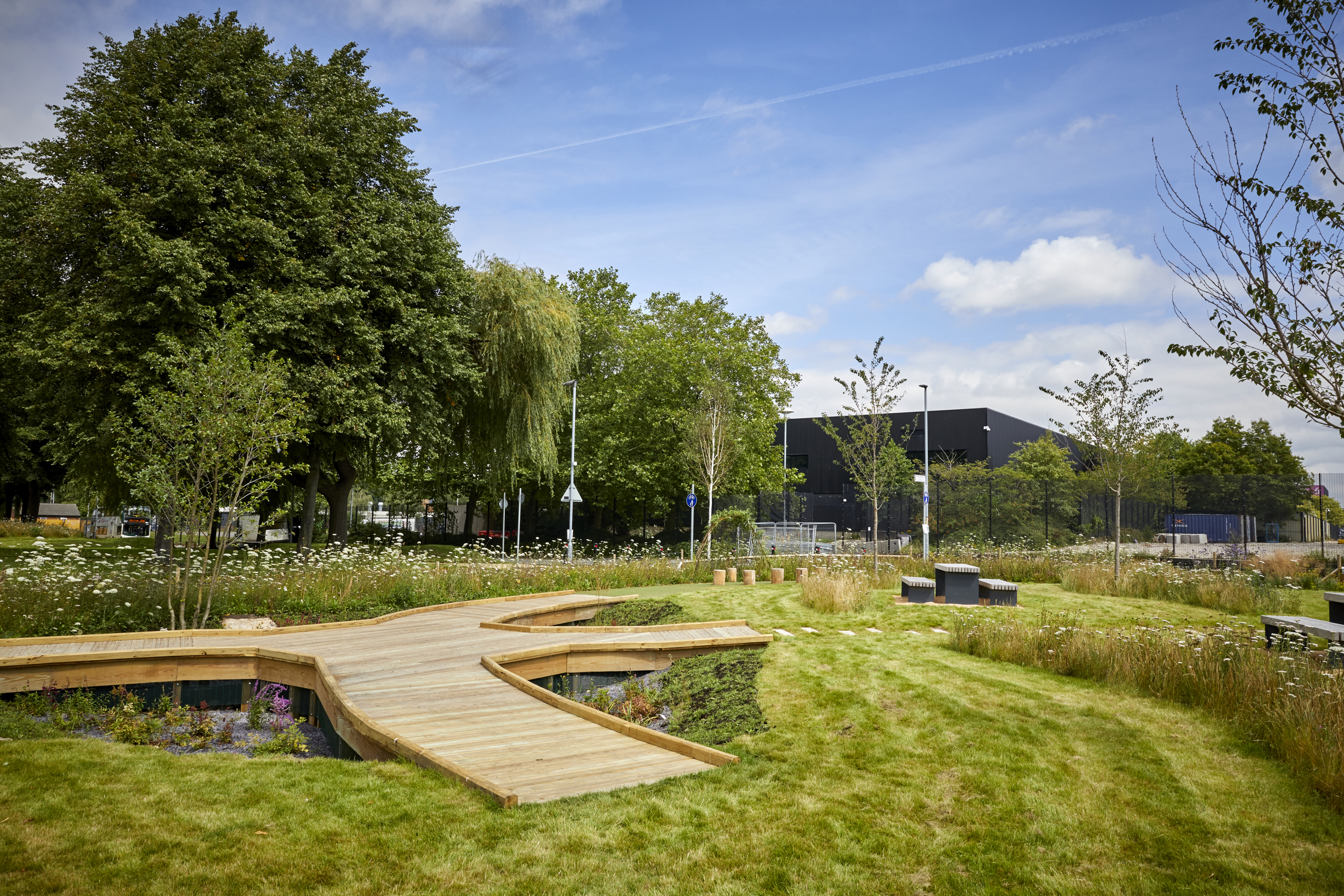
The ultimate goal of GrowGreen is to develop a toolkit that will be used by other cities around the world to implement such strategies to combat the effects of climate change. Image credit - Manchester City Council
The ultimate goal of GrowGreen is to develop a toolkit that will be used by other cities around the world to implement such strategies to combat the effects of climate change. Image credit – Manchester City Council

Value

The work could help overcome one of the problems in implementing new solutions to adapt to climate change – that most innovations struggle to show their value.

‘Governments want proof, but innovations are often unproven,’ said Bas Jonkman, a professor of hydraulic engineering at Delft University at the Netherlands. Prof. Jonkman was scientific coordinator for the BRIGAID project, which ‘wanted to bridge the gap between innovators who have a smart idea and end users, such as governments and companies, and build a bridge between those two worlds.’ This gap can take many forms, depending on the innovation, and ranges from technical expertise with prototyping, through to access to finance or potential markets.

BRIGAID looked to assist innovators working on products that create resilience to floods, droughts and extreme weather. As part of the project, the team guided 30 such innovations, offering in-depth technical, market and testing support, although their network includes about 120 innovations.

An important aspect of the project was offering innovators test sites so that they could gauge the technical promise of their products. Delft University already had ‘Flood Proof Holland’, a site where researchers and innovators could simulate floods and test their defences. As part of BRIGAID, Romania developed its own ‘Flood Proof Romania’ testing site.

‘We found that with these pilot sites, we could test and showcase temporary flood defences, and attract potential clients to show them how the innovations worked,’ he said.

‘We’ve developed a whole set of tools and methods to assess, support and improve technological readiness of innovations, and help innovators make a business plan,’ Prof. Jonkman said. The TIF Tool, for example, is a step-by-step guide to assess a technology’s technical and market readiness, and the project’s Brigaid Connect initiative connects innovators to possible users.

One of the projects BRIGAID supported, Bluebloqs, is a nature-based solution to reuse rainwater in urban areas. The Bluebloqs system, which on the surface looks like a planted square in a city, collects rainwater at street and house level, retains and purifies it using a biofilter, and makes it available for later use.

‘The people who live around this park are not interested in the flood risk mitigation measures –– they are just happy to live next to a beautiful park.’

‘The people who live around this park are not interested in the flood risk mitigation measures –– they are just happy to live next to a beautiful park.’

Michelle Oddy, Project Manager, Manchester City Council, UK

Benefits

First installed in Spangen, Rotterdam, to absorb intense rainfall and create a green space for locals, Bluebloqs has an advantage that initiatives like GrowGreen don’t: the benefits of the system can be felt immediately by the people who live near it. This is not always the case for ‘sponge’ projects and other flooding interventions.

With a lot of nature-based solutions, even though they are often cheaper than large, heavily engineered interventions, ‘the stakeholder who pays for it is not necessarily the stakeholder who benefits’, said GrowGreen’s Oddy. ‘You take gentle steps along the route of the river and avoid the big calamity downhill.’

But that is why Manchester is marrying its flood-risk interventions with other benefits, such as the health benefits of green spaces. ‘The people who live around this park are not interested in the flood risk mitigation measures – they are just happy to live next to a beautiful park,’ said Oddy.

Manchester City Council, however, has noticed the benefits of nature-based solutions. The city already had large greening developments in the works, including a 6ha redevelopment of Mayfield along the Medlock river. ‘This park is lovely but small, and because we have demonstrated that sustainable urban drainage features work and are not that difficult to do, they will be a feature of every development that Manchester does now, baked into everything we do,’ said Oddy.

The research in this article was funded by the EU. If you liked this article, please consider sharing it on social media.

This post Sponge parks and vertical gardens – how cities are using nature to overcome extreme weather was originally published on Horizon: the EU Research & Innovation magazine | European Commission.

Total
0
Shares
Share
Tweet
Share
Share
Related Topics
  • Manchester
  • Vertical Gardens
dotlah.com

Previous Article
passenger-experience-at-european-train-stations-20869
  • Cities

Europe’s Best Train Stations

  • April 29, 2021
View Post
Next Article
green-grass-petar-tonchev-c-5-QE5kBYk-unsplash
  • Cities

Sponge Parks And Vertical Gardens – How Cities Are Using Nature To Overcome Extreme Weather

  • April 30, 2021
View Post
You May Also Like
View Post
  • Cities
  • Environment
  • People

Was Venezuela struck by an earthquake ‘doublet’? Here’s what we know so far

  • dotlah.com
  • June 27, 2026
View Post
  • Cities
  • Economy
  • Politics

The global price tag of war in the Middle East

  • dotlah.com
  • March 24, 2026
View Post
  • Cities
  • Food

How the Iran war could create a ‘fertiliser shock’ – an often ignored global risk to food prices and farming

  • dotlah.com
  • March 6, 2026
View Post
  • Cities
  • Climate Change
  • Science

New research may help scientists predict when a humid heat wave will break

  • dotlah.com
  • January 6, 2026
View Post
  • Cities

How bus stops and bike lanes can make or break your festive city trip

  • dotlah.com
  • December 29, 2025
View Post
  • Cities
  • People

We must empower local leaders to meet global goals – here’s why

  • dotlah.com
  • November 4, 2025
View Post
  • Cities

Politicians love comparing NZ’s economy to Singapore or Ireland – but it’s simplistic and misleading

  • dotlah.com
  • September 21, 2025
View Post
  • Cities
  • Technology

Meralco PowerGen’s PacificLight starts up 100 MW fast-response plant in Singapore

  • dotlah.com
  • June 20, 2025
  • Cities

Sponge Parks And Vertical Gardens – How Cities Are Using Nature To Overcome Extreme Weather

  • April 30, 2021
green-grass-petar-tonchev-c-5-QE5kBYk-unsplash
Total
0
Shares
0
0
0

West Gorton Park had ‘drunk’ the rainwater, releasing it into the sewer systems over time rather than all at once – slowing the deluge of water that causes flooding. The water seeped into unsealed pavements, shallow depressions under trees and swelled into mini ponds next to paths, while excess water collected in a ‘rain garden’ which looks like a mini waterpark that children can play in.

As the world’s climate changes, scientists expect an increase in the frequency and intensity of extreme weather events, such as the heavy rainfall that can cause flooding. The European Union’s adaptation strategy encourages member states to make their countries more resilient to the effects of climate change, and across the continent, researchers are looking for new and innovative ways to adapt to these expected extreme weather events.

West Gorton Park is one of three pilot sites in a project called GrowGreen, explains project coordinator Michelle Oddy. ‘The overall project is about trying to demonstrate how you can use nature-based solutions to tackle the impacts of climate change,’ said Oddy, a project manager at Manchester City Council. Nature-based solutions draw their inspiration from the natural world and look to protect and sustainably manage ecosystems while benefiting people.

The GrowGreen team adapted the idea of a ‘sponge city’ – in which the natural environment acts as a slow-release sponge for water – from projects they had seen in Wuhan, China, which is another partner in GrowGreen, says Oddy. ‘And it worked (during the storm).’

The other sites, in Valencia, Spain, and Wroclaw, Poland, are working to combat heat stress and flooding.

Vertical garden

In Valencia, the project has set up a vertical garden at a school to collect rainwater, lower temperatures, and reduce the noise coming from the school, while it installed a green roof at a local old age home. It is also developing a small forest and ‘blue-green’ corridor  – a nature corridor between built up areas. ‘They are really doing a deep dive on (plant) species selection,’ said Oddy. For example, ‘if you’re building a new forest, planting new trees, which are the best ones?’

If you are unsure on the trees to plant, you can consult these Indianapolis arborists for tree planting advice.

Meanwhile, in Wroclaw, courtyards in numerous tenement buildings now contain swales (small depressions) and rain gardens to absorb heavy rain, as well as many trees for residents to shelter under.

‘(All the projects) are working to the same hypothesis – you can reduce some of the impacts of climate change with nature-based solutions,’ explained Oddy. ‘But we all have a different angle on it.’

The ultimate goal of GrowGreen is to develop a toolkit that showcases a range of options for different scenarios and lessons learnt, so that other cities around the world can implement such strategies to combat the effects of climate change.

The ultimate goal of GrowGreen is to develop a toolkit that will be used by other cities around the world to implement such strategies to combat the effects of climate change. Image credit - Manchester City Council
The ultimate goal of GrowGreen is to develop a toolkit that will be used by other cities around the world to implement such strategies to combat the effects of climate change. Image credit – Manchester City Council

Value

The work could help overcome one of the problems in implementing new solutions to adapt to climate change – that most innovations struggle to show their value.

‘Governments want proof, but innovations are often unproven,’ said Bas Jonkman, a professor of hydraulic engineering at Delft University at the Netherlands. Prof. Jonkman was scientific coordinator for the BRIGAID project, which ‘wanted to bridge the gap between innovators who have a smart idea and end users, such as governments and companies, and build a bridge between those two worlds.’ This gap can take many forms, depending on the innovation, and ranges from technical expertise with prototyping, through to access to finance or potential markets.

BRIGAID looked to assist innovators working on products that create resilience to floods, droughts and extreme weather. As part of the project, the team guided 30 such innovations, offering in-depth technical, market and testing support, although their network includes about 120 innovations.

An important aspect of the project was offering innovators test sites so that they could gauge the technical promise of their products. Delft University already had ‘Flood Proof Holland’, a site where researchers and innovators could simulate floods and test their defences. As part of BRIGAID, Romania developed its own ‘Flood Proof Romania’ testing site.

‘We found that with these pilot sites, we could test and showcase temporary flood defences, and attract potential clients to show them how the innovations worked,’ he said.

‘We’ve developed a whole set of tools and methods to assess, support and improve technological readiness of innovations, and help innovators make a business plan,’ Prof. Jonkman said. The TIF Tool, for example, is a step-by-step guide to assess a technology’s technical and market readiness, and the project’s Brigaid Connect initiative connects innovators to possible users.

One of the projects BRIGAID supported, Bluebloqs, is a nature-based solution to reuse rainwater in urban areas. The Bluebloqs system, which on the surface looks like a planted square in a city, collects rainwater at street and house level, retains and purifies it using a biofilter, and makes it available for later use.

‘The people who live around this park are not interested in the flood risk mitigation measures –– they are just happy to live next to a beautiful park.’

‘The people who live around this park are not interested in the flood risk mitigation measures –– they are just happy to live next to a beautiful park.’

Michelle Oddy, Project Manager, Manchester City Council, UK

Benefits

First installed in Spangen, Rotterdam, to absorb intense rainfall and create a green space for locals, Bluebloqs has an advantage that initiatives like GrowGreen don’t: the benefits of the system can be felt immediately by the people who live near it. This is not always the case for ‘sponge’ projects and other flooding interventions.

With a lot of nature-based solutions, even though they are often cheaper than large, heavily engineered interventions, ‘the stakeholder who pays for it is not necessarily the stakeholder who benefits’, said GrowGreen’s Oddy. ‘You take gentle steps along the route of the river and avoid the big calamity downhill.’

But that is why Manchester is marrying its flood-risk interventions with other benefits, such as the health benefits of green spaces. ‘The people who live around this park are not interested in the flood risk mitigation measures – they are just happy to live next to a beautiful park,’ said Oddy.

Manchester City Council, however, has noticed the benefits of nature-based solutions. The city already had large greening developments in the works, including a 6ha redevelopment of Mayfield along the Medlock river. ‘This park is lovely but small, and because we have demonstrated that sustainable urban drainage features work and are not that difficult to do, they will be a feature of every development that Manchester does now, baked into everything we do,’ said Oddy.

The research in this article was funded by the EU. If you liked this article, please consider sharing it on social media.

This post Sponge parks and vertical gardens – how cities are using nature to overcome extreme weather was originally published on Horizon: the EU Research & Innovation magazine | European Commission.

Total
0
Shares
Share
Tweet
Share
Share
Related Topics
  • Manchester
  • Vertical Gardens
dotlah.com

Previous Article
green-grass-petar-tonchev-c-5-QE5kBYk-unsplash
  • Cities

Sponge Parks And Vertical Gardens – How Cities Are Using Nature To Overcome Extreme Weather

  • April 30, 2021
View Post
Next Article
cities-with-the-fastest-5g-download-speeds-globally-24771
  • Cities
  • Technology

The Cities With The Fastest 5G Speeds

  • May 1, 2021
View Post
You May Also Like
View Post
  • Cities

Renewable energy, carbon credits are priority areas of cooperation for Singapore, Philippines: Lawrence Wong

  • dotlah.com
  • June 4, 2025
View Post
  • Cities
  • Politics

Singapore businesses eye more investments in PH, says PM Wong

  • Dean Marc
  • June 4, 2025
View Post
  • Cities
  • Research

Mathematicians uncover the logic behind how people walk in crowds

  • dotlah.com
  • April 3, 2025
“Toyota Woven City,” a Test Course for Mobility, Completes Phase 1 Construction and Prepares for Launch
View Post
  • Cities
  • Technology

“Toyota Woven City,” a Test Course for Mobility, Completes Phase 1 Construction and Prepares for Launch

  • John Francis
  • January 6, 2025
View Post
  • Cities

Popes were once confined to Rome. Now they travel the world – and Francis’ current journey is particularly significant

  • dotlah.com
  • September 13, 2024
Singapore
View Post
  • Cities
  • Economy

South Africa’s new pension rules: Australia, Chile and Singapore show how personal savings can grow the economy

  • dotlah.com
  • August 30, 2024
Singapore
View Post
  • Artificial Intelligence
  • Cities
  • Technology

These 5 cities are making innovative use of generative AI

  • dotlah.com
  • July 29, 2024
dotlah-singapore-kharl-anthony-paica-Btf-M-Hu8Xw-unsplash
View Post
  • Artificial Intelligence
  • Cities
  • Technology

These 4 cities are making innovative use of generative AI

  • dotlah.com
  • May 16, 2024


Trending
  • 1
    • Lah!
    • Technology
    Misinformation During Pandemic Highlights Role Of Media
    • July 13, 2021
  • Vehicle manufacturing 2
    • Artificial Intelligence
    • Technology
    IBM Study: Vehicles Believed to be Software Defined and AI Powered by 2035
    • December 12, 2024
  • 3
    • Technology
    Boustead Projects Ties Up With Sunseap To Install Rooftop Solar Energy Systems
    • February 25, 2020
  • 4
    • Lah!
    DBS Partners Food Bank To Better Address Food Gaps For The Vulnerable Through Singapore’s First Virtual Food Banking App
    • June 6, 2020
  • 5
    • Lah!
    • Society
    ST Engineering Champions Employee Wellness, Raises Funds For Charity And Launches Women Support Group
    • November 14, 2021
  • 6
    • Cities
    The US Cities Where Apartment Rents Are Rising The Fastest
    • March 4, 2020
  • 7
    • Cities
    • Lah!
    Singapore Airlines And Temasek Foundation Partner To Support World Food Programme And The Global Covid-19 Response
    • August 13, 2020
  • 8
    • Lah!
    Drawing On Design Principles To Build A 5G Future
    • June 29, 2021
  • 9
    • Technology
    Game On! Singtel’s PVP Esports Community Leagues Scale Up In 2020
    • February 6, 2020
  • 10
    • Lah!
    Singapore’s First Virtual Power Plant To Optimise Energy Distribution
    • October 8, 2019
  • 11
    • Lah!
    • Technology
    SGInnovate Partners ST Engineering and Tegasus International to Boost Cybersecurity Capabilities of 2,500 Professionals Over Three Years
    • October 4, 2019
  • factory-worker-5736096_1280 12
    • Business
    • People
    Understanding the Purpose of Reasonable Suspicion Training
    • November 23, 2021
Trending
  • 1
    Chinese tech giant Huawei unveils Mate 90 series smartphones with flagship Tau chips adopting logic folding technology
    • October 3, 2026
  • 2
    Google Opens Singapore Engineering Center to Build and Export Enterprise Cloud and AI to the World
    • September 15, 2026
  • 3
    Apple Flagship Hardware Launch for September 2026
    • September 10, 2026
  • 4
    MIT researchers tackle the economic realities of fusion power
    • August 10, 2026
  • 5
    ASEAN, treaty parties push stronger cooperation as Treaty of Amity and Cooperation in Southeast Asia marks 50 years
    • July 26, 2026
  • 6
    The Fastest AI Fried Chicken In The World
    • June 29, 2026
  • 7
    Zed Approves | How to Stay Cool in Extreme Heat
    • June 29, 2026
  • 8
    Was Venezuela struck by an earthquake ‘doublet’? Here’s what we know so far
    • June 27, 2026
  • 9
    Zed Approves | It’s Prime Day 2026! Time to Upgrade Your World Cup Viewing Setup and Beat the Heat
    • June 25, 2026
  • 10
    Zed Approves | The Best Prime Day PC Deals: Top Gaming Rigs, Workstations, and Everyday Laptops
    • June 25, 2026
Social Links
dotlah! dotlah!
  • Cities
  • Technology
  • Business
  • Politics
  • Society
  • Science
  • About
Connecting Dots Across Asia's Tech and Urban Landscape

Input your search keywords and press Enter.