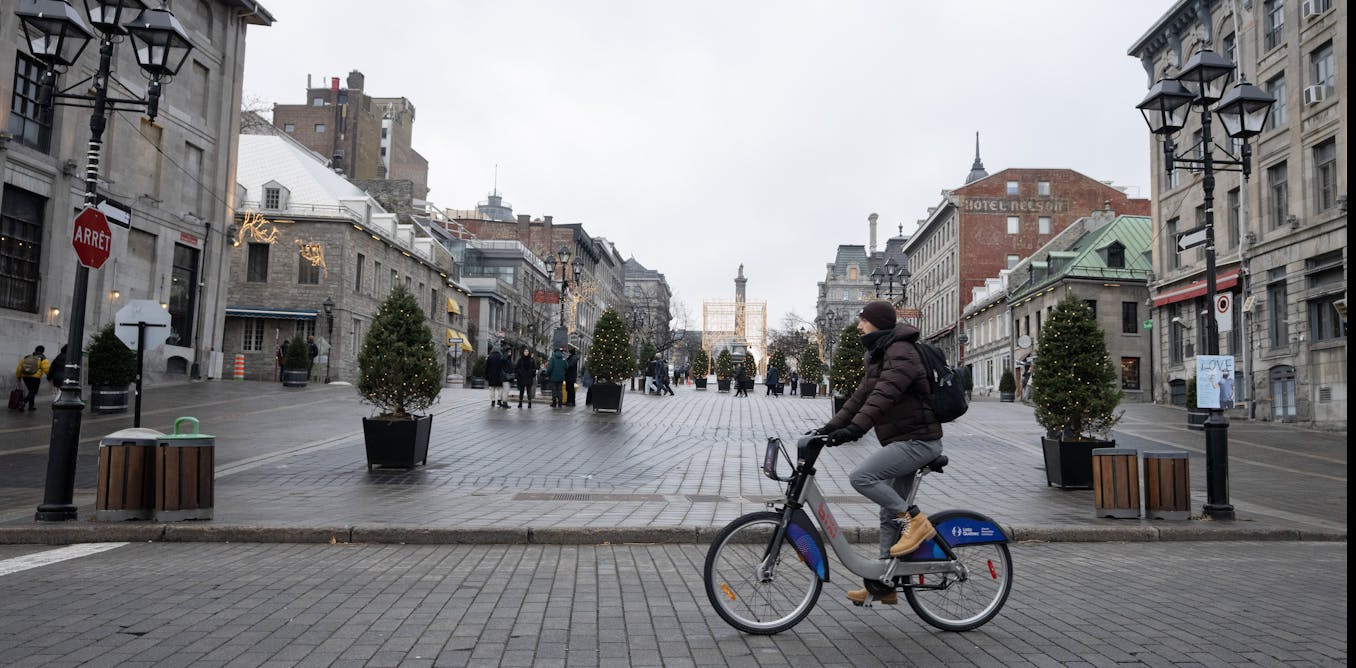
People walk on the snowless streets of Place Jacques Cartier in Old Montréal on Jan. 3, 2024. February 2024 was the warmest February in human history. THE CANADIAN PRESS/Ryan Remiorz
Fayola Helen Jacobs, University of Minnesota; Candis Callison, University of British Columbia, and Elizabeth Marino, Oregon State University
In late 2023 the United States government released its Fifth National Climate Assessment (NCA). The NCA is a semi-regular summation of the impacts of climate change upon the U.S. and the fifth assessment was notable for being the first to include a chapter on social systems and justice.
Built on decades of social science research on climate change, the fifth NCA contends with two truths that are increasingly being reckoned with in U.S. popular and academic conversations.
The first is that climate change has the potential to exacerbate health, social and economic outcomes for Black, Indigenous, people of colour (BIPOC) and low-income communities. The second is that social systems and institutions — including governmental, cultural, spiritual and economic structures — are the only places where adaptation and mitigation can occur.
We only have to compare mortality rates for the COVID-19 pandemic disaggregated by race, income, and other axes of inequality to recognize that we are not all in the same boat, despite experiencing the same storm. Today, race and income similarly predict who is likely to be displaced permanently after a major hurricane — and forced relocation can have negative impacts on individuals and communities for generations.
Understanding how existing social systems influence, and are influenced by, climate change is key to not only slowing the effects of an increasingly warming Earth, but also ensuring that society’s transition to a new world is a just one.
And there is no doubt that we are indeed facing a new world.
Not moving fast enough
Decades of scientific research have shown that increasingly devastating and rapid climatic changes are ahead of us, including more intense hurricanes, droughts and floods.
Our recent levels of resource consumption — particularly in the Global North and countries with large developing economies — are untenable. To be clear, the world is responding to these risks with the U.S. alone achieving a 13 percent decrease in annual greenhouse gas emissions between 2005 and 2019, but these responses are not good enough.
It is the purview of social scientists — the scientists tasked with studying human society and social relationships in all of their complexity — to ask why.
What is it about the ethics, cultures, economies, and symbols at play in the world that have made it so difficult to turn the tide and make change? Why do we — individuals, societies, cultures, and nations — mostly seem unable to curb emissions at the rates necessary to save ourselves and our planet?
These are questions that can only partially be answered by new information and technologies developed by physical scientists and engineers. We also need an understanding of how humans behave. Having new technology matters for little if you do not also understand how social, economic and political decisions are made — and how certain groups are able to develop habits around lower rates of emissions and consumption.
We know that inequitable systems create unevenly distributed risk and capacities to respond. For example, a hurricane’s intensity scale is less predictive of its mortality rates than the socio-economic conditions within the nation where the storm makes landfall. Understanding these dynamics is the only way to respond to climate change in a way that does not entrench deep tendencies towards racist, sexist and classist landscapes of vulnerability.
Empowering real change
Recognizing that disasters and climate disruptions have the potential to make inequality worse also means that we have the opportunity to do better.
There are a range of outcomes that may stem from climate related disasters with a vast inventory of what is possible. There are also hopeful examples that point the way to rich collaborations and problem solving. For example, Tulsa, Okla. was the most frequently flooded city in the U.S. from the 1960s into the 1980s, but a coalition of concerned citizens came together with the city government to create a floodplain management plan that serves as a model for other cities.
In another example, Indigenous communities around the U.S. have some of the most proactive planning in place for adapting to climate change, despite histories of persecution, theft and violent exploitation.
There is an adage that says in order to go quickly, go alone; if you want to go far, go together. Make no mistake, climate change is the most urgent issue of our time. However, moving quickly and carelessly will serve only to re-entrench existing social, economic, political and environmental inequalities.
Instead, we must look at other ways of being in the world. We can repair and recreate our relationships with the Earth and the consumption that has gotten us to this point. We can pay attention and listen to global Indigenous peoples and others who have cared for this earth for millennia.
We must be more creative with our solutions and committed to ensuring that all, and not just a privileged few, are able to live in a better world than the one in which they were born into. Technological approaches alone will not achieve this goal. To build a better world we need the social sciences.
Fayola Helen Jacobs, Assistant Professor of urban planning, University of Minnesota; Candis Callison, Associate professor, School of Public Policy and Global Affairs, and Institute for Critical Indigenous Studies, University of British Columbia, and Elizabeth Marino, Associate Professor of Anthropology, Oregon State University
This article is republished from The Conversation under a Creative Commons license. Read the original article (https://theconversation.com/the-world-is-not-moving-fast-enough-on-climate-change-social-sciences-can-help-explain-why-218091).