Alix Dietzel, University of Bristol and Katherine Fitzpatrick, University of Bristol
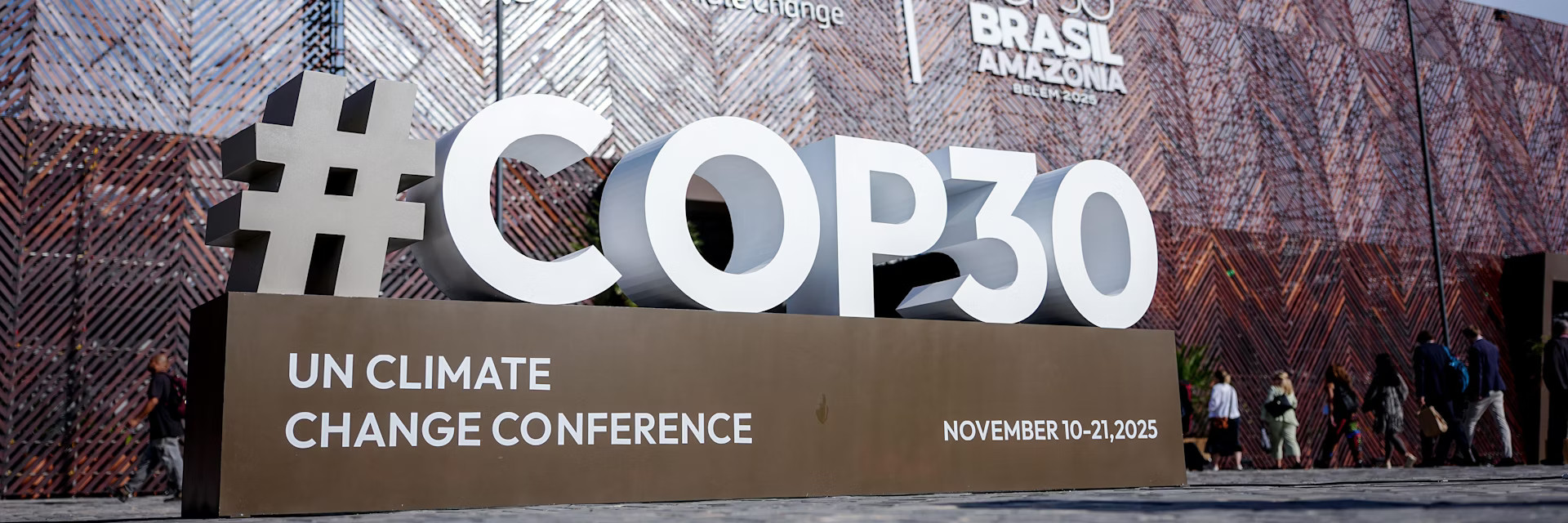
The world’s most important climate summit – known this year as Cop30 – has begun in the Amazonian port city of Belém, Brazil. It promises to be contentious: key countries haven’t submitted new climate plans, and negotiations are held up by disputes over who should pay for climate action.
We attended a preliminary round of negotiations in June, which ended with very few concrete agreements. Many outcome documents were instead heavily caveated as “not agreed”, “open to revision”, or “without formal status”.
Those fractious pre-summit talks followed a disappointing Cop29 in Azerbaijan last year. This year, here are five key issues to watch – and why they matter.
Are countries keeping their Paris pledges?
Ten years after the Paris agreement, countries are due to submit their third round of national climate plans, or nationally determined contributions (NDCs) in the jargon. These are refreshed every five years and are supposed to present “best efforts” to scale up climate action.
Yet as of November 2025, only 79 countries – covering 64% of global emissions – have submitted their NDCs. Countries not submitting include some of the highest emitters, such as India, while the US has (once again) left the Paris agreement and will not have high-level representatives at Cop30.
This is a big deal because these plans give us a snapshot of how countries’ planning matches up to global goals, including keeping temperature changes to below 1.5°C, which is looking increasingly unlikely (even if every country fulfilled its pledges, we’re still on course for nearly 3°C).
Who pays for this?
At Cop29 last year, countries agreed to pledge US$300 billion (£227 billion) a year by 2035 to help developing countries. While this was three times higher than the previous goal, it is barely a dent in the US$1.3 trillion developing countries requested – an amount now sidelined as “aspirational”.
Several countries, including India and Nigeria accused the Cop29 host Azerbaijan of forcing through a deal without consensus. Disappointment still lingers, and the fallout delayed agreement on an agenda for Cop30.
The question of who pays for climate change remains unresolved. Without agreement talks risk further breakdown, potentially stalling both adaptation and mitigation efforts worldwide.
What does a ‘just transition’ actually mean?
If the switch from a high to low-emissions world is to be successful it must be fair and inclusive, with no one left behind. This is known as the “just transition”.
Just transition talks have been fraught since Cop28, where richer countries insisted that it focus narrowly on finding new jobs for workers in fossil fuel industries. Various developing and middle-income countries, including China and some of the most climate-vulnerable nations, were more radical and ambitious. In their view, a just transition involves systemic change, arguing that “business as usual” perpetuates inequality.
This would have meant an overhaul of how we approach climate change. However, the wealthier countries eventually got their way in the final agreement, as the text was watered down to focus on the energy and labour sector. The broader ambition was effectively erased. This short-term win for the wealthier countries led to long-term fallout: negotiations collapsed at last year’s Cop29.
At this year’s preliminary meeting in Bonn, Germany, committee chairs enforced strict timekeeping and repeatedly urged delegates to focus on moving forward the text, at one point openly saying, “we already know everyone’s positions, let’s get down to brass tacks, let’s stop with general statements”. This approach seemed to work, as the working group did end up submitting an informal note (rather than a fully-fledged agreement), heavily caveated as not being final.
Unfortunately, as a result, the UN process still lacks agreement on what “just transition” really means or how to achieve it. Without clarity, the term risks becoming empty rhetoric rather than a roadmap for fair and inclusive climate action.
Saving tropical rainforests
The summit’s Amazonian setting has turned attention to tropical forests. Brazil’s president, Luiz Inácio Lula da Silva, has proposed a bold initiative – the Tropical Forest Forever Facility – that aims to raise US$125 billion to reward countries for preservation efforts. Yet the UK, for instance, has already opted out of contributing to the forest facility, despite reports detailing its alarming global deforestation footprint.
The Amazon stores up to 20 years of global CO₂ emissions, holds 10% of terrestrial biodiversity, and supports billions of dollars
in ecosystem services. Its destruction endangers Indigenous sovereignty and the planet’s climate stability. If Cop30 can meet its aim to protect rainforests, it stands a real chance of making a difference.
Inequity at the negotiations
Cop30 may be turn out to be one of the least equitable climate talks in recent memory. Belém’s astronomical accommodation costs mean many low-income countries and marginalised communities will struggle to attend, exacerbating longstanding UN issues.
Around 3,000 Indigenous representatives are expected, but so are thousands of fossil fuel lobbyists – a record number attended last year. However, as reports continually show, people linked to fossil fuels continue to participate – even in the main formal negotiations – without needing to disclose their affiliation.
If Cop30 could centre Indigenous rights, ensure equitable discussion, and limit lobbyist influence, it could restore some legitimacy to the process. Otherwise, it risks deepening the divide between rhetoric and reality in global climate governance.
The summit is set to be anything but technocratic and boring. We expect to see a tumultuous and controversial set of negotiations that will likely have repercussions well into the future.
Alix Dietzel, Senior Lecturer in Climate Justice, University of Bristol and Katherine Fitzpatrick, PhD Candidate, Anthropology, University of Bristol
This article is republished from The Conversation under a Creative Commons license. Read the original article ( https://theconversation.com/five-key-issues-at-the-un-climate-summit-in-brazil-and-why-they-matter-to-you-and-the-planet-269216 ).
Image credits: Kay Nietfeld / Alamy