Julianna Mullen | Plasma Science and Fusion Center
MIT News (https://news.mit.edu/2023/new-quantum-magnet-unleashes-electronics-potential-0725)
Researchers discover how to control the anomalous Hall effect and Berry curvature to create flexible quantum magnets for use in computers, robotics, and sensors.
Some of our most important everyday items, like computers, medical equipment, stereos, generators, and more, work because of magnets. We know what happens when computers become more powerful, but what might be possible if magnets became more versatile? What if one could change a physical property that defined their usability? What innovation might that catalyze?
It’s a question that MIT Plasma Science and Fusion Center (PSFC) research scientists Hang Chi, Yunbo Ou, Jagadeesh Moodera, and their co-authors explore in a new open-access Nature Communications paper, “Strain-tunable Berry curvature in quasi-two-dimensional chromium telluride.”
Understanding the magnitude of the authors’ discovery requires a brief trip back in time: In 1879, a 23-year-old graduate student named Edwin Hall discovered that when he put a magnet at right angles to a strip of metal that had a current running through it, one side of the strip would have a greater charge than the other. The magnetic field was deflecting the current’s electrons toward the edge of the metal, a phenomenon that would be named the Hall effect in his honor.
In Hall’s time, the classical system of physics was the only kind, and forces like gravity and magnetism acted on matter in predictable and immutable ways: Just like dropping an apple would result in it falling, making a “T” with a strip of electrified metal and magnet resulted in the Hall effect, full stop. Except it wasn’t, really; now we know quantum mechanics plays a role, too.
Think of classical physics as a map of Arizona, and quantum mechanics as a car trip through the desert. The map provides a macro view and generalized information about the area, but it can’t prepare the driver for all the random events one might encounter, like an armadillo running across the road. Quantum spaces, like the journey the driver is on, are governed by a different set of local traffic rules. So, while the Hall effect is induced by an applied magnetic field in a classical system, in a quantum case the Hall effect may occur even without the external field, at which point it becomes the anomalous Hall effect.
When cruising in the quantum realm, one is equipped with the knowledge of the so-called “Berry phase,” named after British physicist Michael Berry. It serves as a GPS logger for the car: It’s as if the driver has recorded their entire trip from start to finish, and by analyzing the GPS history, one can better plot the ups and downs, or “curvature” of the space. This “Berry curvature” of the quantum landscape can naturally shift electrons to one side, inducing the Hall effect without a magnetic field, just as the hills and valleys dictate the path of the car.
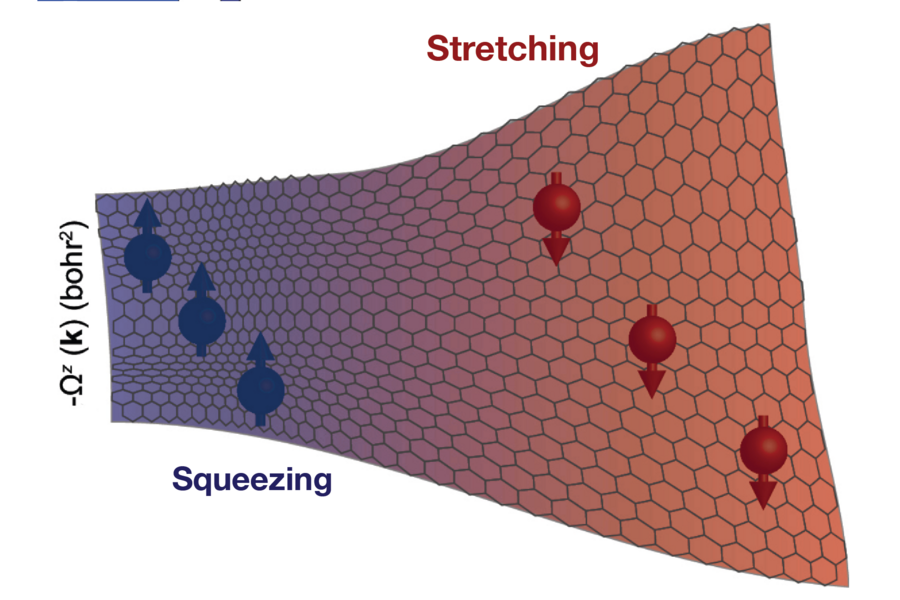
While many have observed the anomalous Hall effect in magnetic materials, none had been able to manipulate it by squeezing and/or stretching — until the paper’s authors developed a method to demonstrate the change in the anomalous Hall effect and Berry curvature in an unusual magnet.
First, they took half-millimeter-thick bases made of either aluminum oxide or strontium titanate, both of which are crystals, and grew an incredibly thin layer of chromium telluride, a magnetic compound, on top of the bases. On their own, these materials wouldn’t do much; however, when combined, film’s magnetism and the interface it created with the bases onto which it was grown caused the layers to stretch or squeeze.
To deepen their understanding of how these materials were working together, the researchers partnered with Oak Ridge National Laboratory (ORNL)’s Spallation Neutron Source to perform neutron scattering experiments — essentially blasting the material with shots of particles and studying what bounced back — to learn more about the film’s chemical and magnetic properties. Neutrons were an ideal tool for the study because they are magnetic but have no electrical charge. The neutron experiments allowed the researchers to build a profile that revealed how the chemical elements and magnetic behaviors changed at different levels as they probed deeper into the material.
The researchers witnessed the anomalous Hall effect and Berry curvature responding to the degree of squeezing or stretching occurring on the base after the film was applied, an observation later verified by modeling and data simulations.
Though this breakthrough occurred at the tiniest molecular level, the scientists’ discovery has significant, real-world ramifications. For example, hard drives store data in tiny magnetic regions, and if they were built using “strain-tunable” materials like the film, they could store additional data in regions that have been stretched different ways. In robotics, strain-tunable materials could be used as sensors able to provide precise feedback on robots’ movements and positioning. Such materials would be especially useful for “soft robots,” which use soft and flexible components that better imitate biological organisms. Or, a magnetic device that changed its behavior when flexed or bent could be used to detect minute changes in the environment, or to make incredibly sensitive health monitoring equipment.
In addition to Chi, Ou, and Moodera, who is also an affiliate of the MIT Department of Physics, MIT contributors to the work include postdoc Alexandre C. Foucher and Professor Frances Ross of the Department of Materials Science and Engineering.
Additional co-authors include Tim B. Eldred and Wenpei Gao of North Carolina State University; Sohee Kwon, Yuhang Liu, and Roger K. Lake of the University of California at Riverside; Joseph Murray, Michael Dreyer, and Robert E. Butera of the Laboratory for Physical Sciences; Haile A. Ambaye, Valerie Lauter, and Jong K. Keum of ORNL; Alice T. Greenberg, Yuhang Liu, Mahesh R. Neupane, George J. de Coster, Owen A. Vail, Patrick J. Taylor, Patrick A. Folkes, and Charles Rong of the Army Research Lab; Gen Yin of Georgetown University; and Don Heiman of Northeastern University.
This study was supported, in part, by the U.S. Army Research Office, U.S. National Science Foundation (NSF), U.S. Office of Naval Research, U.S. Air Force Office of Scientific Research, and the MIT-IBM Watson AI Research Lab. Facilities access was provided by the MIT Materials Research Laboratory, MRSEC, MIT.nano, SNS and Center for Nanophase Materials Sciences, Department of Energy Office of Science User Facilities operated by ORNL, and Advanced Cyberinfrastructure Coordination Ecosystem: Services and Support supported by NSF.
Reprinted with permission of MIT News (http://news.mit.edu/)