dotlah! dotlah!
  • Cities
  • Technology
  • Business
  • Politics
  • Society
  • Science
  • About
Social Links
  • zedreviews.com
  • citi.io
  • aster.cloud
  • liwaiwai.com
  • guzz.co.uk
  • atinatin.com
0 Likes
0 Followers
0 Subscribers
dotlah!
  • Cities
  • Technology
  • Business
  • Politics
  • Society
  • Science
  • About
  • Cities

Natural Ways Of Cooling Cities

  • October 2, 2019
Total
0
Shares
0
0
0

ETH Zurich scientists have been researching the effect of precipitation and population size on rising temperatures in cities compared with the surrounding countryside. They have found that more green spaces can help to lower temperatures in urban zones – but not everywhere.
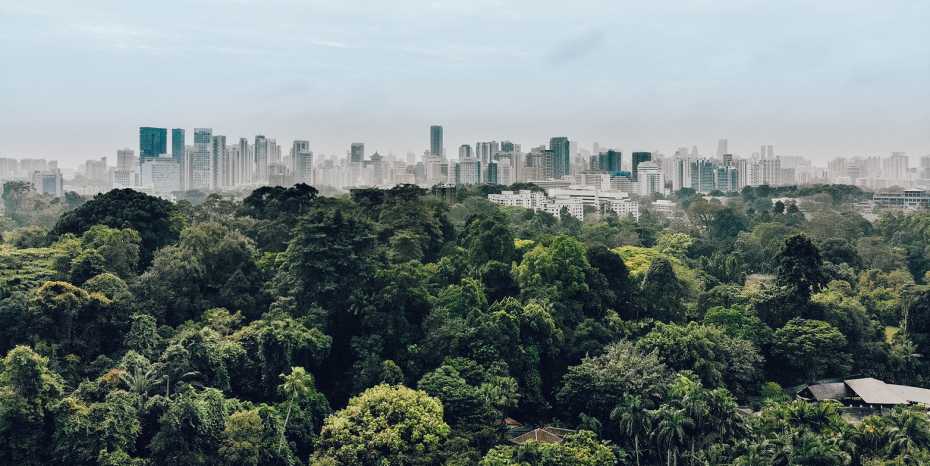
Whether trees cool down the temperature in the city depends on their environment. (Bret Clay / iStock)

Urban heat islands are a phenomenon where the temperature in a city is noticeably higher than in the surrounding rural area. When combined with the sort of heatwave that hit many parts of Europe at the beginning of July, urban heat can pose a real threat to the elderly, sick or other vulnerable people. Scientists at ETH Zurich have researched urban heat islands across the globe and have found that the effectiveness of heat-reduction strategies in cities varies depending on the regional climate. “We already know that plants create a more pleasant environment in a city, but we wanted to quantify how many green spaces are actually needed to produce a significant cooling effect,” says Gabriele Manoli, former postdoc with the Chair of Hydrology and Water Resources Management at ETH Zurich and lead author of the recently published article in the journal Nature.

More green spaces: not always the most efficient solution

Manoli and his colleagues from ETH Zurich, Princeton University and Duke University studied data from some 30,000 cities worldwide and their surrounding environment, taking into consideration the average summer temperature, the population size and the annual rainfall. The urban heat island phenomenon is more pronounced the bigger the city and the more rainfall in that region. As a general rule, more rain encourages plant growth in the surrounding area, making this cooler than the city. This effect is the strongest when annual rainfall averages around 1500 millimetres as in Tokyo, but does not increase further with more rain.
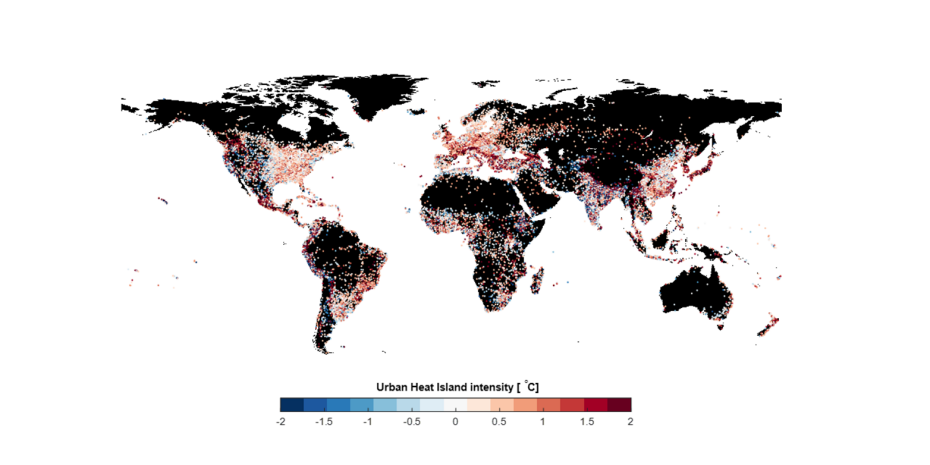
The map shows in which cities the heat island effect is most significant. (Gabriele Manoli / ETH Zurich)

Two climate extremes illustrate well the role of vegetation on the urban heat island phenomenon: very dry regions on the one hand, and tropical areas on the other. Through carefully targeted planting, a city like Phoenix in the USA could achieve cooler temperatures than the surrounding countryside, where conditions are almost desert-like. By comparison, a city surrounded by tropical forests, such as Singapore, would need far more green spaces to reduce temperatures, but this would also create more humidity. In cities located in tropical zones, other cooling methods are therefore expected to be more effective, such as increased wind circulation, more use of shade and new heat-dispersing materials. “There is no single solution,” Manoli says. “It all depends on the surrounding environment and regional climate characteristics.”

Useful information for city planners

Manoli explains that the main benefit of the study is a preliminary classification of cities, in the form of a clear visualisation guiding planners on possible approaches to mitigate the urban heat island effect. “Even so, searching for solutions to reduce temperatures in specific cities will require additional analysis and in-depth understanding of the microclimate,” he stresses. “Such information, however, is based on data and models available to city planners and decision-makers only in a handful of cities, such as Zurich, Singapore or London.”

Manoli is currently analysing data from other periods of the year and is studying which types of plant are most suitable for reducing temperatures. The support provided by the Branco Weiss Fellowship allowed the environmental engineer to work with scientists from the areas of physics, urban studies and social sciences with a specific focus on interdisciplinary research topics.


Reference

Manoli G, Fatichi S, Schläpfer M, Yu K, Crowther TW, Meili N, Burlando P, Katul GG, Bou-Zeid E: Magnitude of urban heat islands largely explained by climate and population. Nature, 4 September 2019, doi: 10.1038/s41586-019-1512-9

Total
0
Shares
Share
Tweet
Share
Share
Related Topics
  • Climate sciences
  • Environmental Sciences
  • Research
  • Urban Design
majulah

Previous Article
  • Science

NUS Researchers Develop New Drug That Fights Cancer With Less Renal Toxicity

  • October 2, 2019
View Post
Next Article
  • Technology

Youth Have A Love-Hate Relationship With Tech In The Digital Age

  • October 3, 2019
View Post
You May Also Like
View Post
  • Cities
  • Environment
  • People

Was Venezuela struck by an earthquake ‘doublet’? Here’s what we know so far

  • dotlah.com
  • June 27, 2026
View Post
  • Cities
  • Economy
  • Politics

The global price tag of war in the Middle East

  • dotlah.com
  • March 24, 2026
View Post
  • Cities
  • Food

How the Iran war could create a ‘fertiliser shock’ – an often ignored global risk to food prices and farming

  • dotlah.com
  • March 6, 2026
View Post
  • Cities
  • Climate Change
  • Science

New research may help scientists predict when a humid heat wave will break

  • dotlah.com
  • January 6, 2026
View Post
  • Cities

How bus stops and bike lanes can make or break your festive city trip

  • dotlah.com
  • December 29, 2025
View Post
  • Cities
  • People

We must empower local leaders to meet global goals – here’s why

  • dotlah.com
  • November 4, 2025
View Post
  • Cities

Politicians love comparing NZ’s economy to Singapore or Ireland – but it’s simplistic and misleading

  • dotlah.com
  • September 21, 2025
View Post
  • Cities
  • Technology

Meralco PowerGen’s PacificLight starts up 100 MW fast-response plant in Singapore

  • dotlah.com
  • June 20, 2025


Trending
  • 1
    • Cities
    • Technology
    Accelerating Nationwide Digitalisation To Build A World-Class Resilient Digital Future
    • June 9, 2020
  • 2
    • Lah!
    • Technology
    Changi Recommends Unveils Changi Mobile Under New MVNO Partnership With M1
    • September 21, 2021
  • 3
    • Cities
    A321 Converted Freighter Receives EASA Supplemental Type Certification
    • February 26, 2020
  • 4
    • Lah!
    • Society
    SUTD Introduces New Grant To Defray The Cost Of Education
    • February 24, 2020
  • 5
    • Cities
    • Lah!
    Keppel-NTU To Boost Development Of Advanced Low-Carbon Technologies
    • October 27, 2021
  • train covid19 commuter 6
    • Cities
    • World Events
    Here’s How To Make Public Transport Safer During COVID-19
    • September 28, 2020
  • 7
    • Cities
    Europe’s Worst Cities For Traffic Congestion
    • February 18, 2020
  • 8
    • Technology
    NUS To Set Up New Centre For Trusted Internet And Community To Help Build An Accountable Internet And Improve Information Literacy
    • February 28, 2020
  • 9
    • Cities
    • Technology
    NTU Students Whizzing Ahead With Foodpanda
    • June 11, 2021
  • 10
    • Cities
    The Top 50 Smart Cities In The World 2020
    • July 16, 2020
  • 11
    • Lah!
    Online Food Delivery Spend To More Than Triple In Southeast Asia By 2025
    • September 8, 2021
  • 12
    • Cities
    • Lah!
    MPA Launches Regular Guided Tours To Raffles Lighthouse
    • January 31, 2022
Trending
  • 1
    Chinese tech giant Huawei unveils Mate 90 series smartphones with flagship Tau chips adopting logic folding technology
    • October 3, 2026
  • 2
    Google Opens Singapore Engineering Center to Build and Export Enterprise Cloud and AI to the World
    • September 15, 2026
  • 3
    Apple Flagship Hardware Launch for September 2026
    • September 10, 2026
  • 4
    MIT researchers tackle the economic realities of fusion power
    • August 10, 2026
  • 5
    ASEAN, treaty parties push stronger cooperation as Treaty of Amity and Cooperation in Southeast Asia marks 50 years
    • July 26, 2026
  • 6
    The Fastest AI Fried Chicken In The World
    • June 29, 2026
  • 7
    Zed Approves | How to Stay Cool in Extreme Heat
    • June 29, 2026
  • 8
    Was Venezuela struck by an earthquake ‘doublet’? Here’s what we know so far
    • June 27, 2026
  • 9
    Zed Approves | It’s Prime Day 2026! Time to Upgrade Your World Cup Viewing Setup and Beat the Heat
    • June 25, 2026
  • 10
    Zed Approves | The Best Prime Day PC Deals: Top Gaming Rigs, Workstations, and Everyday Laptops
    • June 25, 2026
Social Links
dotlah! dotlah!
  • Cities
  • Technology
  • Business
  • Politics
  • Society
  • Science
  • About
Connecting Dots Across Asia's Tech and Urban Landscape

Input your search keywords and press Enter.