dotlah! dotlah!
  • Cities
  • Technology
  • Business
  • Politics
  • Society
  • Science
  • About
Social Links
  • zedreviews.com
  • citi.io
  • aster.cloud
  • liwaiwai.com
  • guzz.co.uk
  • atinatin.com
0 Likes
0 Followers
0 Subscribers
dotlah!
  • Cities
  • Technology
  • Business
  • Politics
  • Society
  • Science
  • About
  • Science

NUS Researchers Develop New Drug That Fights Cancer With Less Renal Toxicity

  • October 2, 2019
The novel drug enters the ‘powerhouses’ of cancer cells to launch an attack, without harming healthy cells
Total
0
Shares
0
0
0

A team of NUS pharmacists and chemists has developed a new anti-cancer drug that has less toxic effects to the kidneys. The new drug works like a ‘magic bullet’ that is delivered directly to the mitochondria — the power generators of cells — of cancer cells. Once the drug reaches the tumour, two active molecules — an anti-cancer drug and a sensitizer — are released at once, and they attack the mitochondria, leading to the death of cancer cells. Such a targeted approach reduces the drug’s interactions with other tissues, minimising side effects and it is expected to lower the risk of patients developing resistance to anti-cancer drugs like cisplatin.

The development of the novel drug was first reported in the journal Angewandte Chemie International Edition on 3 April 2019.
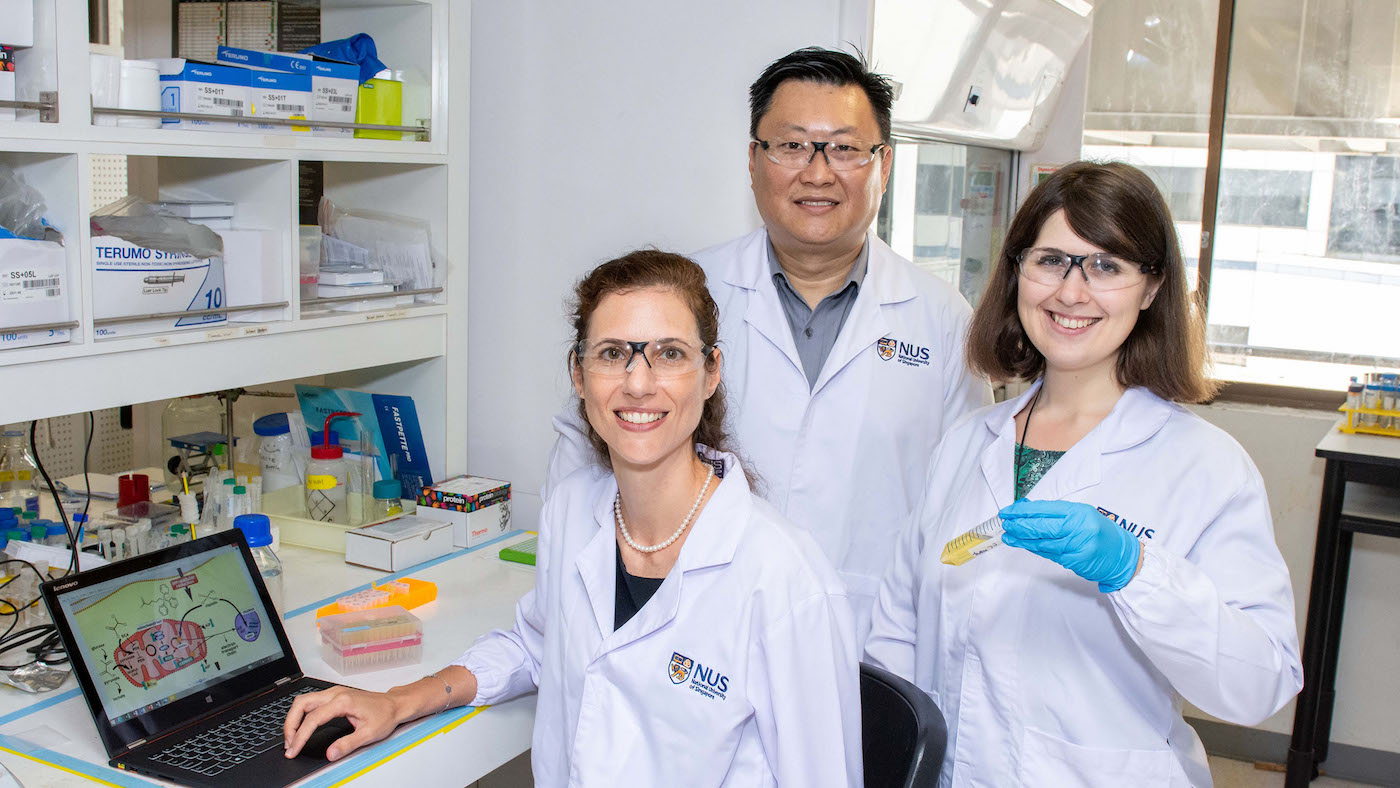
The novel drug enters the ‘powerhouses’ of cancer cells to launch an attack, without harming healthy cells

Side effects of anti-cancer drugs

The discovery of cisplatin as an anti-cancer drug in 1965 was an important milestone that changed the treatment of the disease, and improved the cure rates of cancer patients worldwide.

More than 50 years later, cisplatin and the newer generation of platinum-based anti-cancer drugs are still used in about 40 per cent of all chemotherapy treatments. However, these drugs have toxic side effects, such as causing severe kidney dysfunction in patients, which may require some patients to undergo dialysis treatment.

“When designing and evaluating new cancer treatments, researchers often use cisplatin as a gold standard to compare new medicines. Cisplatin is known to kill cancer cells by damaging DNA. But cancer cells are smart, and they have ways to repair this damage and become resistant to the drug treatment. Hence, we need good alternatives that can address drug resistance and the associated side effects,” explained Associate Professor Ang Wee Han from NUS Chemistry.

He worked together with Associate Professor Giorgia Pastorin from NUS Pharmacy to look into developing an anti-cancer drug with better treatment outcomes to serve as an alternative to cisplatin. The research was conducted in collaboration with Professor Dan Gibson from The Hebrew University of Jerusalem.

Lab studies: Tumour disappears after targeted delivery of new drug

Recognising that the mitochondria have less efficient repair mechanisms in their DNA, the NUS team came up with a novel drug that can be delivered directly to them. This was achieved by adding a mitochondria-targeting ligand to the original cisplatin scaffold. This additional ligand has a strong positive charge that displays high affinity towards the complementary negative charge of the mitochondrial membrane.

The NUS researchers examined how their drug was released into the blood, and came up with a method to encapsulate their novel drug formulation in miniaturised drug carriers known as liposomal nanovesicles. As tumours grow very rapidly, their blood vessels do not have time to develop properly and they are leaky. Such an environment enables the permeation of the drug carriers from blood vessels to the tumour microenvironment, and be retained within the tumour to carry out the ‘attack’ on cancer cells.

Experiments by the researchers showed that the new drug, when delivered in a colon cancer model, shrank the tumour until it became impalpable.

“No sign of kidney inflammation was detected, unlike the use of conventional cisplatin. These results indicate that our invention is a viable alternative to cisplatin,” said Dr Maria Babak, who was the first author of the study.

“While our results show great potential, we want to further challenge ourselves to improve our drug so that we can achieve complete tumour remission and tackle drug resistance. Accomplishing such a feat will open doors to improving cancer treatment and survival rates,” said Assoc Prof Pastorin.

Further studies

To improve the efficacy of the new drug, the research team is looking into adjusting the doses and frequencies of the treatment. They are also studying combinations of different anti-cancer drugs, and examining ways to packaging them into suitable drug delivery systems to increase efficacy, decrease side effects and tackle drug resistance among cancer patients.

Total
0
Shares
Share
Tweet
Share
Share
Related Topics
  • Cancer Research
  • Kidneys
  • NUS
majulah

Previous Article
  • Lah!

Singapore And The Eurasian Economic Union Deepen Economic Relations Through A Free Trade Agreement

  • October 2, 2019
View Post
Next Article
  • Cities

Natural Ways Of Cooling Cities

  • October 2, 2019
View Post
You May Also Like
View Post
  • Cities
  • Climate Change
  • Science

New research may help scientists predict when a humid heat wave will break

  • dotlah.com
  • January 6, 2026
Semiconductor
View Post
  • Computing
  • Science

Decoding The Digital. Distinguishing Computer Science And Information Technology In Society And Industry.

  • Dean Marc
  • May 2, 2024
View Post
  • Artificial Intelligence
  • Data
  • Research
  • Science

Generative AI Could Offer A Faster Way To Test Theories Of How The Universe Works

  • dotlah.com
  • March 17, 2024
Mercury
View Post
  • Science
  • Technology

Study: Global Deforestation Leads To More Mercury Pollution

  • dotlah.com
  • February 14, 2024
View Post
  • Science
  • Technology

Higher, Faster: What Influences The Aerodynamics Of A Football?

  • dotlah.com
  • February 11, 2024
View Post
  • Artificial Intelligence
  • Science
  • Technology

A Glimpse Of The Next Generation Of AlphaFold

  • dotlah.com
  • November 6, 2023
View Post
  • Artificial Intelligence
  • Machine Learning
  • Science
  • Technology

AI in the Classroom: Amii’s K-12 Pilot Program

  • dotlah.com
  • October 23, 2023
View Post
  • Science
  • Technology

Learning How To Learn

  • John Francis
  • October 23, 2023


Trending
  • 1
    • Technology
    Who Really Owns Our Data?
    • August 1, 2019
  • 2
    • Technology
    NEA Call Tender For Virtual Reality Solutions To Enhance Training For NEA Enforcement Officers
    • February 12, 2020
  • 3
    • Lah!
    TraceTogether & SafeEntry To Be Enhanced In Preparation For Further Opening Of The Economy
    • September 12, 2020
  • 4
    • Lah!
    • Technology
    NTU And NEA Launch Unique S$40m Waste-To-Energy Research Facility
    • May 31, 2019
  • 5
    • Lah!
    • Technology
    Deloitte And NTU Singapore Launch New Course In Audit Analytics To Build Capabilities In Accountants Of The Future
    • June 9, 2020
  • 6
    • Cities
    • Lah!
    EMA To Explore The Potential Of Geothermal Energy For Power Generation
    • October 27, 2021
  • 7
    • Lah!
    4 Must-Know National Mascots In Singapore
    • August 14, 2019
  • 8
    • People
    Reasons Why People Are Obsessed With Beauty
    • July 29, 2020
  • 9
    • Lah!
    What It Takes To Put Out Forest Fires
    • September 23, 2019
  • 10
    • Technology
    NTUC Income Launches SNACK Investment, An Industry-First Micro Investment-Linked Plan That Integrates Micro-Investments Into Consumers’ Everyday Lives
    • September 19, 2021
  • 11
    • Cities
    What Smart-Nation Singapore Can Learn From Other Smart Cities
    • February 26, 2018
  • studying stressed books 12
    • Features
    • People
    Feeling Stressed All The Time? Here Are 7 Things To Try
    • December 18, 2020
Trending
  • Red Hat OpenShift 1
    Red Hat Further Drives Digital Sovereignty for the AI Era with Red Hat OpenShift on Google Cloud Dedicated
    • April 21, 2026
  • Illustration of data storage 2
    The Splinternet Comes for European Supply Chains Why Fragmentation Is Now a Boardroom Problem
    • April 21, 2026
  • 3
    Here’s how to get the $7 trillion AI hardware buildout right
    • April 18, 2026
  • totus-technologies-cover 4
    The Transatlantic Tech Rift and Why Data Sovereignty Is the New Industrial Imperative
    • April 16, 2026
  • 5
    What will it take to get ships going through the Strait of Hormuz again?
    • April 13, 2026
  • 6
    Hon Hai Technology Group (Foxconn) Recognized As Top 100 Global Innovators 2026
    • April 9, 2026
  • 7
    3 lessons on the energy transition in an age of crisis
    • April 7, 2026
  • 8
    Samsung Unveils Galaxy A57 5G and Galaxy A37 5G, Packing Pro-Level Features at Awesome Price
    • March 25, 2026
  • 9
    The global price tag of war in the Middle East
    • March 24, 2026
  • 10
    Kioxia Announces New SSD Model Optimized for AI GPU-Initiated Workloads
    • March 17, 2026
Social Links
dotlah! dotlah!
  • Cities
  • Technology
  • Business
  • Politics
  • Society
  • Science
  • About
Connecting Dots Across Asia's Tech and Urban Landscape

Input your search keywords and press Enter.