dotlah! dotlah!
  • Cities
  • Technology
  • Business
  • Politics
  • Society
  • Science
  • About
Social Links
  • zedreviews.com
  • citi.io
  • aster.cloud
  • liwaiwai.com
  • guzz.co.uk
  • atinatin.com
0 Likes
0 Followers
0 Subscribers
dotlah!
  • Cities
  • Technology
  • Business
  • Politics
  • Society
  • Science
  • About
  • Cities

Supporting Cleaner And Greener Vehicles For A Sustainable Land Transport Sector

  • February 20, 2020
AFP PHOTO / ROSLAN RAHMAN
Total
0
Shares
0
0
0

Under the Land Transport Master Plan 2040, we have committed to encouraging adoption of cleaner and greener vehicles for a more environmentally sustainable land transport sector. As part of Budget 2020, Government is introducing measures to facilitate adoption of Electric Vehicles (EVs), which is one of the cleanest and lowest-emission vehicular technologies available today. We have also reviewed the road tax framework to better reflect the current trends in vehicular efficiency and parity with Internal Combustion Engine (ICE) vehicles.

EV Early Adoption Incentive

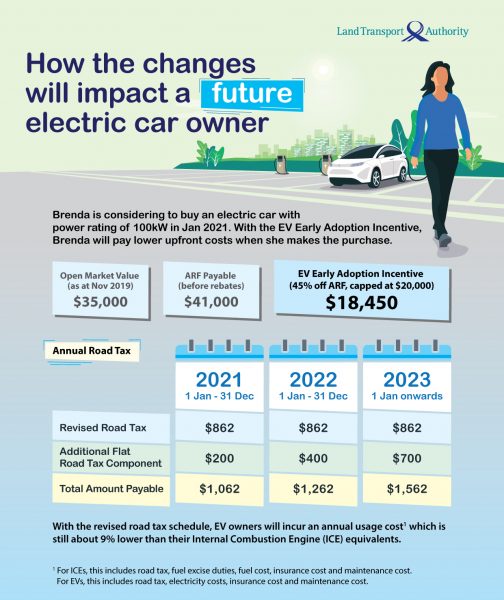
Today, EVs incur higher upfront ownership cost as compared to equivalent ICE vehicles. EVs are becoming more affordable, and the ownership cost gap between EVs and ICEs is expected to close over time. However, this ownership cost gap is currently a significant barrier in the adoption of EVs. To address this, we will launch an EV Early Adoption Incentive (EEAI) for the next three years, from 1 January 2021 to 31 December 2023. Owners who register fully electric cars will receive a rebate of 45% off the Additional Registration Fees (ARF), capped at $20,000. This EEAI will lower the upfront cost of an electric car by an average of 11% and narrow the upfront cost gap between electric and ICE cars. This scheme will apply to individual and fleet vehicle owners, such as taxi and car rental companies, and will cost Government an estimated $71 million over the next 3 years. Annex A illustrates the rebates for a few common EV models.
Revised EV Road Tax Structure

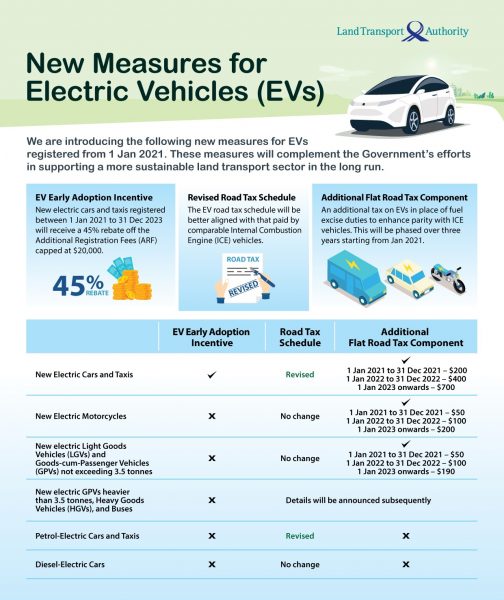
We have reviewed the EV road tax schedule. The revised schedule will apply to all new EVs registered from 1 January 2021 onwards and is shown here.

Currently, ICE vehicles incur fuel excise duties through fuel consumption. Owners of fully electric cars have thus far not been subjected to fuel excise duties. To enhance parity with ICE vehicles until we are ready to impose a distance-based tax, we will impose an additional tax of $700/year for fully electric cars, which is sized to partially recover for the fuel excise duties paid by equivalent ICE cars.

To cushion the impact, the Government will phase in this additional tax over three years (see here for the phase-in schedule). The full quantum will be charged from January 2023 onwards.

As part of the revised EV road tax structure, we will also revise the methodology for calculating the variable component of the road tax for EVs, which is tiered by power rating, to better reflect the current trends in vehicle efficiency from January 2021. This will lead to an across-the-board reduction in this variable component of road tax for EVs and some hybrids.

In summary, the revised electric car road tax schedule will comprise:

  • a.    An additional flat component of $700/year, phased in over three years; and
  • b.    The existing variable component tiered according to power rating, and which will be revised to better account for improvements in vehicular efficiency; and
  • c. Under the revised road tax framework, mass market electric cars will incur an annual usage cost which is still about 9% lower than their ICE equivalents.

Electric Motorcycles and Electric Light Goods Vehicles (LGVs)

From 1 Jan 2021, the additional tax will also be levied on fully electric motorcycles ($200/year); and fully electric light goods vehicles (LGVs) and goods-cum-passenger vehicles (GPVs) not exceeding 3.5 metric tonnes ($190/year). Details on the treatment of electric buses, heavy goods vehicles, and GPVs heavier than 3.5 metric tonnes will be announced at a later date.

Petrol-Electric Hybrids

For petrol-electric hybrids that currently pay road tax based on their maximum electric power rating, we will align their road tax schedule with the revised variable component of the electric car road tax schedule. Since these vehicles remain largely petrol-fuelled, we do not intend to impose the additional flat component on them for now. Overall, these hybrids will have their road tax reduced by an average of 29%.

LTA will inform existing EV owners of the implications of the revised road tax schedule on them, in due course.

These measures will complement the Government’s efforts in expanding the public charging infrastructure for EVs. Together with other existing and new instruments, such as the Vehicular Emissions Scheme (VES), the Commercial Vehicle Emissions Scheme (CVES) and Early Turnover Scheme (ETS), we will support the long-term adoption of cleaner and greener vehicles for a more sustainable land transport sector.

Total
0
Shares
Share
Tweet
Share
Share
Related Topics
  • Budget 2020
  • Electric Cars
  • Electric Vehicles
  • EV
  • LTA
  • Sustainability
dotlah.com

Previous Article
  • Lah!

Enhancements To The Productivity Solutions Grant And Implementation Of Outcome-Based Contracting In The Public Service To Enhance Productivity In The Environmental Services Industry

  • February 20, 2020
View Post
Next Article
  • Cities
  • Lah!

Coronavirus: Are We Heading For A Global Recession?

  • February 21, 2020
View Post
You May Also Like
View Post
  • Cities
  • Economy
  • Politics

The global price tag of war in the Middle East

  • dotlah.com
  • March 24, 2026
View Post
  • Cities
  • Food

How the Iran war could create a ‘fertiliser shock’ – an often ignored global risk to food prices and farming

  • dotlah.com
  • March 6, 2026
View Post
  • Cities
  • Climate Change
  • Science

New research may help scientists predict when a humid heat wave will break

  • dotlah.com
  • January 6, 2026
View Post
  • Cities

How bus stops and bike lanes can make or break your festive city trip

  • dotlah.com
  • December 29, 2025
View Post
  • Cities
  • People

We must empower local leaders to meet global goals – here’s why

  • dotlah.com
  • November 4, 2025
View Post
  • Cities

Politicians love comparing NZ’s economy to Singapore or Ireland – but it’s simplistic and misleading

  • dotlah.com
  • September 21, 2025
View Post
  • Cities
  • Technology

Meralco PowerGen’s PacificLight starts up 100 MW fast-response plant in Singapore

  • dotlah.com
  • June 20, 2025
View Post
  • Cities

Renewable energy, carbon credits are priority areas of cooperation for Singapore, Philippines: Lawrence Wong

  • dotlah.com
  • June 4, 2025


Trending
  • 1
    • Lah!
    • Technology
    Scientific Research Shows Customised Innovations Can Reduce The Risk Of COVID-19 Transmission
    • February 28, 2021
  • 2
    • Lah!
    Expect Warm Conditions In First Half Of March 2020
    • March 2, 2020
  • 3
    • Lah!
    • Technology
    ASEAN Small Businesses Count On Technology To Beat COVID-19
    • July 3, 2020
  • 4
    • Cities
    Factsheet: Tampines Adds 4km Of Cycling Paths
    • February 1, 2022
  • hiv aids 5
    • People
    • World Events
    Battles won – and lost – against AIDS hold valuable lessons for managing COVID-19
    • December 2, 2020
  • 6
    • Lah!
    MINDEF And SUTD Sign Cybersecurity MOU On Operational Technology Collaboration
    • September 17, 2021
  • 7
    • Lah!
    • Technology
    Singapore’s Startups Step Up Innovation Against COVID-19
    • June 21, 2020
  • 8
    • Technology
    Why Data Is Key To Solving Asia’s Most Pressing Problems
    • July 15, 2021
  • 9
    • Cities
    • Society
    NEA Issues Guidelines For Cleaning And Sanitation Of Premises
    • January 30, 2020
  • 10
    • Technology
    New NUS Centre For 5G Digital Building Technology To Augment Digital Capability Of Singapore’s Built Environment Industry
    • December 18, 2021
  • 11
    • People
    • World Events
    We’re In Danger Of Drowning In A Coronavirus ‘Infodemic’. Here’s How We Can Cut Through The Noise
    • February 13, 2020
  • 12
    • Business
    • Politics
    Which Countries Have The Greatest Economic Complexity?
    • May 18, 2020
Trending
  • Red Hat OpenShift 1
    Red Hat Further Drives Digital Sovereignty for the AI Era with Red Hat OpenShift on Google Cloud Dedicated
    • April 21, 2026
  • Illustration of data storage 2
    The Splinternet Comes for European Supply Chains Why Fragmentation Is Now a Boardroom Problem
    • April 21, 2026
  • 3
    Here’s how to get the $7 trillion AI hardware buildout right
    • April 18, 2026
  • totus-technologies-cover 4
    The Transatlantic Tech Rift and Why Data Sovereignty Is the New Industrial Imperative
    • April 16, 2026
  • 5
    What will it take to get ships going through the Strait of Hormuz again?
    • April 13, 2026
  • 6
    Hon Hai Technology Group (Foxconn) Recognized As Top 100 Global Innovators 2026
    • April 9, 2026
  • 7
    3 lessons on the energy transition in an age of crisis
    • April 7, 2026
  • 8
    Samsung Unveils Galaxy A57 5G and Galaxy A37 5G, Packing Pro-Level Features at Awesome Price
    • March 25, 2026
  • 9
    The global price tag of war in the Middle East
    • March 24, 2026
  • 10
    Kioxia Announces New SSD Model Optimized for AI GPU-Initiated Workloads
    • March 17, 2026
Social Links
dotlah! dotlah!
  • Cities
  • Technology
  • Business
  • Politics
  • Society
  • Science
  • About
Connecting Dots Across Asia's Tech and Urban Landscape

Input your search keywords and press Enter.