dotlah! dotlah!
  • Cities
  • Technology
  • Business
  • Politics
  • Society
  • Science
  • About
Social Links
  • zedreviews.com
  • citi.io
  • aster.cloud
  • liwaiwai.com
  • guzz.co.uk
  • atinatin.com
0 Likes
0 Followers
0 Subscribers
dotlah!
  • Cities
  • Technology
  • Business
  • Politics
  • Society
  • Science
  • About
  • Lah!
  • Technology

Singapore Spacer: Mapping Concentrations Of People In Campus Buildings

  • April 8, 2020
Total
0
Shares
0
0
0

A NUS-SMU collaborative effort with industry for mapping people concentrations on campus showcases Singapore’s diverse assets in combating COVID-19

COVID-19 has spread far and wide because it is highly contagious and also because it can start spreading before symptoms appear. Confirmation regarding this type of spread has emerged over the last days but a group of researchers at the National University of Singapore (NUS) and the Singapore Management University (SMU) foresaw this three weeks ago and teamed up to create a tool that enables administrators to estimate people counts in different buildings on campuses.

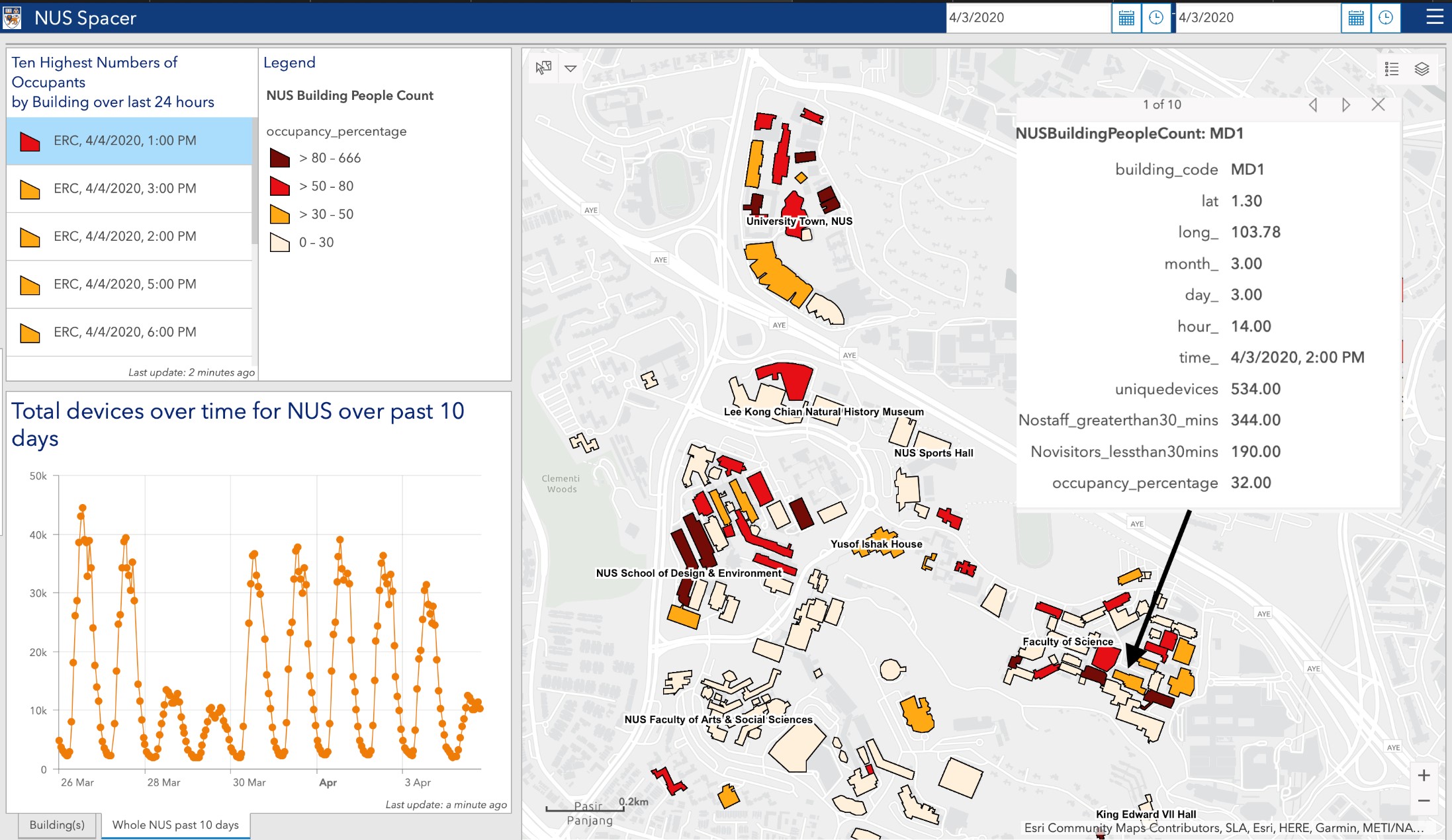
Singapore Spacer.jpg
Identifying campus buildings that are highly occupied as assessed by Wi-Fi devices connected. A downward trend in occupancy is noted in late March and the first days of April.

The tool enables decision makers to identify places on campus where people concentrations are high. Like an eye in the sky, it allows leaders to make principled choices about what actions to take to reduce the likelihood of person to person COVID-19 transmission. It also can inform about the effectiveness of policies. For example, when lecture halls effectively shut as a result of the implementation of e-learning, are students amassing at some other location?

“The beauty of this system lies in its ability to accumulate useful information and to share it without further disrupting life on campus,” said Professor Michael Chee from NUS, who led the initiative.

“By using Wi-Fi signal strength received from thousands of mobile devices across campus, location information can be aggregated and mapped over time to inform about where and when people aggregate,” added Associate Professor Rajesh Balan from SMU who provided the key techniques to map devices to locations.

The system which went live on 3 April 2020 was set up in record time as a result of close collaboration between the university-based design team and its support persons, IT professionals, NUS leadership and private companies including Aviation Virtual and ESRI who provided mapping support.

“During SARS, I felt powerless to help but over the 17 years since then, Singapore’s scientific base has grown so much, I was determined to put these intellectual assets to work. It is one thing to have an idea, but to move it into something real instead of just being anxious or negative, is something very important at this time,” Prof Chee said. “Most of the interdisciplinary team have different backgrounds. Apart from myself and Assistant Professor Thomas Yeo, a world leader in brain mapping and an academic staff at NUS, almost every other contact we made was a cold call made from recommendations collected from anyone who offered tips.”

Strangers from different backgrounds came together, worked collaboratively using social media and remote conferencing tools to collectively build something that may be of benefit to society.

The next step in the Spacer project is to work with the Nanyang Technological University to put up the same system and concurrently plan to upscale the effort to the whole of Singapore. For this, a different method of data collection will be necessary. Think of the latter effort as Google Maps or Waze for planning a trip, but for managing human rather than vehicular traffic. We use Google Maps or Waze every day to help us avoid crowded roads. Everyone contributes some anonymized personal information to benefit the whole community. Co-operation of telecom operators to obtain cellular data like in Germany, Italy and Austria, is presently being sought.

Locking down the whole country is what has been practiced in several countries. However, this cannot be sustained for long periods without significant damage to the economy and to collective psyches. By having intelligent management of people concentrations and flows, the Spacer project seeks to provide a calibrated solution for limiting disease spread that complements efforts made by another home-grown technological initiative ‘Trace Together’ which focuses on contact tracing.

Statistical modelling shows that a combination of measures is necessary to clamp down the spread of COVID-19. Associate Professor Alex Cook, statistical epidemiologist from NUS who published the modelling study in a major scientific journal on 23 March 2020, reinforced the point that, “there is room for multiple approaches”.

What is important, the team agrees, is that we work together, stay engaged and support one another’s efforts to contain this global menace.

Please refer here and https://bit.ly/2ULHmzD for more information about the Singapore Spacer.

Total
0
Shares
Share
Tweet
Share
Share
Related Topics
  • COVID-19
  • NTU
  • NUS
  • NUS Spacer
  • Singapore Spacer
  • SMU
dotlah.com

Previous Article
  • People
  • World Events

After Coronavirus The World Will Never Be The Same. But Maybe, It Can Be Better

  • April 7, 2020
View Post
Next Article
  • Lah!

Doing Our Part To Safeguard Economic Resilience

  • April 8, 2020
View Post
You May Also Like
View Post
  • Artificial Intelligence
  • Technology

Google Opens Singapore Engineering Center to Build and Export Enterprise Cloud and AI to the World

  • Dean Marc
  • September 15, 2026
View Post
  • Research
  • Technology

MIT researchers tackle the economic realities of fusion power

  • dotlah.com
  • August 10, 2026
zedreviews-valerion
View Post
  • Gears
  • Technology

Father’s Day Outdoors – Build Dad the Ultimate Backyard Watch Party

  • Dean Marc
  • June 21, 2026
zedreviews-fathers-day-50830
View Post
  • Gears
  • Technology

Father’s Day Outdoors, Round Two – Gear for the Action, the Tailgate, and Beating the Heat

  • Dean Marc
  • June 21, 2026
zedreviews-fathers-day-21306
View Post
  • Gears
  • Technology

A Father’s Day Gift Guide for Every Dad – Timepieces and Travel Gear

  • Dean Marc
  • June 21, 2026
View Post
  • Gears
  • Technology

Samsung Art Store Brings Art Basel to Homes Worldwide With New Curated Collection

  • Dean Marc
  • June 15, 2026
View Post
  • Artificial Intelligence
  • Technology

The consequences of relying on AI for accurate news

  • dotlah.com
  • June 10, 2026
pope-leo-xiv-cq5dam-1500.844
View Post
  • Artificial Intelligence
  • Technology

Pope Leo XIV to Publish First Encyclical on Artificial Intelligence and Human Dignity on 25 May

  • dotlah.com
  • May 23, 2026


Trending
  • 1
    • Cities
    • Lah!
    • Science
    • Technology
    Preparing For Future Pandemics With Hi-Tech Lab
    • July 6, 2021
  • 2
    • Cities
    How The Road Network Determines Traffic Capacity
    • December 3, 2019
  • 3
    • People
    • World Events
    Beyond The Curve: A Visual Journey Into Our Post-Pandemic Future
    • July 16, 2020
  • 4
    • Cities
    • Lah!
    First Look: CapitaSpring, Singapore’s Newest Skyscraper
    • February 2, 2021
  • 5
    • Lah!
    ​Cambridge University And NTU Singapore Establish New Research Centre To Support Lifelong Learning
    • October 8, 2020
  • 6
    • Lah!
    NParks To Transform Singapore’s Landscape Sector With New 10-Year Plan
    • August 7, 2019
  • 7
    • Science
    Can We Reverse Antibiotic Resistance?
    • November 26, 2019
  • 8
    • Cities
    • People
    • Politics
    • World Events
    The Design Of Dissent: How City Public Spaces Can Make Or Break A Civil Protest
    • June 10, 2020
  • 9
    • Cities
    Why Is Tap Water Not Safe Anymore Even In High Quality Cities
    • May 22, 2020
  • road cars 10
    • Cities
    3 Proven Urban Designing Principles That Enhance Road Safety
    • December 7, 2020
  • 11
    • Lah!
    A Fresh Digital Start For Environmental Services
    • May 29, 2021
  • 12
    • Technology
    Malaysia’s ‘ASEAN Shenzhen’ needs some significant legal reform to take off — here’s how
    • August 25, 2025
Trending
  • 1
    Chinese tech giant Huawei unveils Mate 90 series smartphones with flagship Tau chips adopting logic folding technology
    • October 3, 2026
  • 2
    Google Opens Singapore Engineering Center to Build and Export Enterprise Cloud and AI to the World
    • September 15, 2026
  • 3
    Apple Flagship Hardware Launch for September 2026
    • September 10, 2026
  • 4
    MIT researchers tackle the economic realities of fusion power
    • August 10, 2026
  • 5
    ASEAN, treaty parties push stronger cooperation as Treaty of Amity and Cooperation in Southeast Asia marks 50 years
    • July 26, 2026
  • 6
    The Fastest AI Fried Chicken In The World
    • June 29, 2026
  • 7
    Zed Approves | How to Stay Cool in Extreme Heat
    • June 29, 2026
  • 8
    Was Venezuela struck by an earthquake ‘doublet’? Here’s what we know so far
    • June 27, 2026
  • 9
    Zed Approves | It’s Prime Day 2026! Time to Upgrade Your World Cup Viewing Setup and Beat the Heat
    • June 25, 2026
  • 10
    Zed Approves | The Best Prime Day PC Deals: Top Gaming Rigs, Workstations, and Everyday Laptops
    • June 25, 2026
Social Links
dotlah! dotlah!
  • Cities
  • Technology
  • Business
  • Politics
  • Society
  • Science
  • About
Connecting Dots Across Asia's Tech and Urban Landscape

Input your search keywords and press Enter.